Donation Drive Management Platform for Better Campaign Organization
Introduction
Most donation drives begin with good intentions. Someone notices a need, people start contributing, and within a few days the campaign starts growing faster than expected.
That’s usually the point where things become harder to manage.
Messages come from everywhere, lists keep changing, and nobody is fully sure which donations have already been collected. A lot of organizations still handle this manually, which works for a while, but eventually the process becomes difficult to control.
This is one reason more nonprofits are moving toward a donation drive management platform instead of depending on spreadsheets and scattered communication.
Why Manual Coordination Creates Problems
At first, using calls or group chats feels manageable. But once volunteers, donors, and organizers all start communicating at the same time, confusion naturally builds up.
Someone donates items that are already available in excess. Another person asks for updates that were shared earlier. Organizers spend more time coordinating than actually focusing on the campaign itself.
The issue usually isn’t effort. Most teams work hard. The problem is that the process itself isn’t organized properly.
A More Structured Way to Handle Donation Campaigns
Using a proper donation management system gives campaigns a clearer structure.
Instead of constantly repeating instructions, organizers can define exactly what is needed from the beginning. Contributors get better visibility, which often leads to more useful donations and fewer unnecessary items.
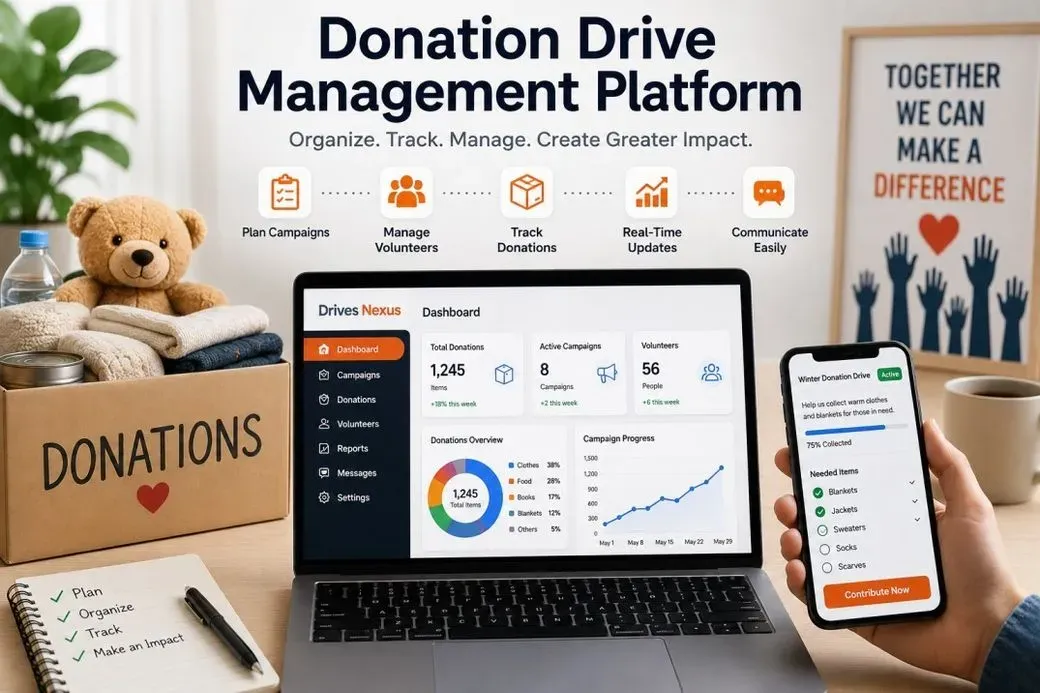
Platforms like Drives Nexus are designed around this kind of workflow, where managing donations feels less chaotic and more controlled.
The goal isn’t to make campaigns complicated. It’s actually the opposite.
Visibility Makes a Bigger Difference Than Expected
One thing many organizations notice immediately is how much easier tracking becomes.
With a simple donation tracking software, organizers can quickly check what has already been received and what still needs attention. There’s less guessing involved, and fewer follow-up messages throughout the day.
Even small improvements in visibility can save a surprising amount of time during active campaigns.
Volunteer Coordination Becomes Easier
Volunteer management is another area where donation drives often slow down.
Without a clear system, people miss updates, tasks overlap, and communication starts becoming repetitive. A reliable donation drive management platform helps reduce this confusion by keeping responsibilities and updates more organized.
It may sound like a small change, but it has a noticeable impact once campaigns start scaling.
Why More Nonprofits Are Using Structured Platforms
Nonprofits today are handling larger campaigns than before, and manual coordination simply becomes harder to maintain over time.
That’s why many organizations are choosing digital platforms that help centralize donations, communication, and campaign tracking in one place.
A good system doesn’t replace the people behind the campaign. It just makes their work easier to manage.
Conclusion
Donation drives rarely struggle because people don’t want to help. In most cases, the real challenge is staying organized once the campaign grows.
Using a dependable nonprofit donation drive platform helps reduce confusion, improve coordination, and create a smoother experience for everyone involved.
For organizations trying to manage campaigns more efficiently, having the right structure can make a bigger difference than expected.