DHW calculator
You can download here the academic report describing in detail the development process of the software. The tool can be used for system sizing as well as for economic analysis. Download the software for Matlab R2025b
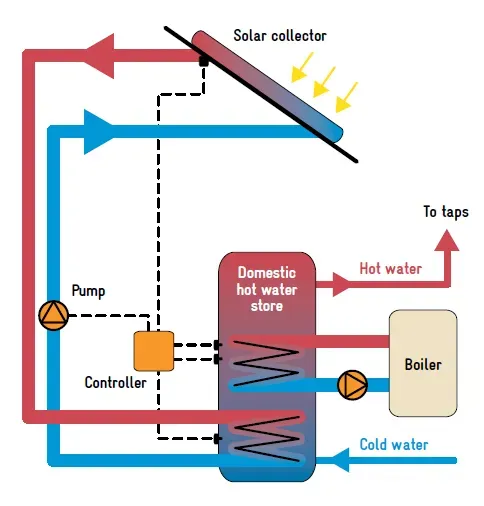
The software incorporates a mathematical model of a solar-assisted plant for Domestic Hot Water (DHW) production. The plant layout adopted in the model is shown in the figure below. By taking weather data and the hot water demand profile as inputs, the tool is able to simulate the dynamic behavior of the system and to compute its operating costs. In the model, solar thermal collectors are used exclusively for DHW production and not for space heating.
Plant sizing
This MATLAB/Simulink tool can be used to assess whether a solar-assisted system is properly sized with respect to the required domestic hot water demand and the geographical location where the plant is intended to operate. The user can modify the technical specifications of the plant, for example:
Auxiliary boiler power and capacity
Solar storage tank capacity
Collector model and technical specifications
Number of modules installed
The hot water request
Alternatively, users can import weather data for a custom geographical location (the default built-in examples are based on Genoa, Italy).
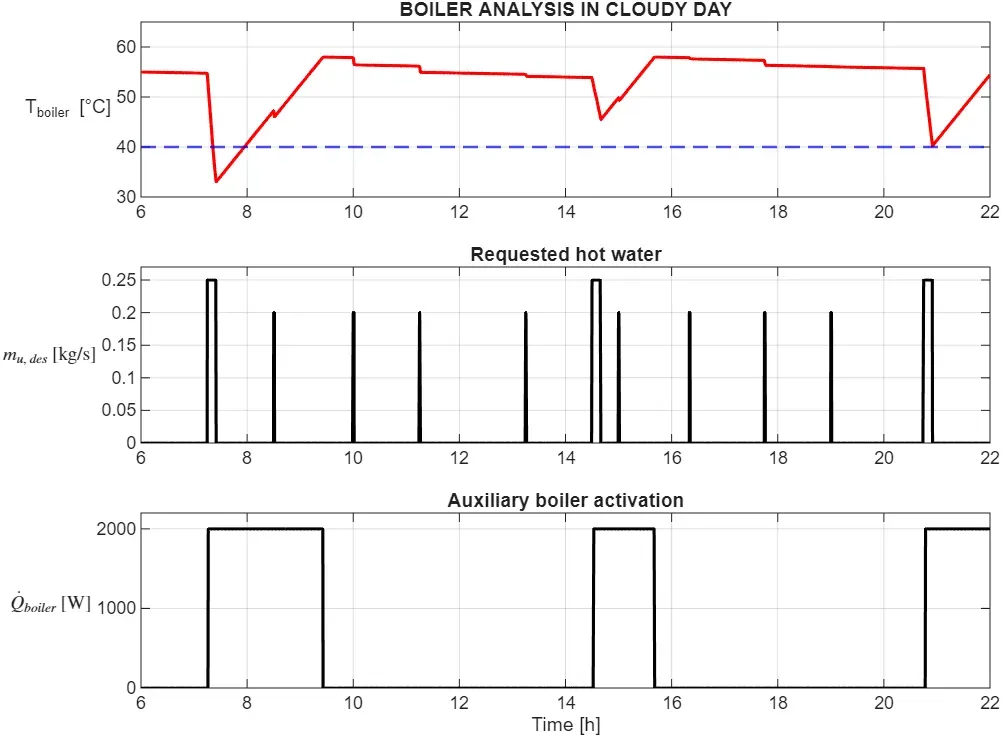
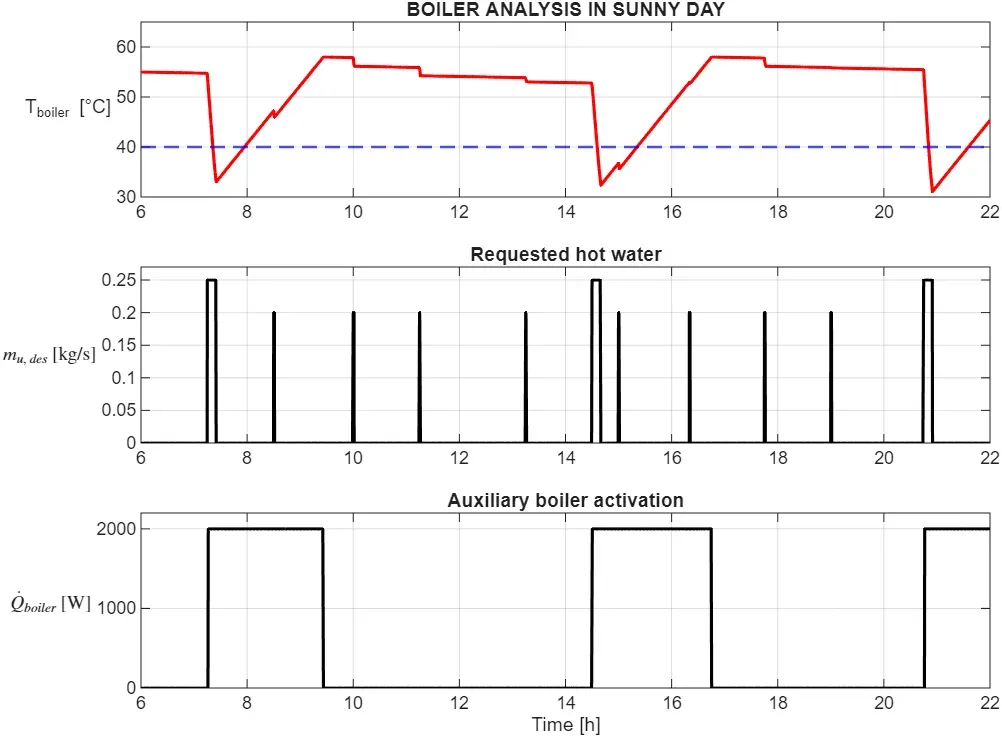
To verify the proper sizing of the system, the software includes the possibility of running daily simulations based on three representative winter days: a sunny day, a cloudy day, and a rainy day. The system is intentionally tested under unfavorable conditions by initializing the simulation without any thermal storage from previous days. This approach allows the evaluation of the system’s ability to supply hot water under a worst-case scenario.
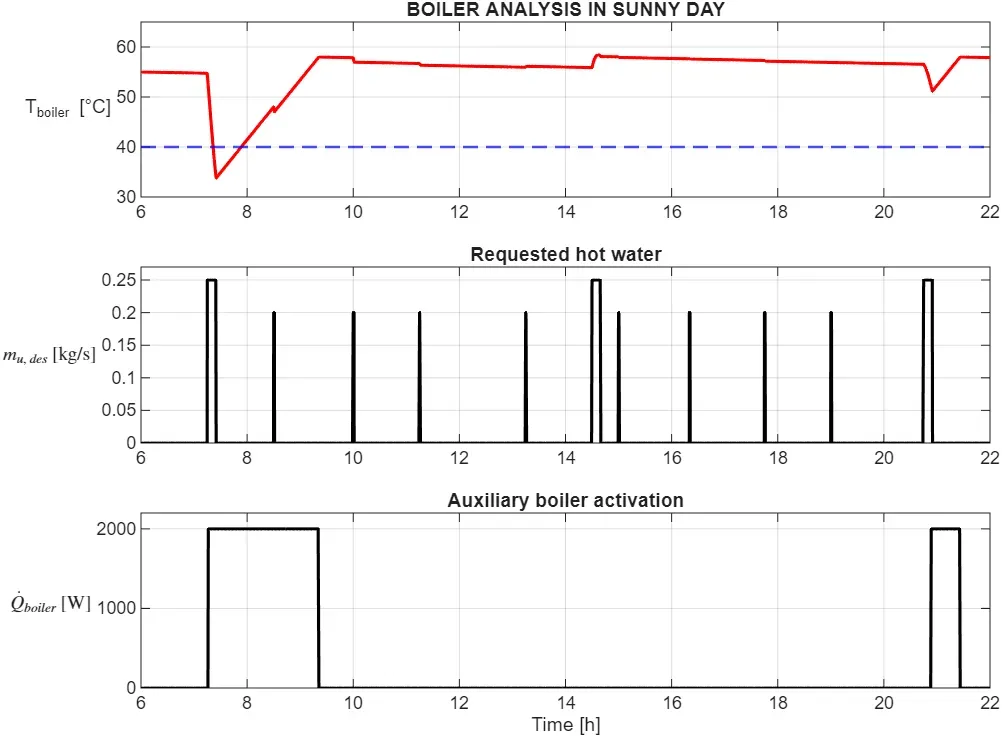
Using the MATLAB post-processing script, it is possible to identify the instances in which the boiler temperature drops below the critical threshold of 40 °C, corresponding to a typical household hot water temperature. In such cases, the system is unable to deliver sufficiently hot water. It should be noted that this analysis refers to the worst-case scenario without thermal storage; therefore, a slight temperature shortfall of a few degrees may be considered acceptable.
Daily simulation results example
Economic calculations
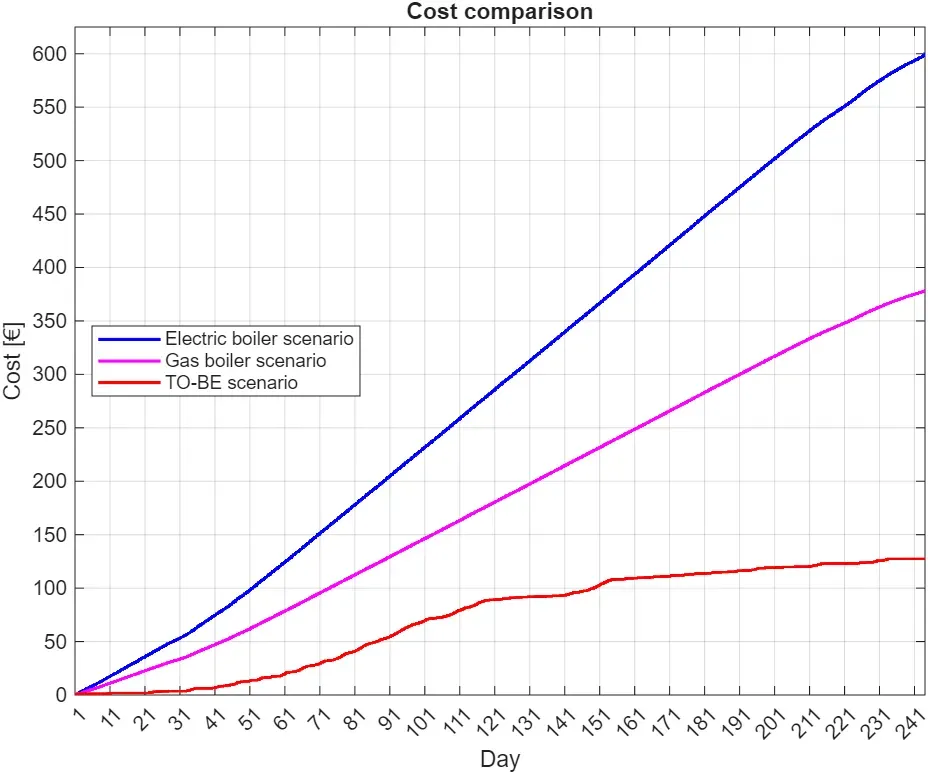
To evaluate the benefits of investing in a solar-assisted system, the software provides a tool to estimate the annual operating cost under different scenarios: a traditional system with a natural gas boiler, an electric boiler, and a solar-assisted system (electric boiler combined with thermal collectors).
The built-in example analyzes the period from October to May in Genoa, Italy, assuming limited hot water demand during the summer season. By customizing the weather data and the analyzed time interval, users can obtain cost estimates and perform economic evaluations of the investment, such as Net Present Value (NPV), Internal Rate of Return (IRR), payback period, profitability index, and sensitivity analysis.
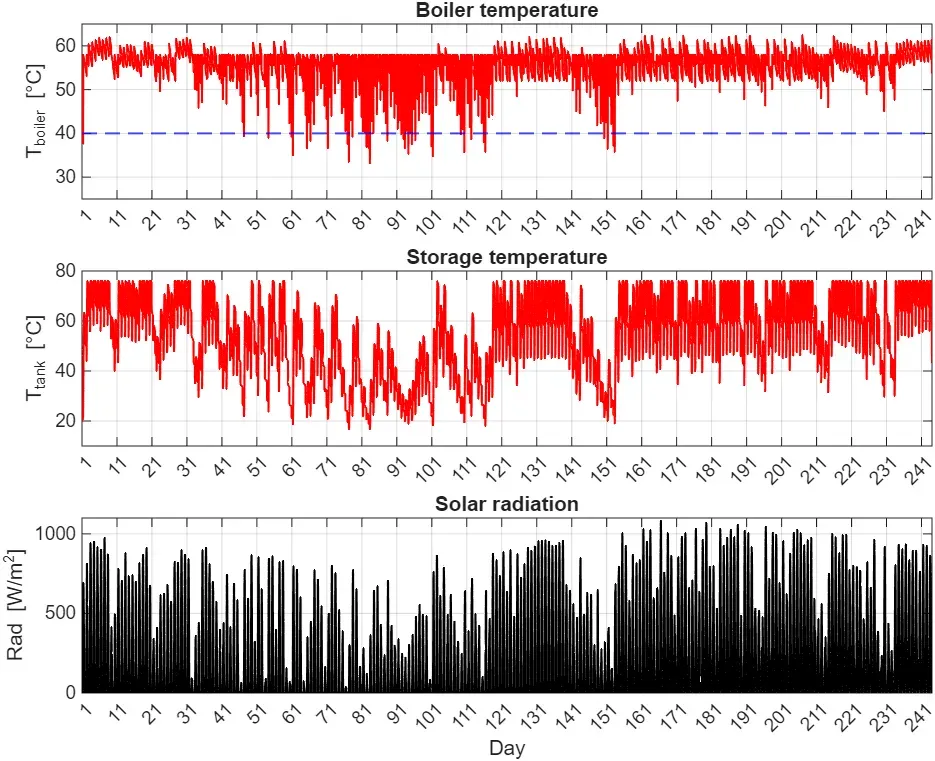
Users can also monitor the boiler temperature to identify any instances in which the delivered temperature is insufficient, as well as the storage tank temperature to assess its contribution and effectiveness over a longer period.
Seasonal simulation results example