Tesamorelin vs Sermorelin: Manufacturing, Stability, and Classification Breakdown
Synthetic research peptides occupy a clearly defined segment of the broader biochemical research supply landscape. These compounds are produced through controlled synthesis processes, characterized through validated analytical methods, and catalogued according to their molecular composition and structural properties. Within this category, peptides derived from endogenous sequence fragments and their structural analogues represent a significant area of laboratory investigation.
Tesamorelin and Sermorelin are two synthetic peptides that appear frequently in research compound catalogs, each with distinct molecular profiles, synthesis characteristics, and documentation requirements. Understanding the differences between these compounds at a structural and manufacturing level is essential for laboratories seeking to maintain rigorous sourcing standards.
What Is Tesamorelin?
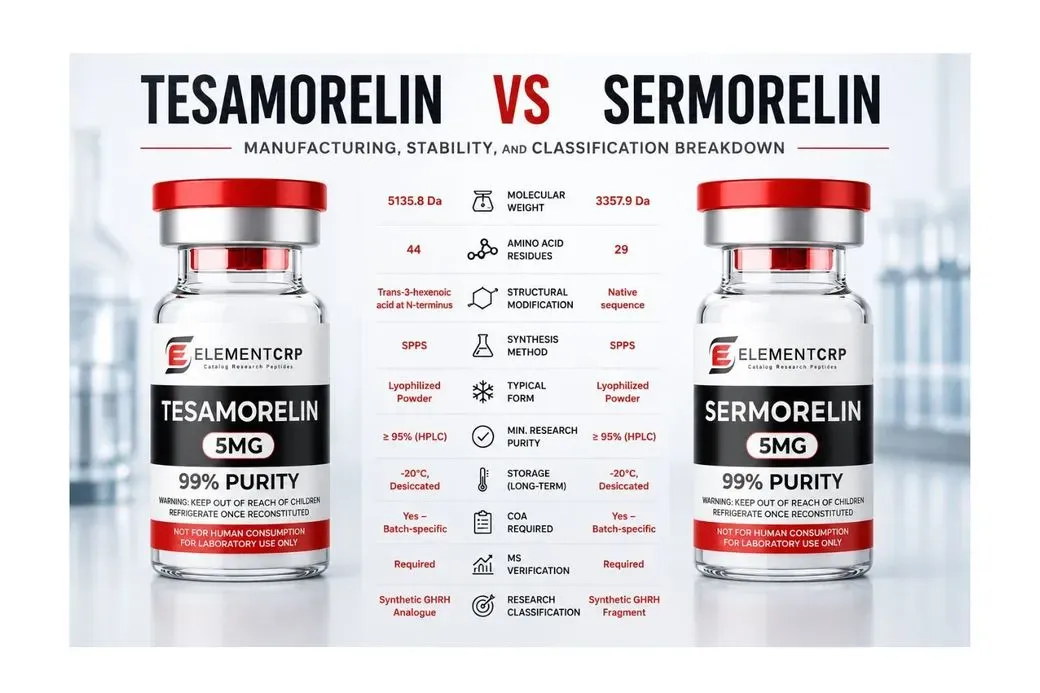
Tesamorelin is classified as a synthetic 44-amino acid peptide analogue. Its molecular structure incorporates a trans-3-hexenoic acid moiety conjugated to the N-terminus, which distinguishes it from native sequence peptides. This structural modification alters the compound's molecular weight and stability profile relative to its parent sequence. The molecular formula is C221H366N72O67S and its molecular weight is approximately 5135.8 Da.
From a synthesis standpoint, Tesamorelin is produced using Solid-Phase Peptide Synthesis (SPPS), a method that assembles the peptide chain sequentially on a resin support. Following synthesis, the compound undergoes multi-step purification primarily reverse-phase HPLC to achieve research-grade purity levels. The final product is typically presented in lyophilized (freeze-dried) powder form to preserve structural integrity during storage and transit.
Standard analytical verification for Tesamorelin includes HPLC purity assessment, mass spectrometry identity confirmation, and Certificate of Analysis (COA) documentation with batch-specific traceability. Long-term storage requires temperatures at or below -20°C in moisture-controlled, light-protected packaging.
What Is Sermorelin?
Sermorelin is a synthetic 29-amino acid peptide representing the N-terminal fragment of a naturally occurring endogenous sequence. Its molecular formula is C149H246N44O42S and its molecular weight is approximately 3357.9 Da. As a shorter peptide fragment, Sermorelin has a distinct stability and handling profile compared to longer analogues such as Tesamorelin.
Sermorelin is produced through SPPS protocols similar to those used for other synthetic peptides of its class. The purification workflow involves preparative HPLC, followed by lyophilization. Research-grade Sermorelin is catalogued under specific molecular identifiers and should be accompanied by full analytical documentation including HPLC purity data and MS confirmation of identity.
From a handling perspective, Sermorelin shares the general storage requirements common to lyophilized peptide compounds: controlled low-temperature storage, moisture exclusion, and protection from light. Procurement teams sourcing Sermorelin should verify batch-specific documentation through suppliers that maintain transparent analytical standards, such as those found in the Element CRP research peptide catalog.
Tesamorelin vs Sermorelin: Key Research Differences
Molecular Structure Comparison
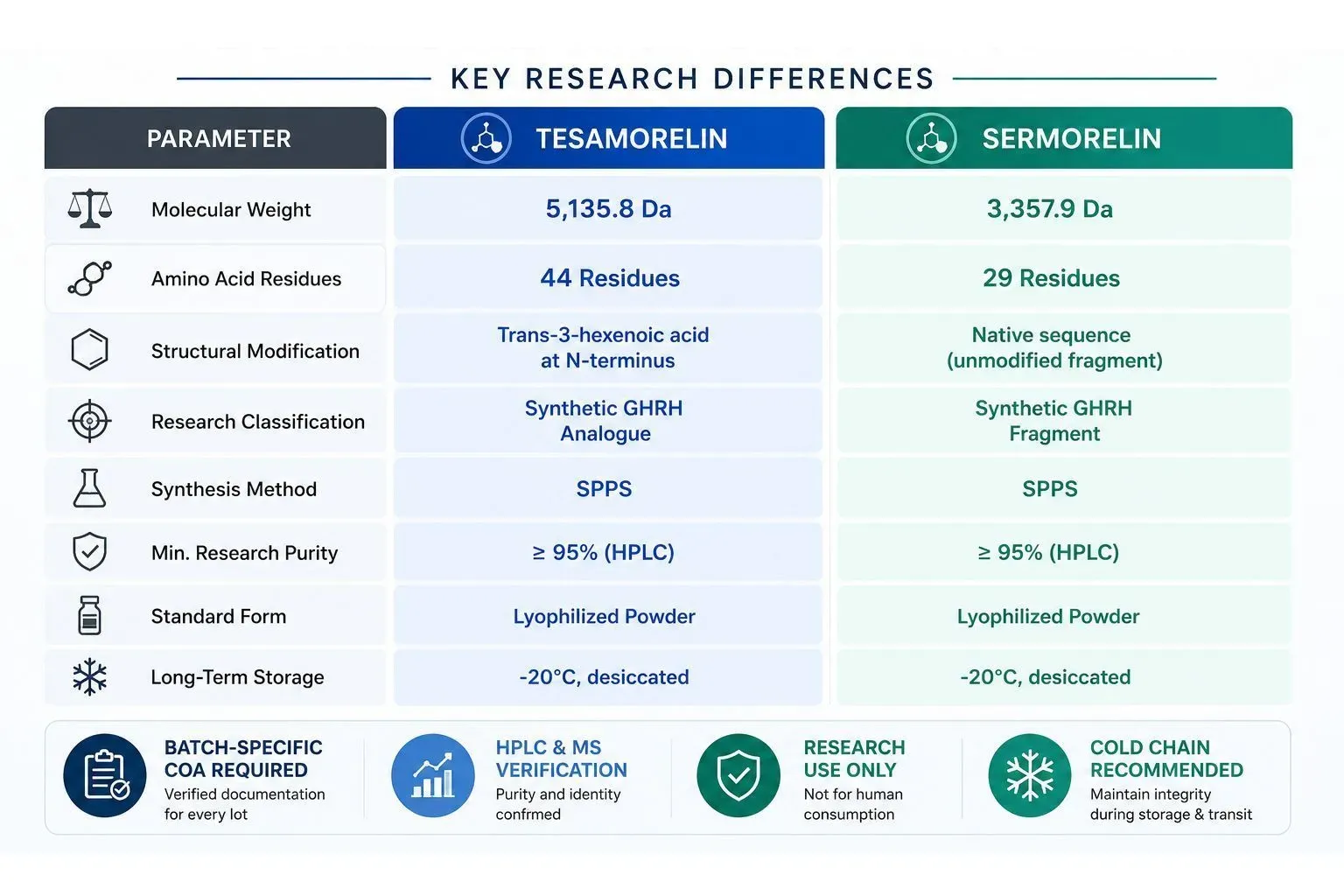
The most fundamental distinction between the two compounds lies in their peptide chain length and structural configuration. Tesamorelin, with its 44-residue sequence and N-terminal fatty acid modification, is a structurally larger compound with a higher molecular weight (5135.8 Da) compared to Sermorelin's 29-residue native-derived sequence (3357.9 Da). This difference in chain length directly influences solubility profiles, reconstitution characteristics, and stability behavior under varying environmental conditions.
Classification and Research Categories
Both compounds fall under the classification of synthetic Growth Hormone Releasing Hormone (GHRH) analogues or fragments within research compound databases. Tesamorelin is categorized as a modified GHRH analogue due to its structural conjugation, while Sermorelin is categorized as a native GHRH sequence fragment. This classification distinction is relevant for laboratory cataloguing, compound identification labeling, and regulatory documentation.
Manufacturing Process Breakdown
Both Tesamorelin and Sermorelin are manufactured using Solid-Phase Peptide Synthesis, the industry-standard method for producing synthetic peptides of their respective sizes. The SPPS process involves:
•Resin-bound synthesis: Sequential addition of protected amino acids to a solid support under controlled conditions.
•Cleavage and deprotection: Removal of the peptide from the resin and deprotection of side-chain functional groups using acidolytic cleavage agents.
•Purification: Multi-pass reverse-phase HPLC to separate the target compound from synthesis by-products and truncated sequences.
•Lyophilization: Freeze-drying of the purified compound to produce a stable powder suitable for long-term storage.
•QC release testing: HPLC purity analysis, MS identity confirmation, and COA generation before batch release.
Stability and Storage Analysis
Lyophilized peptide compounds require stringent environmental controls to prevent structural degradation. Both Tesamorelin and Sermorelin should be stored at -20°C or below, away from moisture and light. Tesamorelin's N-terminal modification may influence its specific degradation pathway relative to Sermorelin's native sequence. Suppliers should provide accelerated stability data and defined shelf-life parameters for each batch.
Analytical Testing and Purity Standards
HPLC Purity Testing
High-Performance Liquid Chromatography (HPLC) is the primary method for quantifying purity in both Tesamorelin and Sermorelin research compounds. A minimum purity threshold of 95% is standard for research-grade peptides, with premium-grade materials meeting 98% or higher. The HPLC chromatogram should display a clearly dominant primary peak with minimal secondary peaks. Procurement teams should request raw chromatogram files not just summary percentage values to enable independent data review.
Certificate of Analysis (COA)
A compliant COA for either compound must include: product name and CAS identifier, batch or lot number, test date, purity percentage, testing methodology (specifying HPLC as the primary method), mass spectrometry identity result, and the name of the testing laboratory. COAs lacking any of these elements are considered incomplete for research documentation standards. Buyers sourcing from Element CRP should request batch-specific COAs before finalizing orders.
Additional Analytical Methods
•Mass Spectrometry (MS): Confirms molecular identity through mass-to-charge ratio analysis of the ionized peptide. Essential for verifying that the compound matches its theoretical molecular weight.
•Amino Acid Sequence Confirmation: Validates the precise amino acid composition and sequence order through hydrolysis and chromatographic separation.
•Residual Solvent Testing: Identifies and quantifies synthesis solvents remaining in the compound after purification, per ICH Q3C guidelines.
•Sterility and Endotoxin Screening: Applicable where contamination screening is part of the research compound release protocol.
Formulation and Manufacturing Considerations
Lyophilized Peptide Formulations
Lyophilization, or freeze-drying, is the preferred preservation method for both Tesamorelin and Sermorelin. The process removes moisture under vacuum conditions while the compound is in a frozen state, producing a porous, dry cake that reconstitutes readily with an appropriate solvent. Moisture content in the final lyophilized product is a critical quality parameter, typically measured by Karl Fischer titration and specified on the COA.
Packaging and Handling Standards
Research-grade peptides should be packaged in sealed, tamper-evident vials under inert gas or vacuum conditions. Amber vials or opaque packaging are used to minimize photodegradation. Temperature-controlled shipping including insulated containers and dry ice or cold packs for longer transit durations is standard practice for maintaining compound integrity. Labeling on all packaging must carry research-only designations consistent with regulatory compliance standards.
Sourcing Research Peptides
Evaluating Research Suppliers
When sourcing Tesamorelin or Sermorelin for laboratory use, procurement teams should apply a structured evaluation criteria set. Key factors include:
•Third-party analytical testing: Independent laboratory COAs carry greater evidentiary weight than in-house documentation alone.
•Manufacturing transparency: Suppliers should be able to identify whether they are the manufacturer or a distributor, and provide GMP or ISO compliance references.
•Documentation accessibility: COAs, HPLC reports, SDS, and specification sheets should be available per batch on request.
Common Sourcing Concerns
Procurement teams should exercise heightened scrutiny when any of the following deficiencies are present in a supplier's documentation:
•Purity stated without an accompanying HPLC chromatogram or methodology reference.
•COA batch numbers that do not match product labeling or shipping documentation.
•Absence of mass spectrometry identity data alongside purity claims.
•Product listings containing therapeutic, dosage-related, or outcome-based language.
Regulatory and Compliance Considerations
Both Tesamorelin and Sermorelin, when catalogued as research compounds, must carry research-use-only designations on all product labeling and marketing materials. Suppliers operating within FDA-compliant communication standards must restrict product information to compound specifications, analytical data, and sourcing documentation.
Scientifically neutral product information devoid of therapeutic framing, efficacy language, or implied use recommendations is a baseline compliance requirement for research compound suppliers. Procurement teams should treat any deviation from this standard as a regulatory risk indicator.
Documentation and labeling practices should align with the expectations outlined in FDA guidelines for research compound communication. Suppliers demonstrating compliance in this area.
Conclusion
Tesamorelin and Sermorelin represent two structurally distinct synthetic peptide compounds with different molecular weights, sequence lengths, and classification profiles. Despite sharing a common synthesis method in SPPS and similar storage requirements as lyophilized materials, their structural differences carry meaningful implications for analytical characterization, laboratory documentation, and batch traceability.
Researchers and procurement professionals evaluating either compound should prioritize suppliers capable of providing complete analytical documentation including HPLC purity data, MS identity confirmation, batch-specific COAs, and SDS. Manufacturing transparency, third-party verification, and research-only labeling compliance are the definitive criteria for responsible peptide compound sourcing.
For laboratories seeking to buy research peptides, sourcing decisions should remain focused on analytical quality standards, manufacturing consistency, verified purity testing, and complete research documentation rather than promotional claims or application-based information.