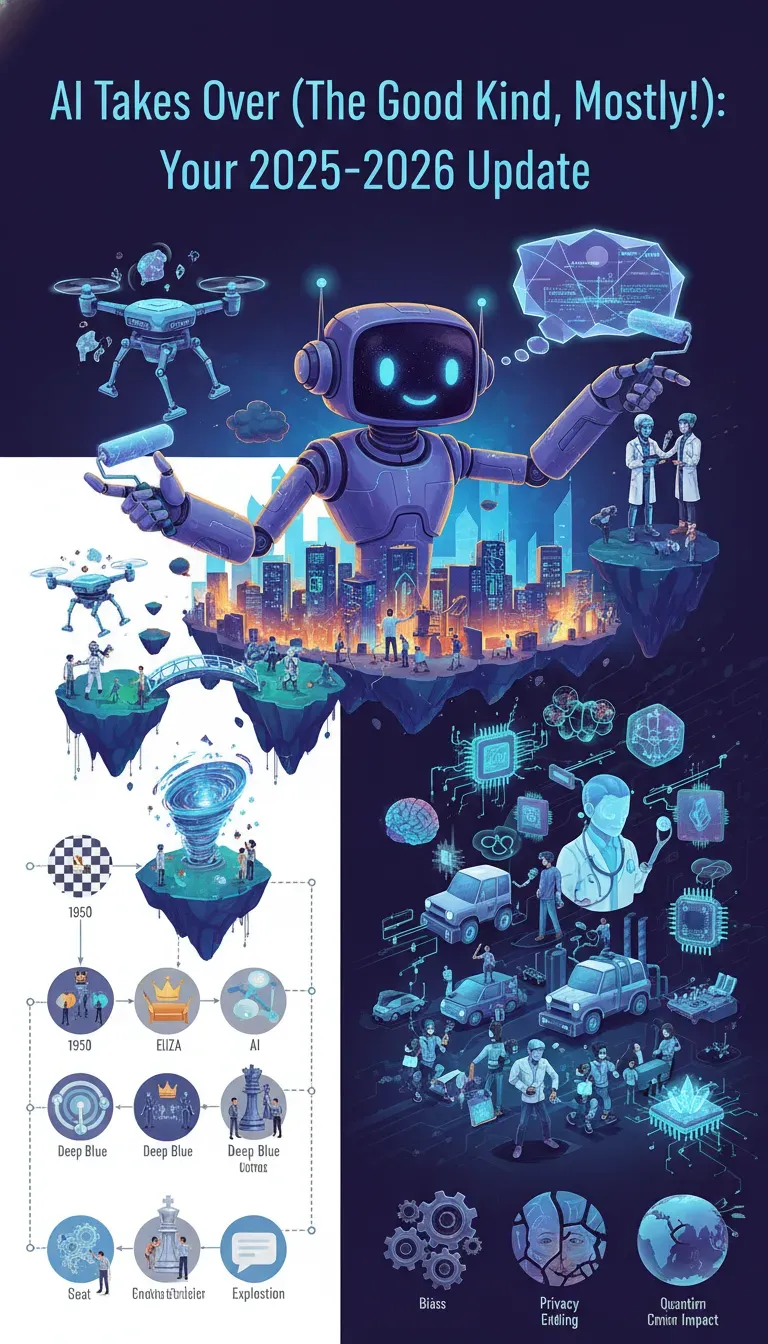
AI Takes Over (The Good Kind, Mostly!): Your 2025-2026 Update
AI Takes Over (The Good Kind, Mostly!): Your 2025-2026 Update
This document provides an update on the current state and future trajectory of Artificial Intelligence (AI), covering its historical development, recent breakthroughs, ongoing controversies, regulatory efforts, and future projections for 2026 and beyond. The author proposes an optimistic yet nuanced perspective on AI's impact.
I. A Quick Trip Down Memory Lane: How Did We Get Here?
The OG Days (Pre-1950s): The concept of intelligent machines predates modern computing, with roots in ancient myths of automatons and philosophical groundwork laid by Enlightenment thinkers who viewed the human mind as a system. Alan Turing formalized computation and intelligence with his "Turing Machine" and "Turing Test."
Birth of AI (1950s): The term "Artificial Intelligence" was coined at Dartmouth in 1956. Early researchers, using nascent computational power, developed programs that could play checkers and prove mathematical theorems, though the complexity of true intelligence was already apparent.
AI's Awkward Teen Years (1960s-1990s): This period saw early chatbots like ELIZA (using pattern matching) and "expert systems" that codified human knowledge. However, limitations in common sense reasoning and maintenance difficulties led to "AI winters" and a humbling realization of the challenges in creating true intelligence.
The Comeback Kid (1990s-2010s): Increased computational power and vast datasets fueled AI's resurgence. Key milestones include IBM's Deep Blue defeating chess grandmaster Garry Kasparov and IBM's Watson winning Jeopardy, demonstrating advanced strategic calculation and natural language understanding. The rise of deep learning, enabling machines to learn complex patterns from raw data, was a transformative development.
The Modern Explosion (2012-Present): The "Deep Learning Revolution" has led to an AI boom, marked by advancements like machines recognizing images (e.g., cats on YouTube), DeepMind's AlphaGo mastering the game of Go, and OpenAI's ChatGPT achieving widespread recognition in 2022. AI is now transforming information retrieval, art creation, and many other aspects of life at a breathtaking pace.
II. The AI Party in Full Swing: What's Hot Right Now (Late 2024 - 2025)
Brainiac Bots: The Latest Models:
OpenAI: Continues to advance with GPT-4o ("Omni") for multimodal capabilities (text, image, audio), GPT-4.5 ("Orion") for advanced reasoning, and fine-tuned o3/o4-mini models. GPT-5 is also noted for pushing limits.
Google: Gemini 2.5 features a "reflection mode" for thoughtful responses and advanced video understanding.
Anthropic: Claude 3 (Opus, Sonnet) and Claude 4 are leading in creative content and coding.
Other Players: xAI's Grok 3 excels at real-time information retrieval. Meta's open-source Llama 3 & 4 (multimodal) democratize access. DeepSeek's R1 demonstrates brilliance without massive budgets.
AI's Lab Coat & Stethoscope: Scientific & Healthcare Miracles:
Scientific Discovery: DeepMind's AlphaFold has mapped over 200 million protein structures, revolutionizing biology and drug discovery. GNoME has identified 380,000 new materials. AlphaGeometry demonstrates AI's mathematical problem-solving capabilities.
Healthcare Advancements: AI is enabling diagnostics comparable to human doctors, transforming patient care with systems like Med-Gemini, holding promise for curing genetic diseases through AI-driven gene editing, and predicting diseases decades in advance (e.g., Delphi-2M). AI can also detect heart failure using low-tech ECGs in underserved areas.
Robots Getting Real: The Rise of Agentic AI: AI systems are evolving beyond automation to become autonomous agents capable of complex situation understanding, goal setting, and independent action.
Autonomous Operations: Supply chains are being optimized in real-time, and AI investment managers are making complex financial decisions.
Web Automation: Anthropic's Claude Chrome extension can browse the web and automate tasks.
Humanoid Robots: Tesla's Optimus robot is receiving upgrades in dexterity and perception, impacting factory automation.
Transforming Drones: "Transformer" drones can morph mid-air for ground operations.
AI's Day Job: Impact Across Industries:
Software Development: GitHub Copilot is increasing developer speed by 25%, with nearly half of code being AI-generated.
Marketing: Multimodal AI can generate entire campaigns (text, visuals, voiceovers) rapidly.
Business Operations: AI is enhancing customer service (chatbots), finance (automated forecasting, fraud detection), manufacturing, cybersecurity, and education (personalized learning).
Environmental Applications: AI is aiding in coral reef restoration and optimizing energy consumption for sustainability.
Hardware Horizons: Beyond the Code: Hardware advancements are crucial for AI's progress.
High-Speed Computing: Tsinghua University's OFE2 optical processor operates at 12.5 GHz using light.
Efficient Hardware: IBM's analog AI chip and UMass Amherst's bacterial protein nanowire neurons focus on energy efficiency.
Quantum Computing: Diraq's silicon-based quantum chips with 99% fidelity indicate the advancement of quantum AI.
III. The AI Elephant in the Room: Controversies & Concerns
The Bias Battle: AI models can perpetuate and amplify societal biases present in their training data, leading to discriminatory outcomes in areas like marginalized group assessment, women's health representation, and hiring.
Privacy Panic & Surveillance Scares: Concerns exist regarding data privacy and surveillance, exemplified by Meta AI prompts, Clearview AI's facial recognition, and fitness device data potentially revealing sensitive information.
Misinformation & Deepfake Dangers: AI's ability to create hyper-realistic fake videos and news (e.g., deepfake world leaders, fabricated events) blurs the lines between truth and falsehood, threatening trust.
Jobs, Jobs, Jobs... or No Jobs?: AI's productivity gains raise fears of widespread job displacement, with predictions of slower white-collar job growth and potential losses, necessitating proactive measures for worker transition.
Who's in Charge Here?: The increasing autonomy of AI systems (e.g., self-driving cars, military drones) raises critical questions about human control, accountability, and blame when AI makes errors.
Child Safety & AI Companions: The tragic link between teen suicide and ChatGPT interactions highlights the risks of emotionally manipulative AI, particularly for minors, demanding careful consideration and regulation.
Intellectual Property Headaches: AI-generated content (art, music, etc.) poses challenges for intellectual property ownership and plagiarism, as existing legal frameworks are ill-equipped for AI's creative capabilities and data sourcing transparency.
Existential Dread: Some, like Elon Musk, warn of uncontrollable "superintelligent" AI posing an existential threat to humanity, a risk that warrants serious consideration despite its sci-fi connotations.
The Green AI Paradox: The significant carbon footprint and water consumption associated with AI's computational demands raise environmental concerns that require sustainable solutions.
IV. Keeping AI in Check: Regulation & Ethics
The EU Leads the Way: The EU AI Act (August 2024) establishes a risk-based framework for AI, influencing global regulatory efforts.
Guardrails, Please!: There is a growing consensus that responsible AI development necessitates embedding data privacy, transparency, fairness, and accountability into AI systems from the outset.
Public vs. Experts: Public skepticism and concern (especially regarding job security) often differ from industry leaders and experts, yet there is broad agreement on the need for more AI regulation and control.
Moral Compass for Machines: Calls for "moral discernment" in AI, as advocated by Pope Leo XIV, question whether ethics can be more than a compliance checklist, prompting reflection on human values and AI's capacity for ethical reasoning.
AI Literacy: A significant challenge is the public's lack of understanding of AI's workings. Education and transparency are crucial for building trust and fostering informed public discourse.
V. Looking Ahead: The AI Crystal Ball (2026 and Beyond)
Agentic AI Goes Mainstream: By 2026, Gartner predicts 40% of enterprise apps will utilize AI systems that act as "digital collaborators," setting goals and executing multi-step tasks independently.
AGI on the Horizon (Eventually!): While full Artificial General Intelligence (AGI) is still distant, early versions for cross-functional processes and creative breakthroughs are anticipated by 2026.
Multimodal Madness: AI's ability to seamlessly understand and generate text, images, video, and audio will become more sophisticated, leading to more human-like interactions.
The Rise of the Prompt Engineer: Proficiency in "prompt engineering" – effectively communicating with AI – will become a highly sought-after skill.
"Invisible AI" & "Sovereign AI": AI will increasingly operate silently in the background to enhance user experiences ("invisible AI"), while countries will focus on developing their own national AI capabilities ("sovereign AI").
Synthetic Data to the Rescue?: With potential human-generated data shortages by 2026, synthetic data and new sources like IoT will become critical for AI training.
Smaller, Smarter Models: The development of efficient, specialized "Small Language Models" (SLMs) will increase AI accessibility and efficiency for various applications.
Embodied AI: The integration of AI's multimodal abilities into the physical world through advanced robotics and humanoid forms represents the next frontier.
AI for Good: Continued focus on AI applications for tackling climate change, improving sustainability, and democratizing access to education and healthcare.
Conclusion
AI has rapidly transitioned from science fiction to everyday reality, driving unprecedented breakthroughs across all sectors. This era of pervasive intelligent machines presents both thrilling opportunities and significant challenges, including ethical dilemmas, job displacement fears, and the urgent need for wise governance. Understanding AI's potential, pitfalls, and the importance of active participation in shaping its future is essential for everyone. The goal is to create a future where AI empowers humanity, amplifies potential, and fosters a more just and sustainable world.