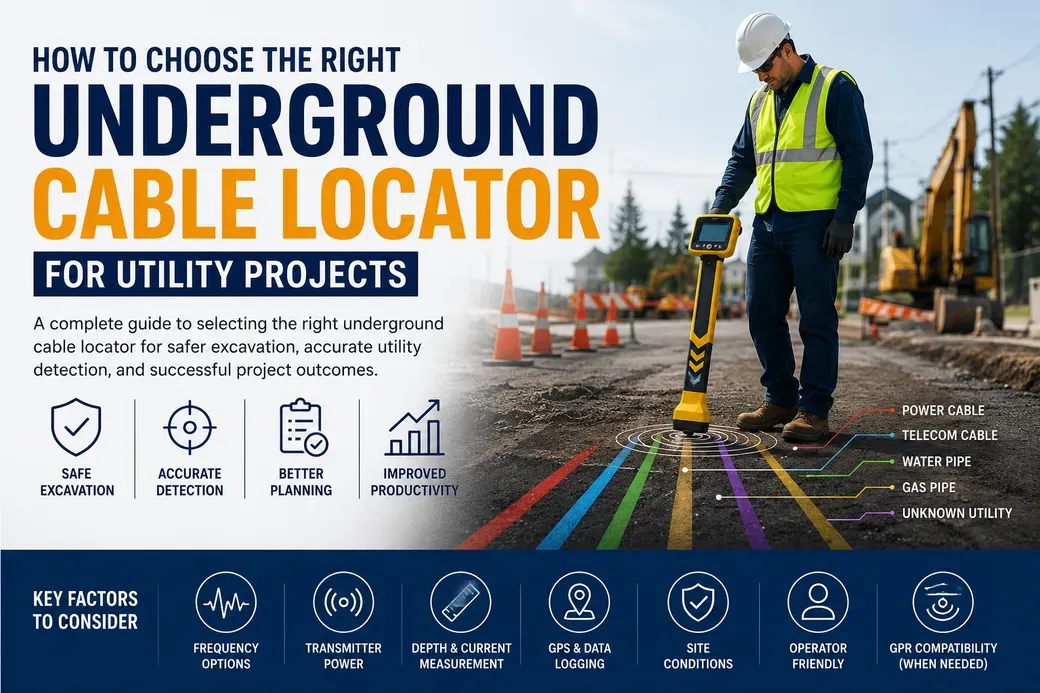
How to Choose the Right Underground Cable Locator for Utility Projects
Introduction
Before any excavation, trenching, road cutting, utility repair, telecom installation, or infrastructure development work begins, one of the most important safety steps is locating buried utilities. Underground power cables, telecom lines, metallic pipes, gas lines, water pipelines, and other services may already exist below the project area. If these assets are not detected properly, the result can be cable damage, service disruption, project delay, repair cost, or serious safety risk.
This is where an underground cable locator becomes essential. A cable locator helps field teams detect, trace, and identify buried conductive utilities before digging. However, not every locator is suitable for every project. A small maintenance job, a long-distance telecom route, a municipal utility survey, and a metro infrastructure project may all need different locating features.
Choosing the right underground cable locator depends on the project type, utility material, site conditions, tracing distance, required accuracy, operator skill level, and documentation needs. This guide explains the key factors that project managers, utility engineers, contractors, and safety teams should consider before selecting cable locating equipment.
What Is an Underground Cable Locator?
An underground cable locator is a field instrument used to detect and trace buried cables and metallic utilities. It usually works with a receiver and, in active locating, a signal transmitter. The transmitter applies a signal to the cable or pipe, and the receiver detects that signal above ground to help identify the route and approximate depth.
Cable locators are commonly used for:
Power cable detection
Telecom cable route tracing
Optical fiber route detection with tracer wire or metallic elements
Metallic pipe detection
Oil and gas pipeline tracing
Pre-excavation utility avoidance
Utility mapping and route documentation
Fault investigation and maintenance support
For complex sites, cable locators may also be used along with Ground Penetrating Radar (GPR), especially when non-metallic utilities or unknown buried assets need to be mapped.
Why Choosing the Right Locator Matters
A wrong or under-specified locator may fail to detect utilities clearly, especially in congested underground environments. Utility projects often involve multiple services laid close to each other. In such cases, the locator must help the operator separate one utility from another, select the right frequency, read signal strength, estimate depth, and trace the route with confidence.
A suitable cable locator supports:
Safer excavation planning
Better route tracing accuracy
Reduced risk of utility strikes
Faster field decision-making
Improved documentation and reporting
Better compliance with project safety practices
Lower rework and repair costs
For large infrastructure, telecom, power, water, and oil & gas projects, the locator should not be selected only on price. It should be selected based on performance, site requirement, durability, application fit, and long-term reliability.
1. Understand the Type of Utility You Need to Locate
The first step is to identify the type of underground utility involved. Different utilities behave differently during locating.
For example, energized power cables may be detected in passive power mode. Metallic pipes and de-energized cables may require active signal application through a transmitter. Telecom routes may need long-distance tracing capability. Plastic or concrete pipes generally cannot be directly detected by standard electromagnetic locators unless they have a tracer wire, metallic tape, duct rodder, or detectable element.
Before choosing a locator, ask:
Is the utility metallic or non-metallic?
Is the cable live or de-energized?
Is there a tracer wire available?
Is the project about avoidance, route tracing, or mapping?
Is depth measurement required?
Is the site congested with multiple services?
For metallic utilities, an electromagnetic pipe and cable locator is usually suitable. For non-metallic utilities, additional tools such as traceable duct rods or GPR may be required.
2. Check the Frequency Options
Frequency selection is one of the most important factors in underground utility locating. Lower frequencies are useful for longer distances and can reduce signal bleed-over to nearby utilities. Higher frequencies can be useful where the signal needs to jump across joints, poor connections, or higher-resistance paths, but they may also couple onto nearby services more easily.
A good cable locator should offer multiple frequency options so the operator can adjust according to site conditions. For simple utility avoidance, basic frequency options may be enough. For complex route tracing, telecom networks, oil and gas pipelines, and urban utility corridors, a multi-frequency locator provides more flexibility.
When reviewing frequency features, check:
Number of available frequencies
Low-frequency options for long-distance tracing
High-frequency options for difficult connections
Ability to select or configure frequency based on site needs
Clear frequency display on the receiver
Multi-frequency equipment is especially helpful for professional utility teams that work across different project environments.
3. Select the Right Transmitter Power
The transmitter sends the locating signal into the cable or pipe. Higher transmitter power can help when tracing longer routes, working in high-resistance conditions, or dealing with poor signal return paths. However, more power is not always the only answer. The correct frequency, connection method, grounding, and operator technique are also important.
For short-distance utility avoidance, a lower-power transmitter may be sufficient. For medium to long-distance cable route tracing, a stronger transmitter can provide better performance. Projects involving telecom OFC routes, power networks, water pipelines, or oil and gas corridors often need a more capable transmitter.
Consider transmitter power based on:
Route length
Cable or pipe condition
Soil and ground conditions
Signal loss risk
Urban congestion
Requirement for long-distance tracing
For professional utility projects, a transmitter and receiver kit should be selected together, not separately.
4. Look for Depth and Current Measurement
Depth estimation is a useful feature during excavation planning and route verification. Many advanced pipe and cable locators provide live depth measurement and current measurement. These features help the operator understand whether the detected signal is likely coming from the target utility or from an unwanted nearby line.
Current measurement is particularly useful because it can help identify signal strength on the target line. If the current suddenly drops or changes, the operator may need to recheck the connection, route, or signal coupling.
Useful display features include:
Live depth reading
Current measurement
Signal strength indicator
Left/right guidance
Compass mode
Peak/null response
Route direction indication
These features make the equipment more useful for both experienced and developing operators.
5. Consider GPS, Data Logging, and Mapping Needs
For many modern utility projects, locating the cable is not enough. Teams also need records, survey data, route logs, and digital mapping output. This is especially important for government projects, smart city work, telecom networks, railways, highways, water utilities, and asset management.
A cable locator with GPS or GNSS mapping can help capture route position, depth data, time, date, and survey information. Data logging also helps managers verify when and how the locator was used on site.
Choose GPS/data logging features if your project needs:
Digital route mapping
GIS integration
Proof of survey work
Utility asset documentation
Site audit records
Contractor performance tracking
Long-term maintenance planning
For high-value infrastructure projects, mapping-enabled locators can reduce manual recording errors and improve asset visibility.
6. Evaluate Site Conditions
Every site is different. A locator that works well in an open rural area may face challenges in a congested city road, industrial plant, metro corridor, airport, railway yard, or wet utility environment.
Before selecting a locator, review the expected working conditions:
Urban or rural site
Dry, wet, muddy, or dusty environment
Long route or short trench
Heavy electromagnetic interference
Multiple buried services
Road, railway, industrial, or utility corridor
Day or night operation
Need for rugged equipment
For tough field use, equipment should be durable, weather-resistant, dust-resistant, and easy to handle. A clear display, ergonomic receiver, strong battery life, and reliable accessories also matter during long working hours.
7. Match the Locator with Operator Skill Level
A highly advanced locator is useful only when the operator can use it correctly. For projects where multiple field teams are involved, the locator should be easy to operate, trainable, and suitable for site-level users.
For basic safety scanning, simple operation modes are useful. For professional route tracing and mapping, advanced features are important, but training becomes necessary.
Project managers should check:
Ease of operation
Display clarity
Training requirement
Availability of product demos
User manual and technical support
Calibration or maintenance needs
Suitability for different operator levels
Operator training should be treated as part of the equipment investment. Good locating practice depends on both technology and technique.
8. Decide Whether You Need GPR Along with Cable Locator
Electromagnetic cable locators are highly useful for conductive cables and metallic pipes. However, they may not directly detect non-metallic utilities such as plastic water pipes, concrete drains, or untraced ducts. In such cases, Ground Penetrating Radar can support underground utility mapping by detecting subsurface anomalies.
GPR can be helpful for:
Non-metallic utility detection
Unknown buried objects
Utility mapping in complex areas
Concrete and road investigation
Subsurface scanning before excavation
For many serious utility mapping projects, using both electromagnetic locating and GPR gives a more complete view of the underground environment.
9. Review After-Sales Support and Product Availability
For utility projects, after-sales support is not optional. Field equipment must be backed by technical guidance, spare parts, accessories, servicing, training, and application support.
Before purchase, evaluate:
Local technical support
Demonstration availability
Training support
Repair and service options
Accessory availability
Warranty terms
Product documentation
Experience in similar industries
A cable locator should be viewed as a long-term field asset, not a one-time purchase.
10. Build a Practical Selection Checklist
Before finalizing an underground cable locator, use this checklist:
Does it support the type of utility we need to locate?
Does it offer passive and active locating modes?
Are the frequency options suitable for our field conditions?
Is the transmitter power enough for our route length?
Does it provide depth and current measurement?
Is GPS or data logging required for this project?
Can the equipment handle dust, water, and site impact?
Is it easy for field teams to operate?
Is training and technical support available?
Can it support future project requirements?
This checklist helps avoid underbuying or overbuying and ensures the equipment fits real project needs.
Conclusion
Choosing the right underground cable locator for utility projects requires more than comparing product prices. The decision should be based on utility type, site conditions, transmitter power, frequency options, locating accuracy, depth measurement, GPS mapping, ruggedness, operator skill, and after-sales support.
For basic excavation safety, a simple avoidance locator may be enough. For professional utility route tracing, telecom projects, power cable detection, pipeline work, and infrastructure mapping, a multi-frequency locator with strong transmitter options, depth reading, current measurement, and data logging can provide better field value.
A well-chosen underground cable locator helps teams work more safely, reduce utility strike risk, improve project planning, and create more reliable underground asset records.
FAQs
1. What is an underground cable locator used for?
An underground cable locator is used to detect and trace buried cables, metallic pipes, and conductive utilities before excavation, maintenance, or route mapping work.
2. Can a cable locator detect plastic pipes?
A standard electromagnetic cable locator cannot directly detect plastic pipes unless they have a tracer wire, metallic tape, duct rodder, or detectable element. For non-metallic utilities, GPR may be required.
3. What is the difference between passive and active locating?
Passive locating detects naturally present signals from live power cables or radio signals. Active locating uses a transmitter to apply a signal to the target cable or pipe, allowing more controlled route tracing.
4. Why are multiple frequencies important in a cable locator?
Different site conditions require different frequencies. Low frequencies are useful for longer routes and better target control, while higher frequencies may help in difficult connection conditions.
5. Is GPS important in underground cable locating?
GPS is useful when route data needs to be recorded, mapped, exported, or stored for future utility asset management. It is especially helpful for infrastructure and GIS-based projects.
6. When should GPR be used with a cable locator?
GPR should be considered when non-metallic utilities, unknown buried objects, or complex underground conditions need to be investigated along with metallic cable and pipe tracing.