Energy Efficiency Testing Lab in India for the Revised BEE Star Ratings of 2026
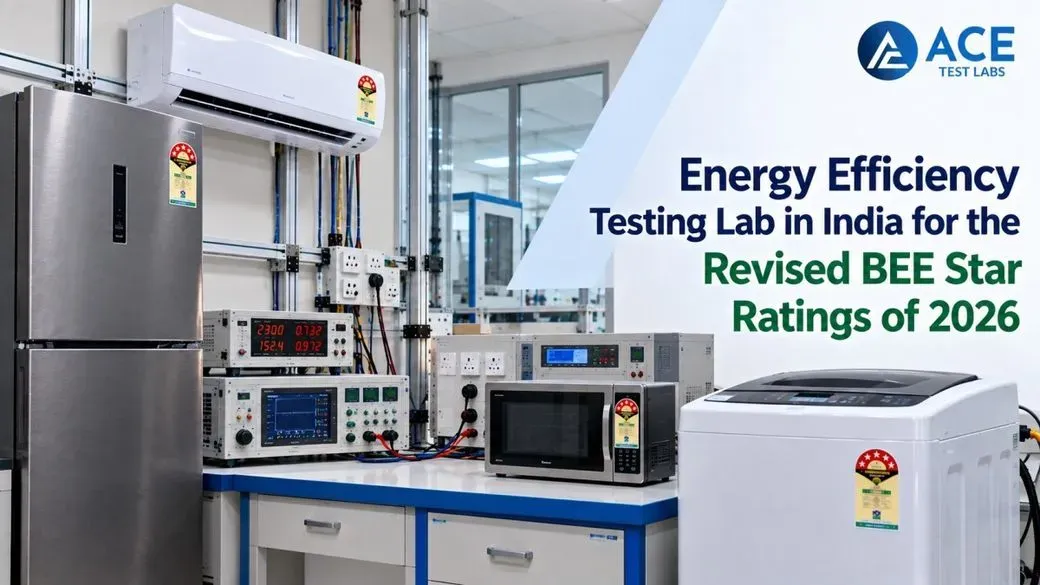
From 1 January 2026, the Bureau of Energy Efficiency revised the star rating tables for refrigerators, ceiling fans and deep freezers. The previous tables for these categories ended on 31 December 2025. If your product was last approved before 2026, manufacturers should review whether its existing rating still aligns with the revised requirements. An energy efficiency testing lab in India can help assess the applicable testing requirements for current models. The change isn’t always a physical redesign. With the new table, an unchanged model can still fall to a lower star in a few categories because the thresholds themselves moved.
What Changed From 1 January 2026
BEE has amended the star rating tables for Frost-Free Refrigerators, Direct Cool Refrigerators, Ceiling Fans and Deep Freezers effective from 1st January 2026 to 31st December 2028 and the labels earlier for these categories expired on 31st December 2025. Room air conditioners were also affected, with the updated ISEER thresholds tightening the definition of what qualifies at each star level. Companies seeking to carry forward an existing model were required to apply on BEE’s Standards & Labelling portal before the deadline, with registration of new models under the revised norms from 1 July 2026. Manufacturers can work with an energy efficiency testing lab India to review the applicable requirements; testing needs and existing model data.
Please confirm with BEE or your testing lab the exact category of your product and the applicable table before starting the registration or retesting process. Appliance categories may have different dates of transition, star-rating thresholds and documentation requirements. The check helps manufacturers determine whether an existing model can continue under the revised requirements or needs updated testing and registration.
Why a Five-Star Model of 2025 May Now Rate Lower
Under the new air-conditioner standards, a 2025 model that would have earned 5 stars no longer gets that rating without a change to the product itself, because the bar for each star was raised. This same logic applies anywhere BEE has updated the table for a category. The classification changes even if the appliance does not. That doesn’t mean any existing five-star product automatically loses a star. It’s simply a matter of where that model’s performance stacks against the new thresholds.
Products Newly Under Mandatory Labelling
Star rating was already mandatory for room air conditioners, ceiling fans, electric storage water heaters, washing machines, tubular fluorescent lamps and self-ballasted LED lamps. With effect from January 1, 2026, the mandatory labelling was extended to refrigerators, deep freezers, colour and UHD televisions, LPG gas stoves, cooling towers, chillers and grid-connected solar PV inverters, which earlier had voluntary norms. Manufacturers may need energy efficiency testing services to check the applicable requirements and testing parameters for these products. BEE reviews and updates this list periodically. So, check for your exact product category for current mandatory-labelling status.
Retesting Existing Models Under the Revised Tables
Whether a model has to be retested depends on its category, its current report and how its measured performance compares to the new table. Check the specifications on file and confirm with BEE or your BIS approved testing lab whether the existing data still supports the applicable rating.
Manufacturers should also compare the old and revised requirements before making a decision on whether to retest. Check the model number, rated capacity, energy consumption data, test conditions and previous test report. In addition, if the product has changed in design or components, the previous results may need to be reviewed. This helps to know what exactly needs to be tested for BEE star label testing instead of repeating all the tests without checking the current requirements.
● Energy Consumption, Volume and Capacity Measurements
In the case of refrigerators and deep freezers, accurate volume and capacity figures are used to figure out where a model sits on the table, so a small measurement error can change the result. These figures should be established through the applicable energy consumption and capacity tests under the current standard, rather than relying only on data from the previous approval.
Why the NABL Scope of the Test Lab Matters
The BEE test reports are only as good as the accreditation behind it. Before sending samples, confirm that the current NABL scope of the laboratory includes the exact test method and parameter your product requires – a NABL accredited lab is not automatically accredited for every test it performs.
Why Choose ACE Test Labs for Energy Efficiency Testing
Ace Test Labs & Metrology Pvt. Ltd. is a NABL accredited testing laboratory in India. Our testing laboratory operates in accordance with the requirements of ISO/IEC 17025:2017. As an energy efficiency testing lab in India, ACE Test Labs offers electrical, electronics and energy-efficiency testing capabilities. It assists manufacturers and importers with test planning, reporting and pre-submission scope checks. Before you send your samples, check the current scope of accredited testing laboratories to see which parameters your product needs.
Sample and Documentation Checklist
Samples of the product, model number, technical specifications and datasheet, energy consumption data, capacity or volume information, previous test reports, circuit diagrams and existing registration documents may be required. A BEE testing lab in India can also help manufacturers confirm the required samples and documents for the applicable product category. Sample quantity, documentation and turnaround times differ by product, contact ACE Test Labs for your specific model.
What Manufacturers Should Do After the 2026 BEE Changes
● Determine relevant BEE product category.
● See 2026-star ratings current table.
● Compare that table with the present test report.
● See if retest is required.
● Verify that the lab has the relevant NABL scope.
● Test and document thoroughly then review your registration.
Use energy efficiency testing services throughout this process that are appropriate to your product category.
FAQ
1. Which appliances need BEE star labelling in 2026?
Room air conditioners, ceiling fans, water heaters, washing machines, LED lamps and tube lights already needed it, with refrigerators, deep freezers, televisions, cooling towers, chillers and solar inverters added from 1 January 2026.
2. Do I need to retest models after the star table revision?
It is contingent upon the category and how your model performance compares to the new table. Confirm with BEE or your lab and don't assume either way.
3. Which laboratory reports does BEE accept?
Reports from NABL accredited laboratories for the specific test method required by BEE for that product category. Please verify the scope before you submit.
4. What happens if a market sample fails check testing?
The result depends on the current enforcement process for that category that BEE is responsible for. Please confirm the BEE enforcement process for that category directly.
Review Your Product Line
A rating earned under the old table does not carry over automatically. Compare your models against current thresholds with support from an air conditioner testing lab in India, where applicable. Discuss your product category, relevant BEE table, testing and documentation needed with ACE Test Labs.
Author: Dimpy Narang is a writer and product testing expert who covers energy efficiency, BEE requirements and product compliance for Indian manufacturers.