Breathe Easy with Ace Test Labs

Discover how Ace Test Labs ensures top-notch air filter testing for cleaner air in homes, industries, and vehicles across India.

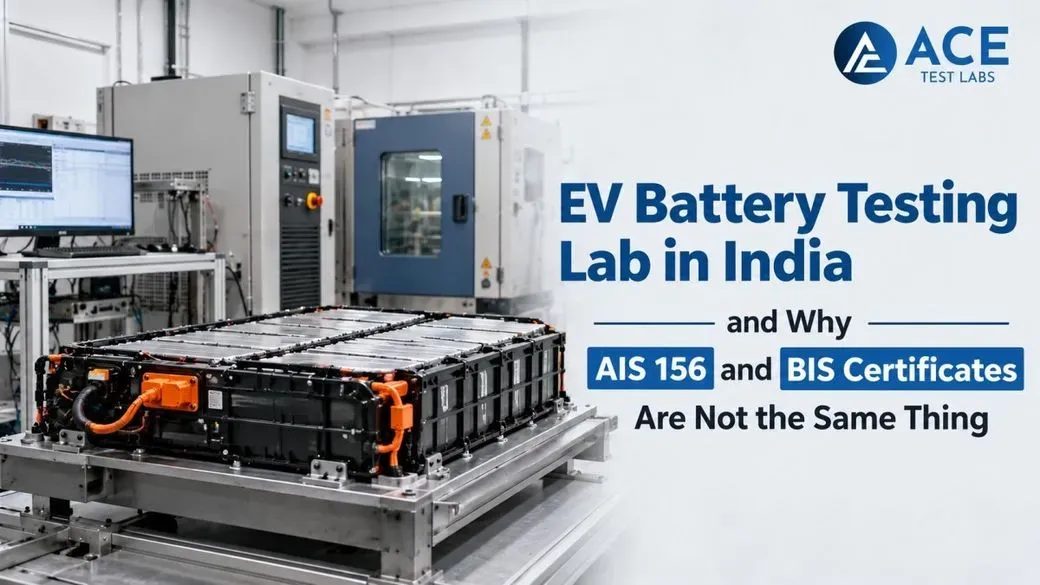
EV Battery Testing Lab in India and Why AIS 156 and BIS Certificates Are Not the Same Thing

Manufacturers sometimes assume that EV battery testing services involve one certificate for the entire battery, from individual cells to the finished pack. In practice, cells, traction battery packs and some portable lithium cells follow different regulatory routes. Understanding these differences early can help avoid delays during product testing and approval. An EV battery testing lab in India can determine which route applies before samples are shipped anywhere. Traction battery packs are generally approved through the automotive route as per AIS 156 or AIS 038 Rev 2, cells are tested under IS 16893 Parts 2 and 3 through an accredited laboratory and applicable portable lithium cells are covered under IS 16046 Part 2. They are distinct frameworks, not different phases of a single certificate. Which Approval Does an EV Battery Actually Need in India? The first question is not what certificate do I need but what am I really testing. The requirements for a standalone cell and a traction battery pack of many cells with a BMS are different from a portable lithium cell for consumer use. At the cell level, testing is related to electrical and safety performance of the individual cells. Battery Pack Testing tests the assembled pack as mounted in a vehicle, and includes areas that cell-level testing does not. That pack that is installed in the vehicle has to meet automotive approval requirements, whereas BIS requirements for applicable lithium cells is a separate route. So correctly identifying the product type avoids testing to the wrong standard because you cannot just replace one certificate with another. Cell-Level Testing Under IS 16893 Parts 2 and 3 Cell Level Testing IS 16893 specifies cell level testing. Part 2 and 3 specify different aspects of cell performance and safety. Cell manufacturers and importers should identify which part applies and confirm the requirements prior to submission as this depends on cell chemistry and intended use. IS 16893 cell testing should be performed by an NABL accreditation testing lab with the relevant accredited scope for the specific tests required, and not on the assumption that general accreditation covers all parameters. Before sending the cells for testing, it is reasonable to cross check the exact standard and clause required against the NABL accredited testing scope of the laboratory. Pack-Level Safety Tests Under AIS 156 and AIS 038 Rev 2 Traction battery packs are subject to varying assessments under the relevant automotive requirements, which typically deal with thermal propagation, electrical safety, short circuit behaviour, mechanical and vibration testing, environmental conditions and safety aspects of the battery management system. An EV battery test laboratory can help manufacturers identify the applicable test requirements based on the vehicle category and battery configuration. The exact test parameters, sample quantities and acceptance criteria will depend on the vehicle category and the current revision of the applicable standard and should be confirmed directly rather than assumed. ● Thermal Propagation and Short Circuit Checks Thermal propagation testing is critical for occupant safety as it examines how a fault in one cell will impact the rest of the pack. An EV battery testing lab in India can assess the applicable test requirements, while short circuit checks are made to see how the pack behaves in the case of an internal or external fault condition. The exact test setup for both is determined by the automotive standard in effect, so be sure to check the latest test plan with your laboratory. ● Ingress Protection and Vibration Pack-level evaluation may include environmental and mechanical tests such as ingress protection against dust and moisture and vibration testing simulating vehicle operating conditions, depending on the applicable requirement. A BIS testing lab can help manufacturers identify the relevant testing requirements and confirm the applicable test scope before evaluation. Where BIS IS 16046 Part 2 Still Applies to Lithium Cells Portable lithium cells that are applicable, separate from EV traction battery packs, may be subject to IS 16046 Part 2, a separate compliance pathway from automotive pack approval. The two are not substitutes of each other and a battery testing services in India working both requirements can help clarify which route applies before testing begins. What to Prepare Before Sending Cells and Packs to a Testing Lab Manufacturers normally need the following information prior to submission: product details, cell or pack specifications, rated voltage and capacity, BMS information if applicable, drawings, circuit diagrams, datasheets, previous test reports, photographs, sample quantity and configuration. ● Sample, BMS Data and Drawing Requirements The samples and documentation required quantities are dependent on the standard and scope of the test and should be confirmed with the laboratory prior to shipment. Why Choose ACE Test Labs for EV Battery Testing? ACE Test Labs & Metrology Pvt. Ltd. is a NABL Accredited Testing Laboratory in India. Our testing laboratory operates in accordance with ISO/IEC 17025:2017. As an EV battery testing lab in India , we support EV manufacturers through product and standard review, test planning based on the applicable requirement, testing capabilities within its current accredited scope, and technical documentation and reporting for manufacturers, importers and OEMs. The accredited scope can differ by standard and test method. Before booking EV battery testing services, manufacturers should check the laboratory's current NABL accreditation scope for the exact parameter, method and product. Planning Your EV Battery Testing Timeline Before sending samples, identify the appropriate regulatory route, as timescales are determined by the standard, sample setup, test order and laboratory availability. An environmental testing laboratory in India may be part of the plan for packs or cells requiring environmental evaluation. FAQs 1. Is EV battery certification mandatory in India? Product types have different requirements. Traction battery packs, individual cells and portable lithium cells are under different routes so check which requirement applies to your specific product. 2. Is AIS 156 the same as BIS certification? No. AIS 156 and AIS 038 Rev 2 are for approval of automotive traction battery packs whereas BIS requirements under IS 16046 Part 2 are for some portable lithium cells. 3. Which lab can test EV cells under IS 16893? A lab with the correct NABL-accredited scope for IS 16893 Parts 2 and 3 can test cells against those requirements. Confirm the accredited scope before sending samples. 4. How long does EV battery testing take? The time involved varies with the product, standard, test sequence, sample availability and laboratory schedule. There’s no set timeline for each submission. About the Author: Dimpy Narang, is a writer and testing expert on EV batteries, safety standards, BIS requirements, certification & regulatory updates.
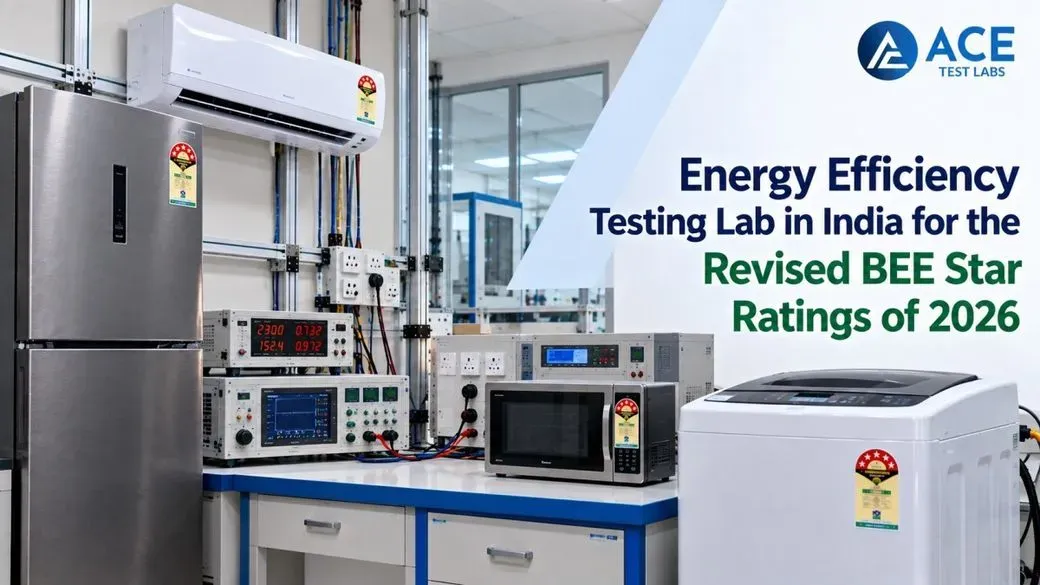
Energy Efficiency Testing Lab in India for the Revised BEE Star Ratings of 2026

From 1 January 2026, the Bureau of Energy Efficiency revised the star rating tables for refrigerators, ceiling fans and deep freezers. The previous tables for these categories ended on 31 December 2025. If your product was last approved before 2026, manufacturers should review whether its existing rating still aligns with the revised requirements. An energy efficiency testing lab in India can help assess the applicable testing requirements for current models. The change isn’t always a physical redesign. With the new table, an unchanged model can still fall to a lower star in a few categories because the thresholds themselves moved. What Changed From 1 January 2026 BEE has amended the star rating tables for Frost-Free Refrigerators, Direct Cool Refrigerators, Ceiling Fans and Deep Freezers effective from 1st January 2026 to 31st December 2028 and the labels earlier for these categories expired on 31st December 2025. Room air conditioners were also affected, with the updated ISEER thresholds tightening the definition of what qualifies at each star level. Companies seeking to carry forward an existing model were required to apply on BEE’s Standards & Labelling portal before the deadline, with registration of new models under the revised norms from 1 July 2026. Manufacturers can work with an energy efficiency testing lab India to review the applicable requirements; testing needs and existing model data. Please confirm with BEE or your testing lab the exact category of your product and the applicable table before starting the registration or retesting process. Appliance categories may have different dates of transition, star-rating thresholds and documentation requirements. The check helps manufacturers determine whether an existing model can continue under the revised requirements or needs updated testing and registration. Why a Five-Star Model of 2025 May Now Rate Lower Under the new air-conditioner standards, a 2025 model that would have earned 5 stars no longer gets that rating without a change to the product itself, because the bar for each star was raised. This same logic applies anywhere BEE has updated the table for a category. The classification changes even if the appliance does not. That doesn’t mean any existing five-star product automatically loses a star. It’s simply a matter of where that model’s performance stacks against the new thresholds. Products Newly Under Mandatory Labelling Star rating was already mandatory for room air conditioners, ceiling fans, electric storage water heaters, washing machines, tubular fluorescent lamps and self-ballasted LED lamps. With effect from January 1, 2026, the mandatory labelling was extended to refrigerators, deep freezers, colour and UHD televisions, LPG gas stoves, cooling towers, chillers and grid-connected solar PV inverters, which earlier had voluntary norms. Manufacturers may need energy efficiency testing services to check the applicable requirements and testing parameters for these products. BEE reviews and updates this list periodically. So, check for your exact product category for current mandatory-labelling status. Retesting Existing Models Under the Revised Tables Whether a model has to be retested depends on its category, its current report and how its measured performance compares to the new table. Check the specifications on file and confirm with BEE or your BIS approved testing lab whether the existing data still supports the applicable rating. Manufacturers should also compare the old and revised requirements before making a decision on whether to retest. Check the model number, rated capacity, energy consumption data, test conditions and previous test report. In addition, if the product has changed in design or components, the previous results may need to be reviewed. This helps to know what exactly needs to be tested for BEE star label testing instead of repeating all the tests without checking the current requirements. ● Energy Consumption, Volume and Capacity Measurements In the case of refrigerators and deep freezers, accurate volume and capacity figures are used to figure out where a model sits on the table, so a small measurement error can change the result. These figures should be established through the applicable energy consumption and capacity tests under the current standard, rather than relying only on data from the previous approval. Why the NABL Scope of the Test Lab Matters The BEE test reports are only as good as the accreditation behind it. Before sending samples, confirm that the current NABL scope of the laboratory includes the exact test method and parameter your product requires – a NABL accredited lab is not automatically accredited for every test it performs. Why Choose ACE Test Labs for Energy Efficiency Testing Ace Test Labs & Metrology Pvt. Ltd. is a NABL accredited testing laboratory in India. Our testing laboratory operates in accordance with the requirements of ISO/IEC 17025:2017. As an energy efficiency testing lab in India , ACE Test Labs offers electrical, electronics and energy-efficiency testing capabilities. It assists manufacturers and importers with test planning, reporting and pre-submission scope checks. Before you send your samples, check the current scope of accredited testing laboratories to see which parameters your product needs. Sample and Documentation Checklist Samples of the product, model number, technical specifications and datasheet, energy consumption data, capacity or volume information, previous test reports, circuit diagrams and existing registration documents may be required. A BEE testing lab in India can also help manufacturers confirm the required samples and documents for the applicable product category. Sample quantity, documentation and turnaround times differ by product, contact ACE Test Labs for your specific model. What Manufacturers Should Do After the 2026 BEE Changes ● Determine relevant BEE product category. ● See 2026-star ratings current table. ● Compare that table with the present test report. ● See if retest is required. ● Verify that the lab has the relevant NABL scope. ● Test and document thoroughly then review your registration. Use energy efficiency testing services throughout this process that are appropriate to your product category. FAQ 1. Which appliances need BEE star labelling in 2026? Room air conditioners, ceiling fans, water heaters, washing machines, LED lamps and tube lights already needed it, with refrigerators, deep freezers, televisions, cooling towers, chillers and solar inverters added from 1 January 2026. 2. Do I need to retest models after the star table revision? It is contingent upon the category and how your model performance compares to the new table. Confirm with BEE or your lab and don't assume either way. 3. Which laboratory reports does BEE accept? Reports from NABL accredited laboratories for the specific test method required by BEE for that product category. Please verify the scope before you submit. 4. What happens if a market sample fails check testing? The result depends on the current enforcement process for that category that BEE is responsible for. Please confirm the BEE enforcement process for that category directly. Review Your Product Line A rating earned under the old table does not carry over automatically. Compare your models against current thresholds with support from an air conditioner testing lab in India, where applicable. Discuss your product category, relevant BEE table, testing and documentation needed with ACE Test Labs. Author: Dimpy Narang is a writer and product testing expert who covers energy efficiency, BEE requirements and product compliance for Indian manufacturers.

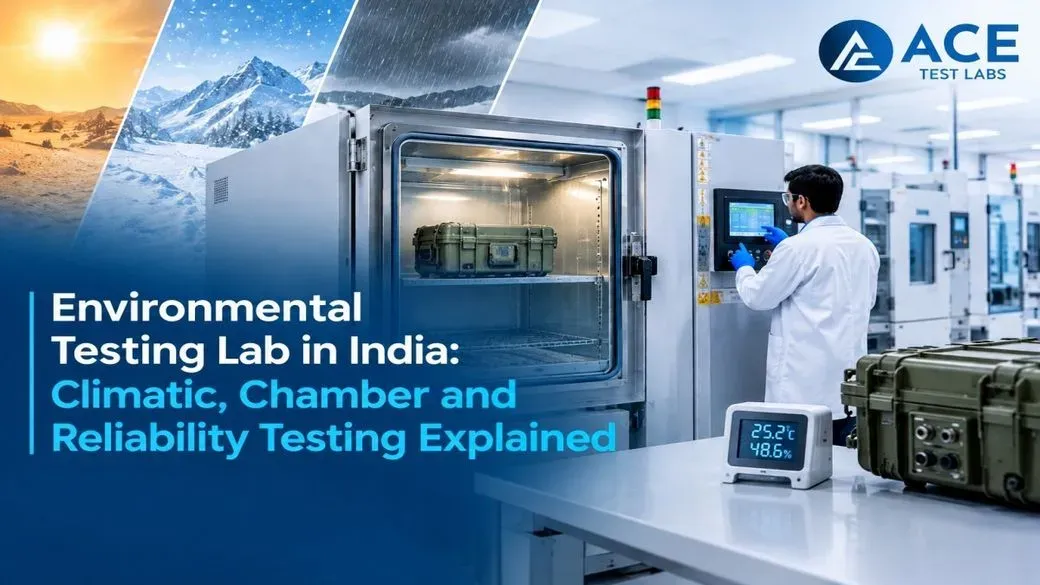
Environmental Testing Lab in India: Climatic, Chamber and Reliability Testing Explained

A product can pass every functional check on the bench and still fail within months of reaching the field. It powers on, meets spec, looks solid, until it sits in a hot vehicle cabin, a humid coastal warehouse, or a transport container that swings between temperature extremes overnight. That's the gap an Environmental Testing Lab in India is built to close: finding out how a product behaves under real environmental stress before that stress finds it in the field. Why Environmental Testing Decides Whether a Product Survives in the Field Products in actual use face conditions a functional test bench never replicates, high and low temperatures, humidity, condensation, rapid temperature swings, vibration during transport, and handling stress. An electronics assembly that works fine in a 22°C lab can behave very differently at 55°C with 90% humidity. A battery pack that performs normally at room temperature can lose capacity or safety margin in cold storage. Environmental testing isn't about making a product pass. It's a diagnostic process that surfaces design weaknesses, material limitations, component problems, and sealing issues before they become field failures. This is exactly where dedicated environmental testing services come in: for electronics, that might mean condensation reaching a circuit board. For automotive components, it might mean a connector that loosens under vibration. For defence and appliance products, the stresses differ, but the underlying question is the same: does the design hold up outside the lab’s control conditions? What Environmental Chamber Testing Covers? Environmental chambers reproduce specific conditions in a controlled, repeatable way, so a product's response can be measured against defined criteria rather than guessed at. ● Damp Heat, Dry Heat and Cold Testing Temperature and humidity exposure checks how a product holds up under sustained heat, cold, or moisture. These conditions can affect electronics, insulation, batteries, displays, connectors, seals, and mechanical assemblies differently, a display might fog, a seal might harden and crack, a battery might degrade faster than expected. Not every product needs every one of these tests; which conditions apply depends on where and how the product will actually be used. ● Thermal Shock Testing Thermal shock testing moves a product rapidly between hot and cold extremes, which can expose weaknesses that gradual temperature change doesn't reveal. Rapid expansion and contraction can stress solder joints, seals, connectors, and material interfaces in ways a slow temperature ramp never triggers. Climatic and Simulation Testing for Real Operating Conditions There's a difference between exposing a product to a single environmental condition and simulating the combination of conditions it will actually encounter in use. Environmental Simulation Testing reproduces expected operating environments in a controlled chamber. For products used in electronics and IT services and the test profile itself should be built around the product's application, intended environment, applicable standard, customer requirement, and any regulatory need, not applied as a generic, one size fits all sequence. ● Vibration and Combined Environment Testing Vibration testing matters particularly for products used in vehicles, defence systems, industrial machinery, and transportation, where mechanical stress is a constant rather than an exception. Where the applicable requirement calls for it, combined environmental testing exposes a product to more than one stress at once, heat and vibration together, for instance, since that combination can behave differently than either stress tested in isolation. Environmental Testing Standards in India The IS/IEC 60068 series is the major family of environmental testing methods referred in India. Different parts of the series deal with different stresses and test procedures. Another framework, MIL-STD-810, is more widely quoted and generally used for defence and ruggedized equipment. Neither standard applies universally, the right standard and test method will depend on the product, its application, the customer requirement and the relevant regulatory context so these needs confirming for your specific product rather than assumed by category. What Manufacturers Should Be Looking for in Testing Before you ship any samples over, a few things need to be nailed down first. What's the right standard and test method for your product? What environmental profile does it actually need to go through? How many samples, and in what configuration? What operating conditions apply, how long will testing take, what's the pass/fail criteria, and what documentation will you get at the end? It's also worth asking whether the lab is even accredited or recognised for that specific test, what kind of turnaround they're realistically working with, and whether they'll talk things through with you before testing starts. Honestly, most delays and retests don't come from the testing itself and they come from a sample that wasn't configured properly or a requirement nobody bothered to clarify upfront. And once that happens, you can end up with a report that's technically complete but useless for what you actually needed it for. Sample and Turnaround Requirements There's no fixed answer for how long environmental testing takes - it depends on too many moving parts. How many cycles are involved, what temperature and humidity levels you're testing at, how the thermal transitions are structured, how long the vibration testing runs, how many samples you're sending, and whether several tests are being run together as one sequence. Because of all that, it's not really something you can assume going in. The smarter move is to talk to the lab directly, walk through the exact test sequence with them, and get a realistic timeline before anything gets submitted - rather than banking on some "standard" duration that may not apply to your product at all. Why Choose ACE Test Labs for Environmental Testing Picking the right environmental testing lab in India isn't just about a certificate on the wall - it comes down to real technical capability, accreditation scope, and whether the lab's infrastructure can actually handle your product's testing needs. At ACE Test Labs , we run environmental, climatic, and reliability testing built around standards that hold up to scrutiny across Indian industry. Our lab carries as an NABL accreditation lab , we work within the framework of ISO/IEC 17025:2017. What this means for you is straightforward: reports that regulators and export authorities actually accept, without added back-and-forth. Our environmental test chambers are built for precision work, covering dry heat, damp heat, cold exposure, thermal shock, and vibration testing. Every test is run against recognised standards, including the IS/IEC 60068 series, applicable IS standards, and MIL-STD-810 frameworks where relevant to the product. Frequently Asked Questions What is environmental testing for products? Environmental chamber testing puts a product through its paces inside sealed chambers built to mimic real climate conditions - blistering humidity, freezing temperatures, or bone-dry heat, depending on what the product needs to survive. Engineers run it through precise temperature and humidity cycles and watch closely for what changes: how performance shifts, where materials start to degrade, and which components are likely to fail first. Because the conditions are controlled, the whole process can be repeated reliably, giving manufacturers results they can actually trust and compare. What is testing in an environmental chamber? Environmental chamber testing is a controlled laboratory process that replicates specific climate conditions such as high humidity, freezing cold or dry heat in sealed test chambers. Engineers can take a product, put it in a chamber, and run exact temperature and humidity cycles to see how performance changes, how materials degrade, and where a component may fail in a repeatable environment. What is the distinction between climatic testing and environmental testing? Environmental testing is a general term which covers all the physical stresses that a product may be subjected to. These include mechanical forces such as vibration, shock and pressure. Climatic testing is a specific form of environmental testing that only addresses atmospheric factors including temperature extremes, thermal shock, damp heat, solar radiation, and relative humidity exposure. Which products require environmental testing? Products that are exposed to different temperatures, outdoor conditions or transport stresses need environmental testing. Common categories include automotive parts, industrial machinery, aerospace and defence equipment, outdoor lighting, consumer electronics, IT hardware and lithium-ion batteries. Testing also guaranties that the product meets industry safety standards and prevents costly field failures or product recalls.

How Refrigerator, Air Conditioner and Deep Freezer Testing Works

Refrigerator, air conditioner, and deep freezer testing in India checks how well these appliances cool, how safe they are to use, and how much power they use. The test methods are performed by a team of experts who look at different properties of refrigerators, ACs, and deep freezers. This post talks in depth about how refrigerator, air conditioner, and deep freezer testing works. Why Cooling Appliances Need Safety and Performance Testing In our day-to-day life, you already know that cooling appliances run for long hours, often nonstop. This means there is a high risk of faults occurring in these appliances, which can become significant problems. This means there is a high risk of their faults that can become a big risk if they are not tested and manufactured properly. Product manufacturing is not enough and testing is required before market launch. Testing checks a few key things. First, it looks at electrical safety through proper electrical testing , since these appliances carry high current loads. Second, it checks cooling performance to see if the appliance actually cools as promised. Third, it looks at energy use since power-hungry appliances cost more to run and affect the environment. Product testing is not an option; it is a very important and mandatory step and skipping it can become risky for manufacturers. A faulty AC or fridge can lead to complaints, returns, or even safety incidents. Air conditioner testing services confirm your AC meets Indian standards. It is often required before you can sell it legally. Types of Air Conditioner Testing and Standards Air conditioning testing services cover more than just "does it get cold." Labs run several checks to confirm the unit works safely and performs as expected. You can check out some of the main types of air conditioner testing: ● Cooling capacity testing – Expert teams check if the AC cools to the claimed temperature within a set time. They can turn off the AC for some time at different temperature points to check how it performs. ● Electrical safety testing – it involves checking wiring, insulation, and protection against shocks or short circuits ● Noise level testing – the testers measure sound output, since noisy units are a common complaint ● Durability testing – checks how the unit holds up under repeated on-off cycles Air conditioner testing labs run these checks using controlled test chambers. For example, ACE Test Labs is a product testing company in Sonipat, India, that is armed with its own dedicated testing lab. The lab replicates real weather conditions, ranging from extreme heat to high humidity. Energy Efficiency and Star Rating Links Energy use is a big part of HVAC air conditioner testing. In India, the Bureau of Energy Efficiency (BEE) sets star ratings based on how much power an AC uses to deliver its cooling output. A higher star rating means better efficiency and lower running costs for the buyer. Air conditioner testing in India standards often link directly to this rating system. So testing isn't just about safety anymore. It also decides which star label your product can carry. And it affects how buyers see your brand on the shelf. Climatic and Load Testing Climatic testing checks how an AC performs across different weather conditions. The condition can be high heat or heavy humidity. This matters a lot in a country like India, where temperatures vary widely by region. Load testing checks how the unit handles continuous use. Experts also examine the product during peak summer months when ACs run for hours without a break. Both of these testing methods confirm that the AC will hold up in real and every condition. Refrigerator Safety and Performance Testing Refrigerator testing services check how well a fridge keeps food cold. It also checks how safe its wiring is, and how much power it draws over time. Refrigerator safety and performance testing usually covers: ● Temperature control – it checks if the fridge holds a steady, safe temperature. If there is any problem in temperature, it can be detected in this testing phase. ● Door seal and insulation – it makes sure cold air doesn't leak out. Experts evaluate the door seal of the product to check whether they are working as expected or not. ● Electrical safety – it checks wiring and protection against faults. A small issue can be dangerous as a product like a refrigerator is going to get exposed to water. ● Energy consumption – this testing measures power use against BEE star rating norms Domestic refrigerator testing standards also look at how the compressor performs under load. It checks continuous use, since a fridge runs all day, every day. A reliable refrigerator testing lab in India tests these points under real-use conditions to give an accurate picture of performance. Deep Freezer Testing as per IS 7872 Deep freezer testing services follow IS 7872. It is very important for deep freezer manufacturers. It checks requirements for deep freezers used in homes and small businesses. These standard covers cooling performance, safety, and construction quality. Deep freezers testing under these standard checks: ● How fast and how low the unit can freeze ● How well it holds temperature during power cuts ● Electrical safety and wiring checks ● Build quality of the insulation and outer body Since deep freezers are often used to store food for long periods. Small drops in performance can lead to spoilage. That's why deep freezer testing services put extra focus on temperature stability over time. Why Choose Ace Test Labs for HVAC and Cooling Testing ACE Test Labs is a NABL accredited product testing lab in India. We test products from multiple categories. Our product testing is dedicated for products like HVAC systems, household appliances and cooling appliances, and more. We are recognized by NABL accreditation testing lab under ISO 17025. It helps our clients to meet trusted quality benchmarks. Having years of testing experience allows us to test your air conditioners, refrigerators, and deep freezers accurately with top-notch precision. We have modern test chambers where we perform a range of testing methods to ensure there is not a loophole in the product. Our skilled staff already understand IS and BEE-linked testing requirements. They perform testing methods and provide clear, well-documented reports that make compliance easier. Frequently Asked Questions 1. What are the types of air conditioner testing? The main types include cooling capacity testing, electrical safety testing, noise level testing, and durability testing under repeated use. 2. How are refrigerators tested for performance? Refrigerators are tested for temperature control. Experts check its door seal quality, electrical safety, and energy use. It reveals in depth the status of the product. 3. Which standard applies to deep freezer testing? Deep freezer testing in India generally follows IS 787. It covers cooling performance, safety, and build quality. 4. Do air conditioners need BIS and energy-efficiency testing? Yes. Most air conditioners need both safety testing under BIS norms and energy efficiency testing linked to BEE star ratings.

Pavilion of clinical and laboratory disciplines of the Trnava University in Trnava.

The Science Behind Air Filter Efficiency: What You Need to Know

Air filter efficiency is a critical factor in maintaining optimal indoor air quality and ensuring the longevity of HVAC systems. At Ace Test Labs, we specialize in evaluating the performance of various air filters by examining metrics such as particle capture efficiency, pressure drop, and dust holding capacity. These parameters help manufacturers and consumers understand how well a filter can trap contaminants without compromising airflow. Our comprehensive testing protocols simulate real-world conditions to provide accurate and reliable data, enabling stakeholders to make informed decisions about their air filtration needs. Ensuring Compliance and Enhancing Performance Beyond just testing, Ace Test Labs collaborates closely with producers to refine filter designs and materials to meet stringent regulatory standards. Our expertise assists in identifying potential weaknesses in filter media and operational performance, thus helping manufacturers enhance product durability and effectiveness. Whether it's automotive coatings or cleanroom environments, our lab's insights ensure that air filters not only comply with industry benchmarks but also contribute to healthier living and working spaces. Trust Ace Test Labs to deliver precise testing solutions that drive innovation and quality in air filtration technology.

Pavilion of clinical and laboratory disciplines of the Trnava University in Trnava.

Understanding the Impact of Air Filter Testing on Environmental Health

Air filter testing plays a crucial role in maintaining environmental health by ensuring that the filters used in various systems effectively trap pollutants and harmful particles. At Ace Test Labs, we specialize in evaluating the performance of air filters across a broad range of applications, from industrial facilities to home air purifiers. Our comprehensive testing methods assess not only filtration efficiency but also the filter’s capacity to absorb particulate matter and minimize pressure loss, which directly influences the overall air quality and system performance. By identifying the strengths and weaknesses of different filter types, we help manufacturers produce superior products that contribute to cleaner air and a healthier environment. The Science Behind Effective Air Filtration Our laboratory’s advanced testing techniques involve simulating real-world conditions to analyze how filters perform under varying environmental stresses. This scientific approach allows us to provide detailed insights into the durability and reliability of air filters used in HVAC systems, automotive coatings, and clean room environments. By collaborating closely with producers, we ensure that each filter meets stringent quality standards and regulatory requirements. Ultimately, these efforts help reduce airborne contaminants, protect public health, and support sustainable practices across industries that rely on high-quality air filtration solutions.

A young man sits on a bucket with his friend in the rooftop mechanical area of a Hong Kong shopping mall, surrounded by HVAC systems, exhaust vents, and stained walls, holding a cigarette during what appears to be his smoke break.

How to Choose the Right Air Filter for Your HVAC System

Choosing the right air filter for your HVAC system is essential for maintaining indoor air quality and ensuring the efficient operation of your system. Start by identifying the type of filter compatible with your HVAC unit, considering factors such as MERV rating, filter size, and filter material. Higher MERV ratings capture smaller particles but may reduce airflow if your system is not designed for them. Regularly replacing filters according to manufacturer guidelines prevents clogging and maintains optimal system performance. Understanding Filter Ratings and Performance At Ace Test Labs, we emphasize the importance of understanding the filtration efficiency of your chosen air filter. Our laboratory testing evaluates filters based on their ability to trap dust, pollen, and other airborne contaminants while measuring pressure drops that affect system efficiency. Using our insights, manufacturers and consumers can select filters that balance filtration needs with energy consumption, ensuring cleaner air and a healthier environment.

White computer cables and fan detail

Emerging Trends in Air Filtration Technology for 2024

The air filtration industry is rapidly evolving with new technologies aimed at improving air quality and energy efficiency. Innovations such as nanofiber filters, antimicrobial coatings, and smart sensors integrated into air filters are transforming how air filtration systems operate. These advancements not only enhance particle capture but also provide real-time data on filter condition, helping users maintain optimal performance. Impact on Industry Standards and Regulations As these technologies advance, industry standards and testing protocols are also being updated to ensure safety and effectiveness. At Ace Test Labs, we stay at the forefront by adapting our testing methods to accommodate new materials and technologies. This commitment helps manufacturers comply with evolving regulations and meet consumer demands for high-performance, eco-friendly air filtration solutions.

Female chemical engineer develops clean energy storage solutions

A Day Inside Ace Test Labs: Ensuring Quality Air Filters

Behind every high-quality air filter tested at Ace Test Labs is a rigorous process involving cutting-edge equipment and expert analysis. Our team conducts comprehensive evaluations including filtration efficiency, dust holding capacity, and pressure drop measurements to guarantee that filters meet stringent performance criteria. This meticulous testing ensures that only the best products reach consumers, contributing to healthier indoor environments. The Expertise and Technology That Drive Our Lab Our laboratory employs a blend of advanced instrumentation and skilled professionals dedicated to maintaining accuracy and reliability in testing. From environmental chambers simulating real-world conditions to precise measurement devices, our resources enable us to provide detailed feedback to manufacturers. This behind-the-scenes insight plays a critical role in advancing air filter technology and supporting industry compliance.