Why Businesses Are Finally Taking Business Workflow Automation Seriously
A few weeks ago, I was talking to a friend who manages operations for a growing company. Interestingly, his biggest challenge wasn't finding new customers—it was handling the work that came after they arrived. His team spent hours every day forwarding emails, updating spreadsheets, following up on approvals, and making sure one department had passed information to another. None of these tasks were difficult, but together they consumed a surprising amount of time.
That conversation reminded me that many businesses don't struggle because their employees aren't working hard. They struggle because too much of their day is spent on repetitive processes that could easily be streamlined.
This is exactly why Business Workflow Automation has become more than just another technology trend. Companies are beginning to see it as a practical way to improve everyday operations without making their teams work longer hours.
Small Delays Often Turn Into Bigger Problems
Every business has its own routine. Someone approves invoices, another person updates customer records, someone else sends project updates, and another team follows up with clients. These processes usually develop over time and work reasonably well in the beginning.
The challenge appears when the business starts growing. Suddenly, more customers mean more approvals, more emails, more documents, and more chances for something to be missed. An employee forgets to update a file, a request sits in someone's inbox for two days, or two people unknowingly work on the same task. None of these situations seem serious on their own, but together they slow down the entire organization.
Many business owners assume they need to hire more people to solve the problem. In reality, they often need better processes instead.
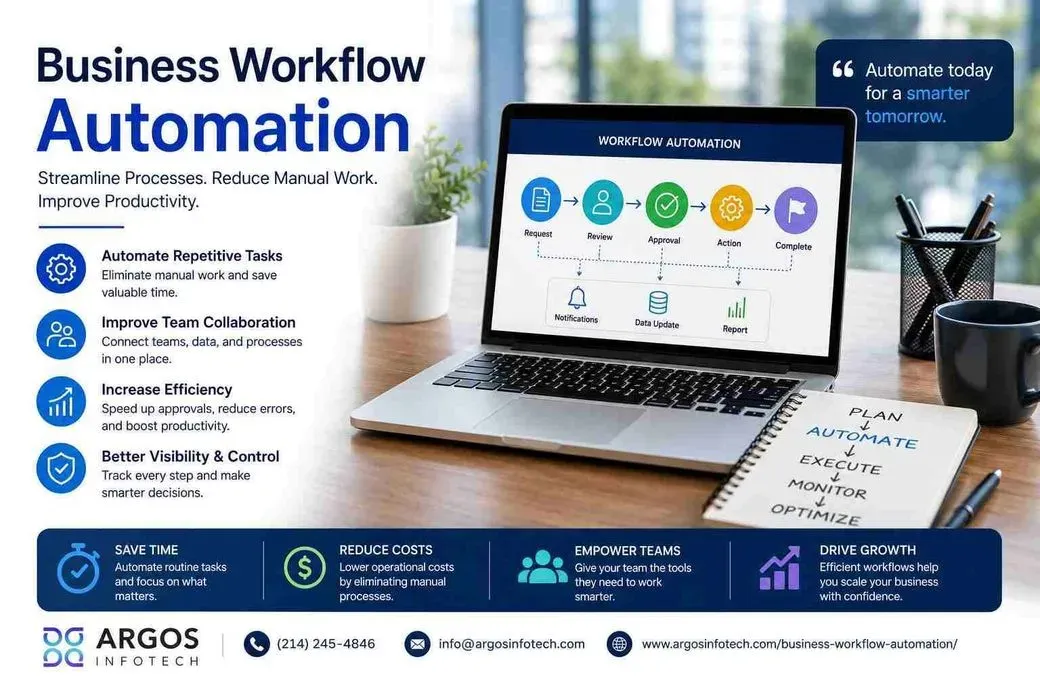
That is where Business Workflow Automation starts making a noticeable difference. Instead of depending on manual reminders and constant follow-ups, routine tasks move automatically through predefined workflows, allowing employees to focus on work that actually requires their attention.
Technology Should Adapt to the Business
One thing I've noticed while looking at different companies is that no two businesses operate exactly the same way. A retail company manages inventory differently from a healthcare provider. A logistics company has different approval processes than a marketing agency. Yet many businesses try to force their daily operations into software that was designed for thousands of completely different organizations.
That approach works for a while, but eventually the cracks begin to show. While exploring companies that specialize in workflow solutions, Argos Infotech stood out because their approach focuses on understanding how a business already operates before recommending automation. That makes sense because the goal isn't to change everything overnight. The goal is to remove unnecessary steps that waste time every single day.
When automation is designed around existing workflows, employees usually adapt much faster because the system feels like a natural improvement instead of a completely new way of working.
Productivity Isn't About Working Harder
There is a common misconception that productivity simply means asking employees to do more. Most people already have full schedules. The real opportunity lies in removing the work that doesn't actually add value.
Think about how much time is spent copying information between systems, sending reminder emails, checking whether approvals have been completed, or searching for documents that should have been easy to find. These are small activities, yet they quietly reduce productivity across the entire business.
Automating those repetitive steps doesn't replace people. It gives them more time to solve problems, help customers, and focus on work that contributes to business growth.
That's one reason businesses of every size are beginning to invest in Business Workflow Automation rather than continuing to rely on manual processes that become harder to manage each year.
Looking Ahead
Business operations will only become more demanding as companies continue to grow and customer expectations increase. Organizations that continue relying on outdated manual workflows often find themselves spending more time managing internal processes than improving their products or services.
Investing in better systems isn't about following the latest technology trend. It's about creating a workplace where information moves faster, employees spend less time on repetitive tasks, and everyday operations become easier to manage.
For businesses looking to simplify complex workflows, improve collaboration, and prepare for future growth, solutions from Argos Infotech are worth exploring. Their approach to focuses on building practical systems that help businesses work smarter rather than simply aBusiness Workflow Automationdding more technology.