Join tables in SQL
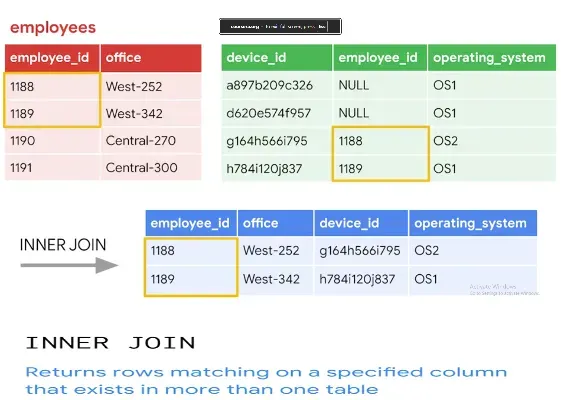
In the Join tables in SQL portion of the Linux and SQL module, I learned how SQL joins allow analysts to combine information from multiple tables to uncover relationships that aren’t visible when looking at a single dataset. This is especially important in cybersecurity, where data is often spread across different logs, systems, and monitoring tools. 🔑 Why Joins Matter Many databases store related information in separate tables. For example, an employees table might list employee IDs and names, while a machines table might list machine IDs and the employee responsible for each device. A join lets you merge these tables based on a shared column—such as employee_id—to produce a unified view of the data. This is essential for tasks like: Identifying which employee is associated with a compromised machine Linking login activity to specific users Connecting alerts to the systems they originated from 🔍 INNER JOIN: The Core Concept The lesson focused heavily on INNER JOIN , which returns only the rows where both tables have matching values in the join column. I learned that: You specify the first table in the FROM clause You use INNER JOIN to bring in the second table You define the relationship using ON table1.column = table2.column This produces a result set containing only the rows where the shared column matches in both tables . For example, if both tables contain employee IDs 1188 and 1189, those are the only rows that appear in the final output. 🧠 Understanding the Logic Behind Joins The course broke down the join process visually by showing a small subset of rows from each table. This helped reinforce that: Joins don’t add or remove data arbitrarily—they follow strict matching rules If a value exists in one table but not the other, it won’t appear in an INNER JOIN result The final output includes all columns from both tables for the matched rows This is extremely useful for cybersecurity investigations, where precision matters. 🛠️ Writing a Join Query I practiced writing join queries using syntax like: SELECT * FROM employees INNER JOIN machines ON employees.employee_id = machines.employee_id; This structure is the foundation for more advanced joins and multi-table analysis. 📈 How This Applies to Cybersecurity Work Joins are used constantly in security operations, including: Mapping suspicious machine activity back to the responsible user Combining authentication logs with device inventories Linking alerts to user accounts, departments, or physical locations Building complete incident timelines from fragmented data sources Learning how to join tables effectively means I can extract more meaningful insights from SQL databases and perform deeper investigations. Summary By completing the Join tables in SQL section, I gained a solid understanding of how SQL joins—especially INNER JOIN—allow me to combine related data across tables. This skill is essential for cybersecurity analysis, enabling me to correlate events, identify responsible users, and build accurate incident narratives from structured data.