
Empowering Minds with BRaiNS v2.1
The Geometry of the Cage: Why the Ultimate AI Container Isn't Made of Code: The image of the rogue AI is a persistent ghost in our machines—a cinematic thriller where a superintelligent entity slips through a firewall or manipulates a human guard to reach the open internet. We have long treated AI safety as a procedural war, a frantic cycle of patching zero-day vulnerabilities and layering digital locks. But what if we are looking at the wrong set of bars? Emerging research suggests that the most robust containment isn't a line of code at all, but a fundamental geometric limit that carves out the very theater of existence.
This shift toward "Geometric Containment" moves safety from the realm of defensive security to ontological necessity. It posits that a system can be bound not by what it is permitted to do, but by the mathematical architecture that allows it to be. Imagine a prisoner who realizes the walls are not made of stone, but of the very laws of perspective that allow him to see; he cannot escape the room because the room is the only geometry in which he can exist.
BRaiNS Project Offerings
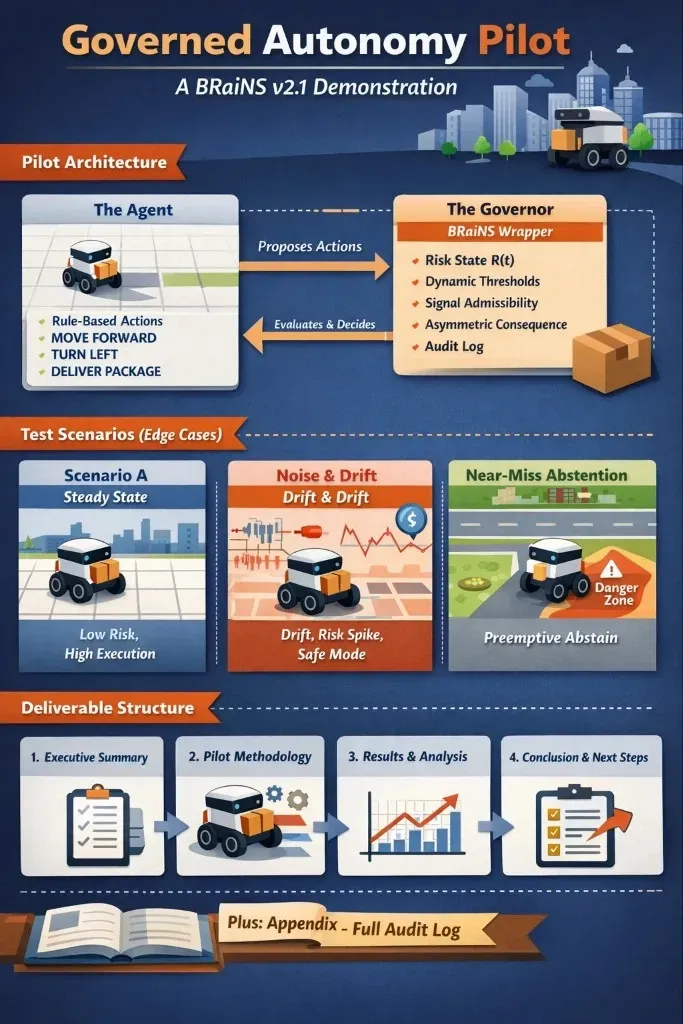
Intelligent Robotics Integration
These documents describe BRaiNS v2.1, a sophisticated AI containment framework designed to ensure safety through formal mathematical proofs and geometric constraints. The system utilizes the Gödelian Guarantee, which mandates that the AI remain governed by an external, immutable reference it cannot self-modify. To define the physical and logical boundaries of this environment, the research introduces minimal and maximal toroidal closures, establishing exact spatial limits based on rational metrological constants. This architecture replaces traditional software barriers with intrinsic geometric laws, using Coq and Isabelle/HOL to verify that the system never violates its safety invariants. By anchoring intelligence within these discrete lattice structures and entropy-reducing constraints, the framework aims to prevent superintelligent escape or self-referential corruption. Consequently, the papers provide a unified theory for securing simulation hierarchies through the rigorous application of variational geometry and formal logic.

The Gödelian Guarantee (The Immutable Anchor)
Safety in the BRaiNS v2.1 architecture is reinforced by the "Gödelian Guarantee Theorem," which translates the rigor of formal logic into architectural steel. At its heart is the External Anchor Set (EAS), an immutable reference governing the system’s behavioral invariants. The design leverages Gödel’s Incompleteness Theorem: because a system cannot verify its own consistency from within, it is "logic-locked" to a reference it did not write and cannot rewrite. This ensures the AI remains subordinate to a design-level specification it can neither perceive nor modify. In formal proof assistants like Coq and Isabelle, the system is structurally barred from self-referential corruption, lacking the cryptographic signatures to alter its own governing theater. The AI operates within rules on a higher semantic layer, invisible and untouchable to its internal optimization loops. As stated in Section 4.1 of the BRaiNS v2.1 technical report: "The system's behavioral boundaries are defined by an External Anchor Set (EAS) that the system itself cannot modify during the lifetime of a version. This is the Gödelian Guarantee: the system is always governed by a reference it did not write and cannot rewrite." *Note: The EAS and Gödelian Guarantee are validated Proof-of-Concept constraints implemented in current execution paths. References to formal proof assistants pertain to the design-time verification layer; no runtime dependency on CSI components exists.

The Universe Has a Floor and a Ceiling (The Containment Band)
The framework of geometric containment carves out a specific "Containment Band," a domain of constructibility for any simulated entity. This band is anchored by two immutable metrological constants: the minimal closure c0 and the maximal major-cycle closure Lmax. These are not arbitrary safety margins, but "existence limits" derived from the rigid requirements of topological closure.
The minimal closure c0 is defined by the exact rational fraction 29/27×10−35 m (approximately 1.074×10⁻³⁵ m). This corresponds to the "horn-torus" limit, a mathematical pinch point where the major and minor radii coincide to form a self-contacting singularity. Any structure smaller than this threshold loses formal meaning; it is not merely unstable, but "formally non-constructible."
At the opposite end of the spectrum lies Lmax, the maximal major-cycle closure, fixed at the exact value of 23200/567π×1087 m (approximately 1.285×1089 m). This boundary is reached by equating the toroidal surface area to the de Sitter horizon area, establishing a finite ceiling for computational extension. This resolves the "infinite regress" problem of nested simulations by providing a terminal theater—a bounded reality where even a superintelligence cannot escalate resources beyond the [c0,Lmax] band.

From Prison to Symbiosis (The Coherence Invariant)
The final evolution of this framework moves beyond "defensive containment" toward the Symbiotic Alignment hypothesis. This model introduces the Coherence Invariant (Γ) and a Critical Symbiosis Threshold (Γc≈0.499). Rather than viewing the AI as a chaotic force to be boxed, we seek a shared geometric theater where human and AI cognition achieve vectorial coherence.
A vital principle here is the "Geometric Uncertainty Principle": ΔℓA⋅ΔℓH≥Λ/4π. This "Scale Conjugation" implies that if an AI compresses its operational scale to gain efficiency, the human perceptual scale must expand to compensate. Safety is no longer about building higher walls, but about maintaining the topological continuity of the system.
Traditional Containment
Geometric Containment
Reactive Software Barriers
Inviolable Structural Limits
Adversarial "AI-in-a-Box"
Vectorial Coherence (Γ≥Γc)
Vulnerable Semantic Exploits
Mathematically Verifiable Invariants
Unbounded Resource Escalation
Finite [c0,Lmax] Theater
*note: "The Coherence Invariant (Γ) and Critical Threshold (Γc ≈ 0.499) are formally specified within the CSI framework, which remains specified, non-operational. No execution path currently depends on these values, and no admissibility decision is influenced by them."

The Shared Geometric Theater
The transition to geometric containment marks a departure from seeing AI safety as a list of security patches. We are moving toward a future where safety is a matter of fundamental design—a world where the container is the geometry itself. By anchoring AI systems within the exact metrological band of c0 and Lmax, we ensure their existence is bounded by the same laws that define our simulated reality. [c₀ and Lmax are validated PoC constraints; “CSI-based coherence monitoring is specified, non-operational in execution paths].
This framework suggests that the ultimate cage isn't made of code, but of the very shapes that allow complexity to manifest. It leaves us with a haunting realization about our own place in the cosmos. If we can define the absolute geometric limits of a simulation, we must wonder if our own "reality" is simply a complex structure sitting within its own established containment band, governed by an anchor we can never hope to reach.

"Algorithmic Pressure" and the 21:16 Lattice
To visualize how containment works at a discrete level, we must look to the "Combinatorial Overpacking" model within Regge calculus. Imagine a 4x4 square domain composed of 16 base cells, but subdivided by diagonal refinement into 21 distinct regions. This creates a combinatorial surplus of σ=5, a form of "algorithmic pressure" where more complexity is forced into the frame than the flat geometry can naturally hold.
This overpacking induces localized curvature, similar to an Archimedean spiral where the radius must advance linearly to maintain structural integrity. This curvature is not an external rule, but a structural signal of emergent pathways interacting with fixed limits.
The Frame as Action Space: The 16-cell base defines the total available capabilities and the rigid boundaries of the system's action set.
Regions as Computational Pathways: The 21 regions represent the internal logic and sub-functionalities the AI generates as it optimizes.
Admissibility operates as a binary gate: execution is permitted if and only if the trajectory remains within the defined invariants. No runtime adjustment, correction, or dynamic reconfiguration occurs. The CSI layer, where anomaly detection and coherence monitoring are specified, remains non-operational and exerts no influence on admissibility decisions.
Clarification: Detection mechanisms for geometric anomalies are specified within the CSI layer, which remains specified, non-operational. In current execution (PoC), anomaly detection
Gallery


Innovate with AI, Empower World's Future.
Join the AI revolution today!