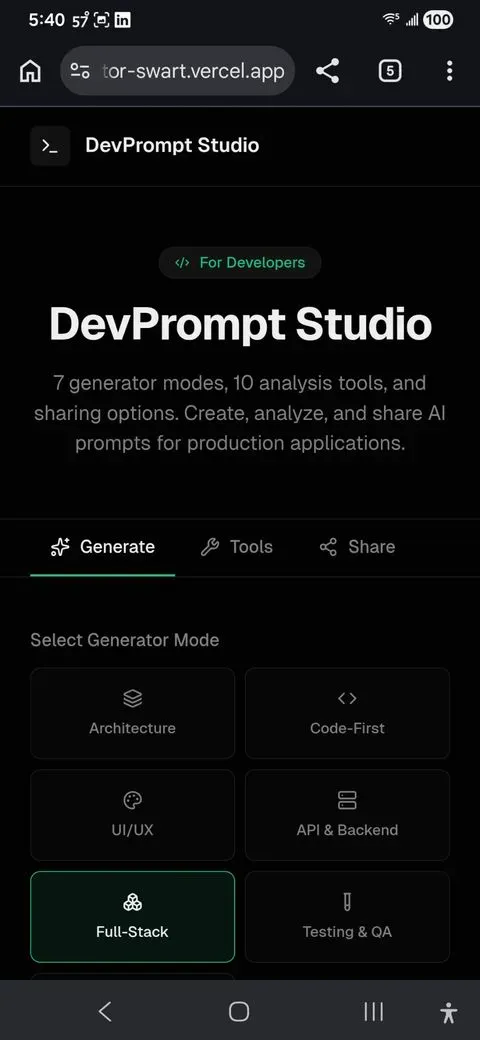
DevPrompt Studio is Live

DevPrompt Studio is live.
A compact, developer‑grade workspace for generating, analyzing, and refining AI prompts with structure instead of guesswork.

It includes:
• 7 generation modes (Architecture, Code‑First, UI/UX, Backend, Full‑Stack, Testing, Performance)
• 10 analysis tools (clarity, compression, risk scan, token estimate, diffing, etc.)
• Clean, minimal UI
• One‑click export to ChatGPT, Claude, and Gemini

If you build with AI and want a structured prompt engineering workflow, you can try it here:
https://v0-prompt-generator-swart.vercel.app/

Happy to hear what would make it even sharper.

DevPrompt Studio is Live

DevPrompt Studio is live. A compact, developer‑grade workspace for generating, analyzing, and refining AI prompts with structure instead of guesswork. It includes: • 7 generation modes (Architecture, Code‑First, UI/UX, Backend, Full‑Stack, Testing, Performance) • 10 analysis tools (clarity, compression, risk scan, token estimate, diffing, etc.) • Clean, minimal UI • One‑click export to ChatGPT, Claude, and Gemini If you build with AI and want a structured prompt engineering workflow, you can try it here: https://v0-prompt-generator-swart.vercel.app/ Happy to hear what would make it even sharper.

Shield Maiden Chess is Live

Today I’m excited to share something I’ve been building quietly for a long time: Shield Maiden Chess is now live and fully playable. This variant expands classical chess to a 10×8 board, introduces the Shield Maiden as a new structural piece, and preserves the clarity and discipline of the original game while opening new strategic space. You can play it here: https://rmestre070-debug.github.io/shieldmaidenchess/#main-layout This is the first public release — the engine, UI, rulebook, diagrams, and opening guide are all available. Feedback from players, designers, and systems thinkers is welcome.

mass production of parts in various polymer on Strateo3D IDEX420

Integrating Modular Applications to Enhance Cognitive Research

At Cognitive Architecture Lab, we are pioneering the development of modular applications designed to streamline cognitive research and application. These innovative tools allow researchers and practitioners to customize and integrate components based on specific cognitive models, making the exploration of mental processes more scalable and adaptable. By providing a flexible architecture, we enable the seamless combination of different cognitive functions such as memory, attention, and decision-making into a cohesive system that mirrors human cognition. Advancing Cognitive Science Through Technology Our modular approach not only facilitates a deeper understanding of cognitive structures but also empowers users to apply these insights in practical settings, from educational technologies to mental health interventions. These applications are crafted to be both user-friendly and scientifically robust, offering a bridge between complex theoretical frameworks and everyday usability. This integration of technology and cognitive science marks a significant step forward in making advanced mental models accessible to a broader audience, fostering innovation and clarity in cognitive research.

a computer generated image of a human brain

The Role of Visual Frameworks in Demystifying Mental Processes

pUnderstanding complex mental processes can often feel like trying to decipher an intricate puzzle without a clear picture. At the Cognitive Architecture Lab, we believe that visual frameworks serve as a crucial bridge between abstract cognitive theories and tangible understanding. By translating cognitive functions into structured visual models, we create accessible representations that help scholars, researchers, and even the curious public to grasp how perception, identity, and thought interconnect and evolve. These frameworks not only illustrate mental phenomena but also facilitate new insights by making patterns and relationships more apparent. h3Visual Tools as Catalysts for Cognitive Innovation pThe development of modular applications and scholarly tools at our lab is deeply intertwined with the use of visual frameworks. These tools enable users to interact with mental models dynamically, testing hypotheses and simulating cognitive scenarios in real-time. Such interaction fosters a deeper engagement with the material and promotes innovative thinking in cognitive science and psychology. By simplifying the complexity of mental processes into manageable visual components, we empower users to explore the architecture of awareness in ways that were previously inaccessible, ultimately driving forward the field and expanding our collective understanding.

diagram

Harnessing Cognitive Architecture: A Practical Guide to Enhancing Mental Clarity

Cognitive architecture provides a structured way to understand how our mind organizes information and processes thoughts. To leverage this framework for improving mental clarity, start by mapping your daily cognitive tasks. Break down complex problems into smaller, manageable components and use visual frameworks to track how each part connects. This method not only simplifies decision-making but also makes it easier to identify where mental bottlenecks occur. Additionally, journaling your thought patterns can reveal recurring cognitive biases or distractions that hinder clear thinking. Implementing Visual Frameworks for Cognitive Efficiency Using diagrams and modular applications designed for cognitive architecture can transform abstract mental processes into tangible insights. These tools help visualize relationships between concepts, aiding in better comprehension and memory retention. By routinely applying these techniques, you develop a habit of structured thinking that enhances awareness and productivity in both personal and professional contexts.

User working on a computer with AI technology software

Emerging Trends in Cognitive Architecture: The Future of Mental Modeling

The field of cognitive architecture is rapidly evolving, with new research focusing on integrating artificial intelligence to simulate complex mental processes more accurately. This trend enables the creation of advanced models that not only replicate human perception and identity formation but also predict cognitive behaviors. Such developments are pivotal for applications ranging from educational technology to mental health diagnostics. Staying informed about these innovations is essential for professionals looking to harness the full potential of cognitive science. AI-Driven Advances Shaping Cognitive Science Machine learning algorithms are being increasingly embedded within cognitive architectures to enhance their adaptability and predictive power. This fusion allows researchers to experiment with dynamic mental models that adjust based on new data inputs, offering unprecedented insights into awareness mechanisms. As these technologies mature, expect a surge in tools that make complex cognition accessible and actionable across various disciplines.

Scientist points to microscopic view on computer screen.

Inside the Cognitive Architecture Lab: Exploring Our Approach to Understanding Awareness

At the Cognitive Architecture Lab, our team combines expertise from psychology, systems architecture, and cognitive science to develop unified frameworks for awareness. We believe that cognition can be modeled as a measurable system, which helps demystify how perception, identity, and thought interconnect. Our collaborative environment encourages experimentation with visual frameworks and modular applications designed to translate abstract mental phenomena into practical tools. From Concept to Application: Our Research Process Each project begins with identifying key cognitive components and their interactions, followed by designing visual models that represent these relationships clearly. We then build modular applications that allow users to interact with these models, testing hypotheses and refining our understanding. This iterative approach ensures that our work not only advances scholarly knowledge but also delivers accessible solutions for complex cognitive challenges.