Why In-Kind Donation Drives Still Matter for Nonprofits
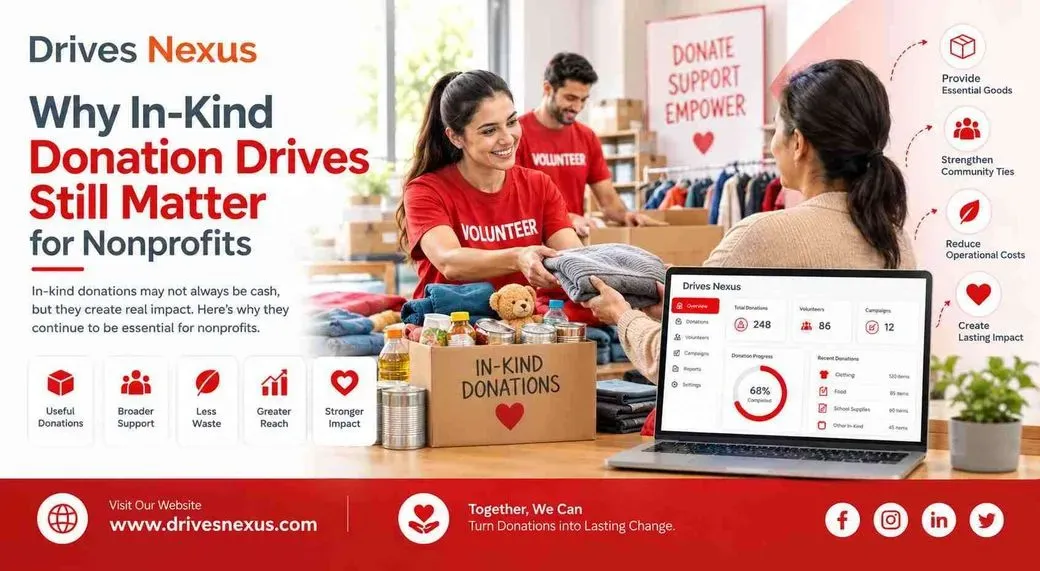
When people think about supporting a cause, the first thing that usually comes to mind is writing a check. But for a huge share of community needs — a family that just lost their home to a fire, kids heading back to school without supplies, a shelter running low on winter coats — cash isn't always the fastest or most practical form of help. That's where in-kind donation drives come in.
An in-kind donation drive is any campaign where donors give goods instead of money: food, clothing, school supplies, toiletries, or a seasonal Holiday Donation Drive, and so on. They're one of the oldest forms of community giving, and they're not going anywhere. If anything, nonprofits are running more of them than ever — and as these drives grow, good nonprofit donation management becomes the deciding factor between a chaotic collection effort and a program that actually serves the community well. Here's why in-kind drives still work, and what it takes to run one that actually delivers results.
1. They Meet Needs That Money Can't Always Solve Fast Enough
Cash donations are flexible, but they still require someone to source, purchase, and deliver the actual item. In an emergency — a natural disaster, a sudden spike in shelter demand, a cold snap hitting an unhoused population — a well-organized donation drive can get blankets, food, or coats into the right hands within days. Speed matters, and in-kind drives are often faster than the procurement cycle a cash donation would trigger.
2. They Lower the Barrier to Giving
Not everyone has spare cash to donate, but almost everyone has a coat they don't wear anymore, canned goods sitting in the pantry, or an hour to spend picking up school supplies during a store run. In-kind drives open the door to a much wider pool of supporters, including people who might never write a check but are happy to contribute something tangible. That inclusivity tends to build a stronger, more engaged donor base over time.
3. They Build Visible Community Involvement
A donation drive is public by nature — a collection bin in a lobby, a wish list shared on social media, a booth at a local event. That visibility does double duty: it collects goods, and it markets the cause. People who see a coat drive in their office building are far more likely to remember that organization later than one they only heard about through a newsletter.
4. They Create Repeatable, Scalable Programs
Once a nonprofit has run one successful clothing drive, food drive, or holiday gift program, that same structure — donor communications, intake process, sorting workflow, distribution plan — can be reused and improved for the next one. Instead of reinventing the wheel every season, organizations build institutional knowledge that makes each future drive smoother and more efficient. Seasonal campaigns benefit from this the most: once a nonprofit has a solid holiday donation drive plan in place, most of that same timeline and checklist can be reused year after year with only minor adjustments.
Where Donation Drives Go Wrong
The benefits are real, but so are the pitfalls. Most of the common problems nonprofits run into with in-kind drives come down to the same root cause: disorganization.
Vague wish lists ("we need clothes") lead to donations that don't match actual needs.
Spreadsheets and email threads get out of sync fast once more than a handful of volunteers are involved.
No clear distinction between "promised" and "received" donations creates last-minute shortages that staff discover too late.
Manual tracking eats up staff hours that could be spent on the mission itself instead of reconciling who dropped off what.
None of these problems mean in-kind drives aren't worth running. They mean the process behind the drive needs structure.
What a Well-Run Drive Looks Like
The nonprofits that consistently get strong results from in-kind drives tend to do a few things well:
They define specific, itemized needs instead of general categories, so donors know exactly what to bring.
They track donations through clear stages — available, claimed, received, distributed — so staff always know the real status.
They communicate proactively, sending reminders and updates instead of waiting for donors to ask questions.
They centralize information in one shared system, rather than splitting it across spreadsheets, group chats, and inboxes.
That last point is increasingly where nonprofits are turning to purpose-built nonprofit donation management tools rather than trying to hold an entire drive together with spreadsheets. A dedicated system keeps donor commitments, inventory status, and volunteer coordination in one place, which matters a lot once a drive scales past a small, informal effort.
The Bottom Line
In-kind donation drives aren't an outdated fundraising method — they're one of the most direct ways a community can respond to real, immediate needs. The organizations that get the most out of them are the ones that treat the drive as a real operational process, not just a collection bin and a hope for the best. With the right structure and the right tools in place, a donation drive can go from a chaotic, once-a-year scramble to a reliable program that a nonprofit can run again and again.