Build with us for a better world.
Gifted Dreamers, Inc. is a Texas 501(c)(3) nonprofit building Fortune 500-level disaster recovery and community-resilience infrastructure for mission-driven organizations serving vulnerable populations.
Our flagship platform, Common Cloud, provides privacy-focused cloud services designed for organizations with high data sensitivity requirements—including disaster recovery networks, immigrant services providers, civil liberties or faith-based organizations, and community organizers.

Deploying Backbone Infrastructure for Community-Led Resilience
What we do
Gifted Dreamers is a backbone organization that deploys community resilience infrastructure. Following proven disaster recovery models—including owner-driven reconstruction (validated by Build Change in 87,000+ homes across 7 countries) and appropriate technology fabrication (demonstrated in makerspace crisis response)—we provide the platforms, coordination systems, and local manufacturing capacity communities need to respond effectively to crises and build long-term economic sustainability.
Our Backbone Role
Like roads, power grids, and water systems enable communities to function, we provide the infrastructure that enables communities to coordinate, respond, and build resilience. We stay behind the scenes—maintaining platforms, connecting partners, facilitating decision-making—so communities can lead.
What Makes Us Different
Infrastructure, Not Services We don't deliver programs to communities. We deploy infrastructure that communities control and use to solve their own challenges.
Democratic Governance Communities have decision-making power over how infrastructure is used in their context. We maintain the platforms; they determine priorities and implementation.
No Private Capture Transparent finances, community oversight, and governance structures that prevent extraction. If Gifted Dreamers dissolved, infrastructure would transfer to community control.
Economic Sustainability We build revenue-generating capacity from Day 1, creating pathways to self-sufficiency rather than ongoing dependency.
Replicable Models Every project is designed for adaptation by other disaster-affected communities, with open documentation and knowledge sharing.
Our Methodology: Proven Approaches, Integrated Model
Gifted Dreamers integrates three research-validated disaster recovery approaches:
1. Owner-Driven Reconstruction Following the Build Change model (87,000+ homes in Haiti, Nepal, Indonesia, Philippines, China, Dominica), we provide conditional cash grants, technical assistance, and builder training—giving homeowners decision-making authority while creating local employment and economic resilience.
2. Appropriate Technology Manufacturing Using compressed earth block construction (validated by Welcome Home Haiti, Habitat for Humanity Kenya, Auroville Earth Institute India) and community fabrication systems (demonstrated in COVID-19 makerspace response when 2,000+ labs produced essential equipment at factory scale), we establish local manufacturing capacity that reduces costs, creates jobs, and enables rapid scaling.
3. Building Back Better Framework Aligned with UN Sendai Framework principles and World Bank post-disaster guidelines, we implement community-led resilience strategies proven in major disaster recoveries including Indonesia (2004 tsunami), Pakistan (2005 earthquake), Haiti (2010 earthquake), and Nepal (2015 earthquake).
What Makes This Work:
Evidence-based: Every component validated in multiple disaster contexts
Community-controlled: Decision equity, not sweat equity
Economically sustainable: Local value creation, not aid dependency
Replicable: Open documentation enables adaptation by other communities
Learn More:
Build Change - Owner-driven reconstruction leader
Auroville Earth Institute - Compressed earth block expertise
Fab Lab Network - Community fabrication systems
UN Sendai Framework - Building Back Better principles
Our Infrastructure Stack
Physical Infrastructure
Emergency Communication & Power Networks: Meshtastic, Starlink & other systems providing backup or off-grid connectivity
Appropriate Technology Fabrication: Local manufacturing capacity using compressed earth block technology (validated in post-disaster Haiti, Kenya, India) and digital fabrication tools for reconstruction and economic development. Our fabrication approach uses compressed earth block (CEB) construction technology, successfully implemented by organizations including Welcome Home Haiti (50+ homes post-earthquake), Habitat for Humanity (Kenya programs), and Auroville Earth Institute (decades of implementation in India). CEBs use 60% local dirt, 30% sand, and 10% cement—requiring no firing, creating local employment, and reducing material transportation costs while meeting disaster-resistant construction standards.
Mutual Aid, Makerspaces & Tool Libraries: Permanent and mobile workshops for local manufacturing, reconstruction, tool lending libraries
Energy Resilience: Solar microgrids and battery storage systems
Community Collaboration: Resilience hubs operating in three modes (Normal, Disruption, Recovery, Digital Infrastructure)
Digital Infrastructure
Our enterprise-grade infrastructure stack (valued at $130,000+ annually through nonprofit programs) enables us to provide Fortune 500-level coordination capacity to disaster-affected communities at no cost to residents. Every platform is selected for proven effectiveness in crisis response and long-term sustainability.
ESRI ArcGIS Online (authoritative mapping, damage assessment, site analysis)
Salesforce Power of Us (community coordination, resource matching, case management)
Google for Nonprofits ($10K/month Ad Grants, Earth Engine, Earth Studio, Cloud, Console, Gemini, Maps API)
Microsoft for Nonprofits
Atlassian, Jira, Confluence, Loom
Developer tech stacks: Claude Code, OpenAI, Copilot, Gemini AI, Github, Gitlab, Auth0, Figma, Supabase, Pipedream, New Relic, Webflow
Adobe Creative Suite & Canva Pro
Notion & Monday.com
Zoom,
Slack,
Miro & Kumu,
Airtable
QuickBooks Online, Stripe, Givebutter (fee-free)
Nord, TrendMicro, Proton, 1Password
NextCloud,
Blockchain, Web3, Matrix & Onion sites with VPS
Social Infrastructure: Building Community Capacity
Beyond physical and digital systems, lasting resilience requires social infrastructure—the relationships, protocols, and capacities that enable collective action:
Democratic Governance & Decision-Making
Multi-stakeholder board with community majority (40% residents)
Transparent budget dashboards and quarterly community assemblies
Digital voting platforms for major decisions
Conflict resolution protocols and community mediation
Skills Development & Knowledge Transfer
Construction trades certification (OSE machine operation, CEB building, disaster-resistant techniques)
Disaster case management training (FEMA-aligned)
Community organizing and facilitation workshops
Peer learning platforms and mentorship programs
Inter-Organizational Coordination
Shared data systems connecting recovery partners
Collaborative planning protocols
Joint funding applications and resource sharing
Policy advocacy coordination
Community Organizing & Social Technology
Art of Hosting methodologies for participatory leadership
Asset-based community development approaches
Time banking and mutual aid coordination systems
Cultural adaptation frameworks ensuring equity and inclusion
Why This Matters:
Technical infrastructure alone doesn't create resilience. The Nepal earthquake recovery (2015) showed that lack of social infrastructure—governance capacity, community organizing, inter-organizational coordination—delays reconstruction even when physical resources are available. We build the social systems that make everything else work.
Economic Infrastructure: From Aid Dependency to Self-Sufficiency
Disaster recovery traditionally creates aid dependency. We build economic infrastructure that enables communities to generate sustainable revenue:
Local Manufacturing Revenue
Custom fabrication services for regional customers
Compressed earth block production for sale
Equipment rental to community members and builders
Construction services beyond initial reconstruction
Workforce Development
Certified training programs (construction trades, fabrication, disaster case management)
Apprenticeship pathways with local employment
Contracts with workforce development agencies
Shared Resource Systems
Time banking for service exchange (reducing cash dependency)
Tool libraries generating modest rental revenue
Equipment cooperatives owned by community members
Consulting Services
Model replication support for other communities
Technical assistance contracts
Training delivery for disaster recovery organizations
501(c)(3) Fiscal Sponsorship
Goal: By Year 3, communities generate 60% of operating costs through earned revenue, ensuring long-term sustainability without perpetual fundraising.
Evidence: Build Change, Welcome Home Haiti, and successful ODR programs worldwide have demonstrated that disaster recovery investment creates lasting economic capacity when structured appropriately.

Gifted Dreamers is a backbone organization
Definition & Function
Backbone organizations are critical infrastructure for collective impact initiatives. They pursue six common activities:
Guiding vision and strategy
Supporting aligned activities
Establishing shared measurement systems
Building public will
Advancing policy
Mobilizing funding
Key Characteristic: A single backbone entity is needed to help support the overall development of civic infrastructure to have collective impact. Backbone organizations help keep the work moving forward in the face of change, maintaining continuity when initiatives end or leaders switch roles.
Why backbone, not incubator/accelerator: - Incubators/accelerators have graduation timelines (6-18 months) and imply eventual separation - We provide ongoing infrastructure that communities continuously use - Backbone organizations maintain systems that enable coordination, not time-limited support programs
We deploy community resilience infrastructure.
We maintain the technology platforms, coordination systems, and fabrication capacity that enable communities to respond to disasters and build long-term self-sufficiency. Think of us as the roads, power grid, and water lines—but for community resilience.What “Backbone Organization” Means
At Gifted Dreamers, we specialize in fostering local neighborhood resilience through a unique blend of community engagement, collaborative projects, and innovative tools. Our expertise lies in creating a living, community-owned knowledge commons that empowers residents to take charge of their local environment and economy. We understand that every neighborhood has its own unique challenges and strengths, and we tailor our approach to harness the collective wisdom and resources of the community to address these effectively.
Comprehensive Services for Neighborhood Empowerment
We offer a range of services designed to facilitate a circular exchange of reciprocity within neighborhoods. These include organizing community gatherings, curating projects that address local needs, and providing access to tools that support sustainable development from disaster relief through long term recovery. Our platforms serves as an open source hub where proven solutions are shared alongside emerging experiments, allowing communities to learn from each other and innovate in real time. This holistic approach ensures that our services not only meet immediate needs but also build long-term resilience.
Unique Selling Points: A Living Knowledge Commons
What sets Gifted Dreamers apart is our commitment to maintaining a dynamic, community-owned knowledge commons that reveals the intricate plumbing of local finance and social relationships. This transparency fosters trust and collaboration among residents, local businesses, and stakeholders, creating a thriving neighborhood ecosystem. By integrating both established and experimental initiatives, we create a vibrant space where ideas flow freely, and collective action leads to tangible improvements in quality of life. Gifted Dreamers is more than a service provider; we are a catalyst for sustainable community transformation.

Build with us
Get Involved
For Communities Facing Disasters: We deploy infrastructure where it's needed most. Contact us to explore how backbone support might serve your community's recovery and resilience goals.
For Partner Organizations: We coordinate, we don't compete. If you're working in disaster recovery, community development, or resilience building, let's connect about infrastructure sharing and joint coordination. Connect on LinkedIn.
For Funders: We're seeking partners who understand that infrastructure investment creates long-term community capacity. Corporate matching programs, foundation grants, and major donors enable us to deploy and maintain the platforms communities need. Donate to Gift a Dream for a better world.
For Volunteers: For Volunteers: Technical expertise in GIS mapping, mesh networking, fabrication/construction, Salesforce administration, compressed earth block building, or community organizing. Check if your employer offers PTO for volunteer hours. Contact us.
Support Our Work
Monthly Infrastructure Sustainers Become a monthly donor to support ongoing platform maintenance, license costs, and coordination capacity. Donate Monthly
One-Time Contribution Support infrastructure deployment for disaster-affected communities. Donate now.
Corporate Matching Many employers match donations. Donate here and Check if yours participates: Search Benevity, Blackbaud/YourCause, Candid/Guidestar for Gifted Dreamers, Inc 501(c)(3) EIN 39-3863796
In-Kind Donations We accept equipment, materials, and professional services. Contact us about specific needs.
How we work
The Resilience Pathways Framework
Stage 1: Community Needs Assessment Communities articulate their challenges using plain-language triage interfaces. No jargon, no bureaucracy—just "here's what's happening."
Stage 2: Infrastructure Capability Mapping We show what's possible with current infrastructure and identify gaps. Example: "Damaged home" connects to OSE fabrication options, contractor coordination, materials sourcing, and relevant training.
Stage 3: Implementation Support Step-by-step guidance using our platforms. Residents connect with others working on similar challenges, access coordination support from partner organizations, and track progress.
Stage 4: Knowledge Capture Communities document what worked and what didn't. This builds a searchable solution library that feeds back into our infrastructure, creating replicable models for future communities.
Our Governance Model
Multi-Stakeholder Board Composition:
40% Community representatives (residents from communities we serve, democratically elected)
30% Technical/subject matter experts (OSE, disaster recovery, manufacturing, GIS)
20% Partner organization representatives (recovery alliances, emergency response)
10% Funders and resource providers
Decision Rights:
Gifted Dreamers Controls:
Which infrastructure platforms to acquire and maintain
Technical implementation, security, and system reliability
Financial sustainability and fundraising strategy
Partnership development and network coordination
Documentation and replication methodology
Communities Control:
How infrastructure is used in their local context
Priority setting for recovery and resilience efforts
Governance of local hubs and coordination spaces
Distribution of locally-generated resources
Cultural adaptation of programs and approaches
Evidence Base: This governance model synthesizes lessons from successful owner-driven reconstruction programs worldwide:
Gujarat, India (2001): Government-led ODR with community decision-making
Nepal (2015): National Reconstruction Authority with community input
Haiti (2010): Multiple NGO implementations of homeowner-driven models
Build Change programs: 87,000+ homes across 7 countries using this approach
Our multi-stakeholder board ensures authentic community power while maintaining the technical capacity and financial sustainability needed for permanent infrastructure.
Joint Decision-Making:
Major infrastructure investments
Partnership agreements and MOUs
Grant applications and funding strategy
Policy advocacy positions
Why Integrated Infrastructure Creates Lasting Resilience
Traditional disaster recovery delivers temporary services and exits. Communities return to vulnerability. We've learned from decades of international disaster recovery what creates permanent change:
Owner-Driven + Technical Support = Success Build Change's 87,000+ home reconstructions prove that homeowners with technical assistance and conditional cash grants outperform contractor-built housing in satisfaction, speed, cost-effectiveness, and community capacity building.
Local Manufacturing = Economic Resilience Welcome Home Haiti's post-earthquake program (50+ CEB homes) demonstrated that local fabrication creates employment, reduces costs, and builds skills that serve communities long after reconstruction ends. The COVID-19 makerspace response (2,000+ labs producing essential equipment) showed this scales during supply chain disruption.
Community Governance = Sustainable Systems World Bank studies of Gujarat, Nepal, and Pakistan disaster recovery show that communities with decision-making power maintain infrastructure long-term. Top-down approaches create dependency; democratic governance creates ownership.
What Makes Gifted Dreamers Different: We don't invent new approaches—we integrate proven ones. Every component of our model has been validated in multiple disaster contexts. What's innovative is bringing these together as permanent community infrastructure rather than temporary program delivery.
The Result: Communities that don't just recover but become more resilient than before the disaster, with infrastructure they own and control for addressing future challenges.
Programs
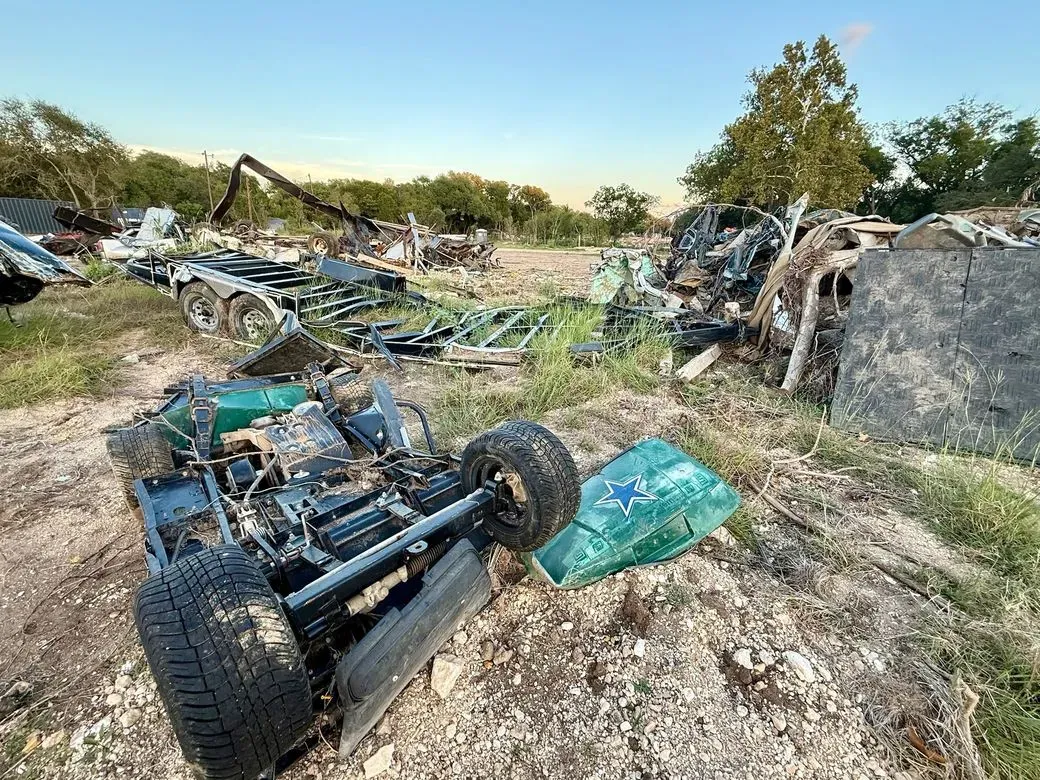
Sandy Creek Flood Recovery (Travis County/Leander, Texas)
Following catastrophic flooding in July 2025 affecting 1300+ homes, Gifted Dreamers is deploying comprehensive disaster recovery infrastructure in the Sandy Creek area of unincorporated Travis County.
Project Overview:
Scale: 400 permanently resilient homes (3-year timeline)
Approach: Owner-driven reconstruction using proven Build Change methodology
Technology: Compressed earth block construction (validated in post-disaster Haiti, Kenya, India)
Infrastructure: Fab lab, emergency mesh network, resilience hub
Governance: Multi-stakeholder model (40% community residents, 30% technical experts, 20% partner organizations, 10% funders)
Innovation Through Integration: Sandy Creek demonstrates how proven disaster recovery approaches—owner-driven reconstruction, appropriate technology manufacturing, and community governance—can be integrated

Physical Infrastructure
Emergency Communication & Power Networks: Meshtastic, Starlink & other systems providing backup or off-grid connectivity
Local Fabrication Infrastructure: Manufacturing capacity for disaster-resilient construction and community economic development, including:
Compressed earth block production (technology validated in Haiti, Kenya, India post-disaster implementations)
Digital fabrication tools (CNC equipment, 3D printing)
Construction equipment for owner-driven reconstruct
Construction equipment for owner-driven reconstruction
Equipment designs sourced from multiple open-source providers including Open Source Ecology, CRATerre, and Auroville Earth Institute
Energy Resilience: Solar microgrids and battery storage systems
Community Collaboration: Resilience hubs operating in three modes (Normal, Disruption, Recovery, Digital Infrastructure)

Digital Infrastructure
This enterprise-grade infrastructure stack (valued at $130,000+ annually through nonprofit programs) enables us to provide Fortune 500-level coordination capacity to disaster-affected communities at no cost to residents. Every platform is selected for proven effectiveness in crisis response and long-term sustaina
ESRI ArcGIS Online (authoritative mapping, damage assessment, site analysis)
Salesforce Power of Us (community coordination, resource matching, case management)
Google for Nonprofits ($10K/month Ad Grants, Earth Engine, Earth Studio, Cloud, Console, Gemini, Maps API)
Microsoft for Nonprofits
Atlassian, Jira, Confluence, Loom
Developer tech stacks: Claude Code, OpenAI, Copilot, Gemini AI, Github, Gitlab, Auth0, Figma, Supabase, Pipedream, New Relic, Webflow
Adobe Creative Suite & Canva Pro
Notion & Monday.com
Zoom,
Slack,
Miro & Kumu,
Airtable
QuickBooks Online
Nord, TrendMicro, Proton, 1Password
Blockchain, Web3, Matrix & Onion sites with VPS
Economic Infrastructure: From Aid Dependency to Self-Sufficiency
From Aid Dependency to Self-Sufficiency
Disaster recovery traditionally creates aid dependency. We build economic infrastructure that enables communities to generate sustainable revenue:
Local Manufacturing Revenue
Custom fabrication services for regional customers
Compressed earth block production for sale
Equipment rental to community members and builders
Construction services beyond initial reconstruction
Workforce Development
Certified training programs (construction trades, fabrication, disaster case management)
Apprenticeship pathways with local employment
Contracts with workforce development agencies
Shared Resource Systems
Time banking for service exchange (reducing cash dependency)
Tool libraries generating modest rental revenue
Equipment cooperatives owned by community members
Consulting
Model replication support for other communities
Technical assistance contracts
Training delivery for disaster recovery organizations

Social Infrastructure: Building Community Capacity
Beyond physical and digital systems, lasting resilience requires social infrastructure—the relationships, protocols, and capacities that enable collective action:
Democratic Governance & Decision-Making
Multi-stakeholder board with community majority (40% residents)
Transparent budget dashboards and quarterly community assemblies
Digital voting platforms for major decisions
Conflict resolution protocols and community mediation
Skills Development & Knowledge Transfer
Construction trades certification (OSE machine operation, CEB building, disaster-resistant techniques)
Disaster case management training (FEMA-aligned)
Community organizing and facilitation workshops
Peer learning platforms and mentorship programs
Inter-Organizational Coordination
Shared data systems connecting recovery partners
Collaborative planning protocols
Joint funding applications and resource sharing
Policy advocacy coordination
Community Organizing & Social Technology
Asset-based community development approaches
Time banking and mutual aid coordination
Resources
Together, we build resilient neighborhoods through shared dreams and action.
Seven Core Principles
Open Source Everything: All designs, documentation, and knowledge freely shared
Community Ownership: No external control, democratic governance, transparent finances
Economic Self-Sufficiency: Revenue-generating from Year 1, sustainable by Year 3
Replicability: Model designed for adaptation to other disaster-affected communities
Resilience by Design: Every system has redundancy, local control, and repair capacity
Skills Transfer: Training as core mission, not afterthought
Environmental Regeneration: Net-positive ecological impact, circular material flows
Connect, Volunteer & Donate
+1-512-200-2193
501(c)(3) EIN 39-3863796
Find us on your Company Matching Portals:
Benevity
Blackbaud/YourCause
Candid/Guidestar