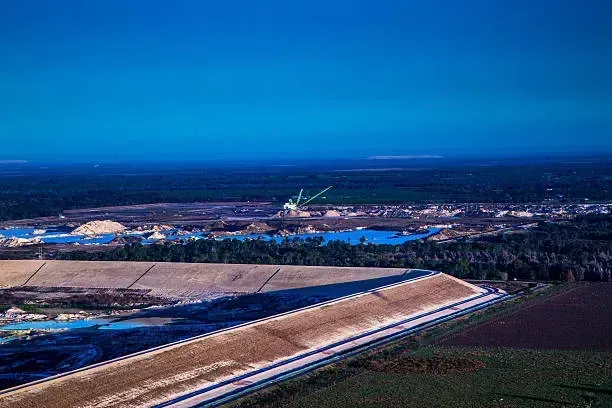
Dry, Radioactive, Unrecognizable: A Phosphate Polemic
Visible from space, a trail of brightly colored man-made water-bodies stretches the spine of Florida's central highland ridge. Here the Pine Flat-woods, Dry Prairies and High Pine have been stripped. Here the Floridan Aquifer, one of the most important freshwater systems in the United States and the foundation of Florida's spring ecosystems, has begun to run dry. Where the first magnitude springs still rocket water from Oligocene limestone below, the crystal clarity of that output has begun to give way to green. Where the water once rose from lesser wells and springs it has grown stagnant and eutrophic. In 2026, one of the most severe droughts in the state's history has shuttered these historic destinations as their wellsprings have run dry. Yet the mines that have made it so remain wet with radioactive wastewater and leachate, the by product of a less known but most consequential industry that has reshaped Florida, alongside industrial agriculture, water-management projects and, and the felling of the great Heart-Pine woods, these mines represent an insidious attack against our very existence in this misunderstood land. Unlike these other industries, whose consequences became visible as the pines fell and the Everglades dried, the true consequences of phosphate mining are only beginning to emerge. The proposed phosphate mine in Bradford and Union counties represents a direct threat to projects of conservation along the Santa Fe River and to the health of the Florida Aquifer itself, but this is hardly a surprising development in the history of land-use in North-Central Florida. Proposed on heritage ranch-land by its owner Mr. Jack Hazen, in the name of several jobs a family tradition of land transformation is being followed up on. Men like Mr. Hazen are of a long line of Florida expropriators who destroy the land they love. Heritage Cracker families that now possess large tracks of desirable riparian ranch-land represent the few survivors of more than a century of drastic transformation. Settlers that once called themselves cowmen for the pride they felt in rustling wild cattle out of the bush and for working under no boss but themselves, disappeared when the fences and the railroads went up, well before the land began to be stripped and drained wholesale. Those that retained their vast acreages in what is now the impoverished Florida interior almost as a family tradition, adapted their independent livelihoods to suit the needs of growing monopolies. Whether it was to sell portions of their land to Plant or Flagler for the railroads, to sell their pine-land to the Putnam Lumber Company, or to allow the mining of mineral phosphate, these practices, deprive generations of the natural wonders found in the very place to which those families owe their way of life. They ceased to drive their cattle free to Punta Rassa long ago, selling instead to monopolizers such as the Summerlins, the Florida Cowmen gave way to either cowboys and ranch-hands (the stewards of other men's property) or to sedentary agriculturalists, raising their stock for the great profits of wealthier men. Almost as a family tradition they hang tight to the right that allowed them to persist, the right to be not stewards of the land that raised them put the managers of its continued exploitation. There are profound social and ecological consequences in this ethic, to the extend that: the very exploitative entitlement which drove the Carolina Parakeets to extinction and Ivory Billed Woodpeckers into disputed existence, may soon drive us all, alongside Mr. Hazen, from this land that raised him should the most destructive land use, phosphate mining, be allowed to continue. Beginning in Alachua County in the mid to late 1800s mineral phosphate was discovered and its extirpation from Florida sands began shaping the state economy and regional ecosystems as much as cattle or oranges ever did. Among many, there are two primary ecological consequences of phosphate mining, specifically the wastewater it produces. Mines result in, contamination from nutrient pollution and radioactive phosphogypsum, as well as the alteration of Florida's hydrological systems through mining waste storage. Phosphate is an essential fertilizer in modern non-organic agriculture, its extirpation has been an essential ingredient in the Second Agricultural and Green Revolutions. It thus directly contributes to non point source pollution from sources across the United States. It affects the Gulf of Mexico and all American watersheds more broadly on its way to sea. In the process of reaching the pay-dirt, miners remove of up to twenty feet of topsoil to reach the phosphate bed. Lax reclamation laws in the state, allow these companies to remove as well, up to fifty feet of topsoil for the clay and radioactive water containment ponds which drastically reshape local ecosystems and are more or less left exposed. In its mining, radioactive minerals concentrated in phosphate deposits, such as uranium-series radionuclides are exposed dangerously close to the surface or in stacks of the phosphogypsum byproduct. The irradiated wastewater is pumped into containment pools which, because of the disturbed soil horizon, are dangerously susceptible to sinkhole formation wherein the totality of that radioactive leachate is dumped headlong into the state's hydrological engine (the Florida Aquifer) which feeds rivers and springs as well as provides drinking water for millions. In this way, and especially on account of Florida legislation that leaves reclamation of phosphate strip-mines largely up to the discretion of private companies such as Mosaic (America's largest phosphate producer), vast swathes of Florida's landscapes are permanently transformed into radioactive anthromes before the phosphate wastewater ever has the chance to enter the aquifer. I've long known of the phosphate mines but only began to understand their true impact the year I noticed the glass clear water of my favorite spring begin to grow tinted in a green hue. It was on my eleventh birthday that I asked the rangers at Blue Spring State Park why what was once clear and blue was becoming opaque and green. I learned something that carried into every encounter I've had with my home state since: the extractative processes upon much of the modern world depends are inexorably tied to natural systems seemingly as far removed from these industrial processes as I was from the ground beef I peered at while pushing my mother's shopping cart. In fact the distance was no distance at all, they, as much as I was to that beef, were tied in immediacy to one another and to an entire history of human development that had transformed my home long before I was born. Tying us all to that process of transformation which will, likely despite our best efforts, continue its impact upon the natural world long after we all are gone. When I was informed that heritage Floridians such as Mr. Hazen, rationalize this negligent transformation on account of jobs and spreadsheet economic growth, I was so outraged I took to typing. Union and Bradford county are upstream from Alachua county along the Santa Fe River. The riparian of the Santa Fe River not only feeds Florida Spring County but is among some of the most well preserved riparian land in the state on account of the Alachua County Conservation Trust. Even if the processing of phosphate will occur off site, as Mr. Hazen claims, the mere process of strip mining along the river will send contaminated wastewater down into the lands which I hike and cherish in every moment I can. Should the mine come, the memory of Marjorie Harris Carr will loom heavily in my mind as I wait in dread for the alligators, turtles, and birds that I watch along those trails to wash, belly-up dead, in the lands she once fought to save from development. Men like Hazen claim America gives them the absolute right to their land and call objectors as Carr was outsiders. Ownership ought to come with the burden of stewardship. While the legal right to destroy for profit has been entrenched in America's legacy, the outrage that causes those affected to fight to save what remains is just as American a tradition. To fight negligence is without a doubt the more honorable of the two most American traditions.