40|40 Days|Nights Reflection
My mission is to write for the ones who are weary, hopeful, and in the middle of becoming.
I write for the hearts carrying quiet battles, for the souls trying to trust again, and for the ones who need to hear God in the places where life feels loud or lonely.
My mission is to offer devotionals that steady the spirit—words shaped by Scripture, lived experience, and the turning point where God met me in my own unraveling.
Reflection
40 Days 40 Nights Reflection
I write to remind others that they are not alone, that each one matters, and that God is still speaking in the middle of the mess and the miracle.
I believe in truth that comforts, honesty that heals, and hope that refuses to quit.
If my words find you on a hard day, I pray they steady you.
If they find you on a good day, I pray they lift you higher.
And if they find you somewhere in between, I pray they remind you that God is near, and so is His grace.
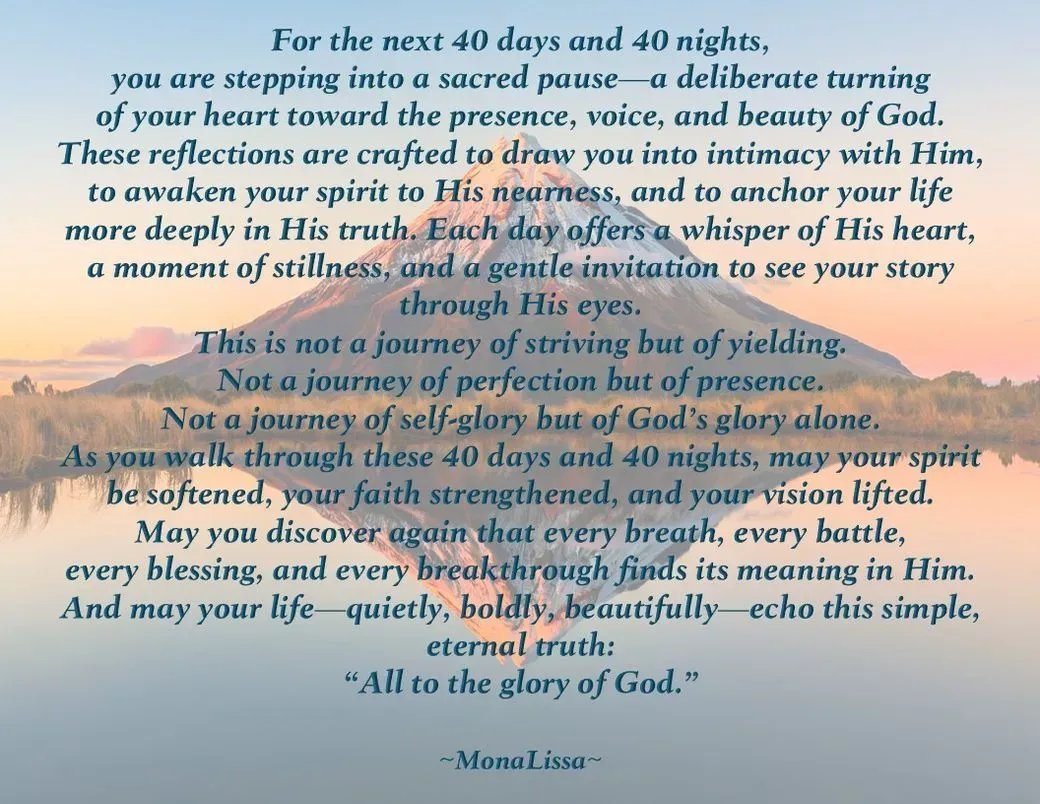
40|40 Days|Nights Reflection
This is the heartbeat behind every devotional I write.
This is the work God entrusted to me.
This is the vision I carry forward—one reader,
one whisper, one heart at a time.
Google Play Books
Each reflection blends Scripture, personal testimony, and practical encouragement, aiming to steady the reader’s spirit and remind them of God’s presence in everyday life.
Readers can approach my devotional reflection book as:
*A daily devotional (one reflection per day over 40 days/nights)
*A seasonal spiritual journey for personal or group study
*A source of encouragement during trials, transitions, or seasons of renewal

Zytaris Artist
Music has the power to transport us to another time and place. Zytaris loves to harness that power with a broad audience of fellow music lovers and passionate musicians alike. Ever since a young age, Zytaris has found great joy and satisfaction by being involved in the creative music process.
It’s been said that music is the language of the soul, a concept of Zytaris has taken to heart throughout his career as a professional in the world of music. There are many ways to describe Zytaris: unique, talented and charismatic. Above all, Zytaris is real.
Embrace Your Personal Journey
Gallery

Me ;
Zytaris -
| 1.3.2023 |

The Consumer Services Analysts III Team-
Renada Conley ;
Marri Mitchell ;
Martha "Marty" Cimmino-Lynn ;
Me ;
Lori Barker ;
Thomas Bauer
| 2.24.2026 |

Sharon Harrel ;
Tyler Andrew ;
Me -
| 11.16.2023 |

Tyler Andrew ;
Matthew (Tyler's son) ;
Me ;
Zytaris -
| 1.4.2023 |

Sherry Cole-Rosales ;
Felicia Miller ;
Me ;
Zytaris (behind) -
| 1.3.2023 |

Martha "Marty" Cimmino-Lynn ;
May Kue-Rowan ;
Me ;
Emily Vigil ;
Amanda Weems ;
Thomas Bauer (behind) -
| 12.19.2025 |

Emily (Thomas Sister) ;
Lauren Binghak (Emily Vigil's friend) ;
Thomas Bauer ;
First Lady Casey DeSantis ;
Me ;
Emily Vigil ;
Amanda Weems -
| 12.19.2025 |

Dana (Mia's friend) ;
Me ;
Mia Minguez -
| 12.12.2024 |

Me ;
Mason DeSantis - (Florida Governor's son)
| 12.19.2025 |

Florida Governor Ron Dion DeSantis ;
Me
| 4.7.2023 |

The First Lady Casey DeSantis ;
Madison DeSantis ;
Me -
| 12.12.2024 |

Elliott Lonsdale ;
Jacob Turner ;
Me ;
Christine Rebuck ;
| 12.19.2023 |

Mamie DeSantis ;
Me -
| 12.12.2024 |
1 / 13
Embrace your journey, transform your life.
Start your transformation today!

God’s Self-Sufficiency and Glory
The Christian doctrine of God’s perfections preserves the dynamic of passages like this, which display who he is for our salvation, while tracing those actions back into the eternal life of who he essentially is and has been from eternity. To put it hypothetically, because of how God acts when he creates and redeems us, we know how God would have been even if he had never done these outward actions. So Christians confess that God has absolute self-sufficiency (aseity). Nothing he does is done out of need or greed, as if he could gain or lack anything. This self-sufficiency also determines how we talk about God’s relation to time and space, which do not limit him in any way, nor is he shut out from any part of them. God’s moral perfections are the ones clearest in Scripture and most characteristic of his identity: goodness, love, mercy, holiness, righteousness, and jealousy. All of the divine perfections considered together shine forth a radiance summarized by the word glory.
This same unity of all his perfections is experienced by God himself as blessedness, or perfect happiness. The doxology in 1 Timothy 6:15–16 is a good example of how these perfections are praised together: God is “blessed” and the “only Sovereign,” exalted over all powers (“King of kings and Lord of lords”), the only source and ground of everlasting life (“who alone has immortality”), and inaccessible to creaturely scrutiny (“who dwells in unapproachable light, whom no one has ever seen or can see”). Glory and eternal lordship are ascribed to him.
Our Salvation
Throughout the OT, God indicated in various ways that he himself would be the salvation of his people (“he has become my salvation”; Ex. 15:2). When the Father sent the Son to become incarnate and the Holy Spirit to indwell the redeemed, he fulfilled his promise in a surprising way. “God with us” meant the Father sending the Son and the Spirit, who are more than created agents—they are fully God. The incarnation and Pentecost are not merely the next mighty acts of God in a sequence but are the central events of salvation history that make known the Trinity’s presence among us.
These two persons within the unity of God had not previously been revealed with such clarity and distinctness; in the OT they were glimpsed, hinted at, or adumbrated (literally, “shadowed forth”). But once they appeared as themselves in salvation history, they had to be recognized as having always existed. The fact that they were sent, though being fully equal with the Father, can be traced to the fact that, within the divine life of the living God, the Son and the Spirit stand eternally in a relationship of being from the Father (as opposed to holding a status lower than the Father’s, as the heresy of Arianism taught). These eternal processions of the Son and the Holy Spirit are the basis of their missions into the history of salvation.
The Doctrine of the Trinity
The result of understanding how the Son and the Spirit stand in relation to the Father is the doctrine of the Trinity: the one God eternally exists as three persons—the Father, the Son, and the Holy Spirit. This formula, combining the three persons in this order, was given directly by the Lord Jesus (Matt. 28:19), though the key words normally used to explain the doctrine do not themselves appear in Scripture: person, essence, relation, or even Trinity. What matters, of course, is that the ideas they point to are biblical. As long as that is established, we are free to use the enormously helpful terms we have inherited from ancient Christian usage. The doctrine of the Trinity can be broken down into a handful of truth claims, each of which can be demonstrated from Scripture: there is one God; the Father is God, as are the Son and the Spirit; the Father is not the Son, nor the Son the Spirit, nor the Spirit the Father; and so on.
Adoption and the Trinity
The most important immediate implication of God’s existence as Father, Son, and Holy Spirit lies in the understanding of salvation. Christian salvation is adoption into the family of God, an event in which the eternally begotten Son of God brings those whom he is not ashamed to call brothers, through union with him, into his filial relationship with the Father. This happens through the atonement in Christ and the indwelling Spirit of adoption in the redeemed. It is no surprise that salvation becomes clearer and deeper when understood in light of the Trinity.
Remember that God did not clearly reveal his triunity in advance of sending the Son or the Holy Spirit; the revelation of the Son and Spirit was directly tied to the event of their coming in person to accomplish and apply salvation. The revelation of this interpersonal depth in God, in other words, was bundled with redemption. The doctrine of the Trinity is thus the result of a thorough understanding of the nature of the gospel, drawing out the implications of what the gospel is and what it entails about the God who is its source.

Salvation Is Spiritual Rescue
First, forms of to save most often refer to our spiritual rescue from well-deserved damnation. Jesus used the language of salvation in this way (Luke 7:49–50; 8:12), as did Paul. Perhaps the most well-known text using the terminology in a redemptive or soteriological sense is the apostle’s declaration in Ephesians that “by grace” we “have been saved through faith” and not because of “works” (Eph. 2:8–9; cf. Rom. 5:9–10; 1 Cor. 1:18, 21; Titus 3:4–5). Paul also makes it clear that although we are saved apart from works, we are not saved without them. That is to say, whereas human moral effort is by no means the foundation or meritorious cause of salvation, grace-empowered works are the fruit and consequence of it. “We are his workmanship,” says Paul, “created in Christ Jesus for good works, which God prepared beforehand, that we should walk in them” (Eph. 2:10). Indeed, the “grace of God has appeared, bringing salvation for all people” (Titus 2:11). But this “salvation” is not without any regard to works, for it is designed to train us to “renounce ungodliness and worldly passions, and to live self-controlled, upright, and godly lives in the present age” (Titus 2:12).
A more expansive examination of this doctrine of salvation reveals that several interrelated truths are entailed, each of which serves in its own way to magnify the mercy shown to sinful men and women.
Regeneration, more popularly known as the new birth or being born again, is the sovereign work of the Holy Spirit in which new life is imparted to those who were “dead” in their “trespasses and sins” (Eph. 2:1, 5; cf. John 3:1–8). This inner renewal is wrought through the preaching of the gospel (James 1:18; 1 Pet. 1:23–25) and issues in repentance from sin and saving faith in Christ.
The NT refers to this work of the Spirit in terms of the divine call of God by which the elect are effectually drawn to Christ (John 6:44; Acts 2:39; Rom. 8:30; 1 Cor. 1:9). Whereas all humankind is externally invited to embrace the saving benefits of Christ’s life, death, and resurrection (Matt. 11:28–30; 22:14), only the elect of God are the undeserved recipients of the internal call by which they are brought to spiritual life and enabled to see the glory of God as revealed in the face of Jesus Christ (2 Cor. 4:6). Awakened to the reality of their sin, the elect repent of it and embrace by faith the offer of full and final forgiveness of sins secured for them through the atoning death of Christ on the cross (Eph. 1:7). At the moment of their conversion, God imputes the righteousness of Christ to them and declares them forgiven and forever justified in his sight (Rom. 3:21–25; 2 Cor. 5:21). Salvation, therefore, becomes an experiential reality for the elect through faith in the alien righteousness of Christ, a faith God graciously supplies (Eph. 2:8–9).
Those whom God thus effectually calls to faith in Christ are blessed with adoption as the spiritual sons and daughters of their heavenly Father (John 1:11–13; 1 John 3:1–3). In redeeming for himself a people, God sanctifies them both definitively, in setting them apart and consecrating them unto himself as his unique possession and eternal inheritance (1 Cor. 6:11), and experientially, by inaugurating through the Spirit a process by which they are progressively conformed to the image of Jesus himself (Rom. 8:29; Phil. 2:12–13; Heb. 10:14). Assurance is repeatedly given in Scripture that those whom God in this way chose, called, regenerated, justified, and is sanctifying will in fact be preserved indefectibly for the consummation of salvation in the glorification of their bodies (Phil. 1:6; 3:20–21; 1 Pet. 1:5).
Such is the breathtaking complexity of God’s saving work in and through Jesus Christ. But the NT language of salvation does not end with our reconciliation to God. There are two additional senses in which one may be saved.
Salvation Is Rescue from Peril
A person may also be saved from perilous circumstances, be it political oppression and tyranny, famine, plague, or the many and varied threats posed by natural catastrophes. The disciples cried out to Jesus in the midst of a life-threatening storm on the Sea of Galilee: “Save us, Lord; we are perishing” (Matt. 8:25). In Philippians 1:19, Paul took comfort that the Philippians were praying for him while he sat in prison: “I know that through your prayers and the help of the Spirit of Jesus Christ this will turn out for my deliverance” (that is to say, his release from incarceration and the ever-present threat of execution).
Salvation Is Healing
Finally, a third way the words to save and salvation are used is with reference to healing of the body. This concept of salvation is found frequently in the gospel narratives in conjunction with the ministry of Jesus to the diseased and demonized. The woman with the discharge of blood was “made well” (lit., “saved”; Matt. 9:21–22) when she reached out in faith and touched the hem of Christ’s garment (cf. Luke 17:19).