Mobility vs. Flexibility – Why Taekwondo Athletes Need Both
Many Taekwondo athletes use the terms flexibility and mobility as if they meant the same thing.
In reality, they describe two very different abilities – and confusing them can seriously limit your performance.
Because one thing is clear:
Just because your leg goes high, doesn’t mean your kick is good.
A lot of athletes are very flexible. They can do splits, lift their leg to head height, and look impressive in static positions.
But once they start kicking, the movement often lacks control, stability, and power.
The kick looks weak, unstable, or “empty”.
That’s where the difference between flexibility and mobility becomes crucial.
What Is Flexibility?
Flexibility describes your passive range of motion.
It refers to how far a joint or muscle can move when an external force helps you.
Typical examples:
Flexibility shows you what range of motion is possible when your muscles are relaxed.
However, it does not tell you whether you can control that position actively.
What Is Mobility?
Mobility is your active control within that range of motion.
It means being able to move into a position and stabilize it using your own muscular strength.
In Taekwondo, this could be:
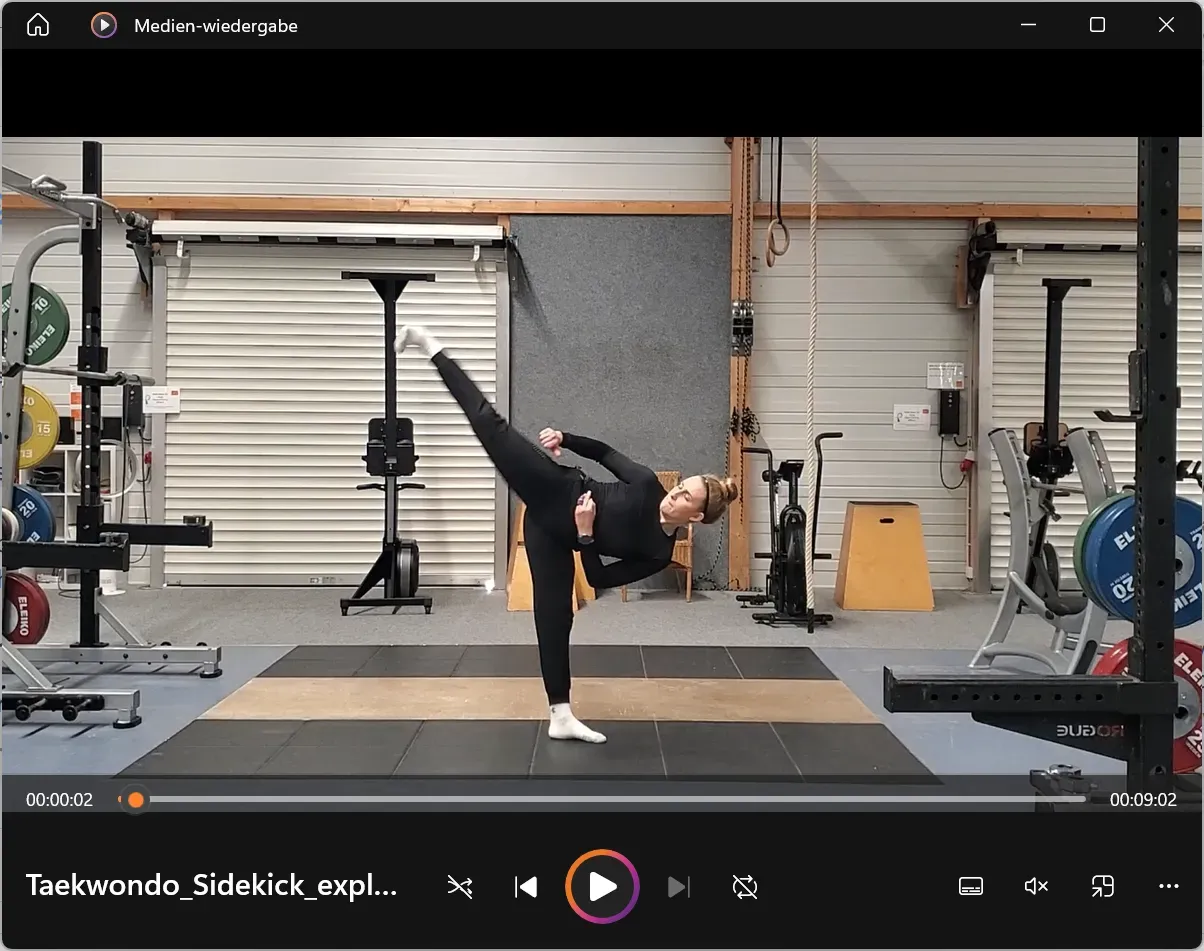
Holding a kick at head height without shaking
Controlling your leg in the end position of a kick
Adjusting or repositioning your leg while it’s fully extended
The real goal is not just a big range of motion, but full control throughout the entire range – especially in end positions.
The Problem With Training Only Flexibility
Flexibility alone creates passive mobility.
Your joints can move far, but they are not protected by active muscular control.
This leads to several problems:
Joint instability
Lack of strength in extreme positions
Poor control during fast kicks, landings, or direction changes
Increased risk of injury, especially under speed and rotation
That’s why many Taekwondo athletes can do the splits,
but struggle to control head-level kicks or stop and adjust their leg once it’s extended.
There is very little transfer from pure flexibility to real, sport-specific performance.
Why Mobility Changes Everything
Mobility training builds active range of motion.
It teaches your body to be strong, stable, and coordinated in every joint angle.
Key benefits of mobility training:
More control and strength in end positions
Better kicking technique and stability
Improved core activation and muscular synergy
Safer handling of rotational forces in hips, knees, and ankles
Better control when stopping or changing movements
Mobility exercises don’t always have to look like Taekwondo techniques.
As long as they train the right muscles and movement patterns, they will directly improve your kicks.
Joint Protection and Proprioception
Another major advantage of mobility training is joint protection.
When muscles actively stabilize a joint, the load is no longer placed on passive structures like ligaments or joint capsules.
This is especially important in Taekwondo, where fast rotations and explosive movements are constant.
Mobility also improves proprioception – your body’s awareness of joint position.
Your brain learns exactly where your joints are in space, allowing faster reactions, better anticipation, and safer movement adjustments.
In simple terms:
Mobility improves both performance and injury prevention.
Flexibility vs. Mobility in Practice
You can think of it like this:
The most effective approach is to combine both:
Use flexibility training to increase range of motion
Use mobility exercises to strengthen and control those same positions
This way, you don’t just gain range – you own it.
Final Thoughts
Flexibility shows how high your kicks could be.
Mobility determines whether those kicks are stable, powerful, and usable.
Without mobility, flexibility is just potential.
With mobility, that potential turns into real performance.
If you want higher kicks, better control, and fewer injuries,
don’t just stretch more – train mobility with purpose.