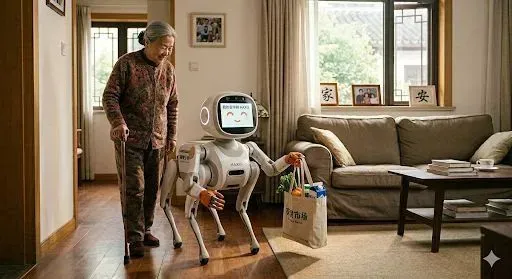
Haxo: A Six-Limbed Centaur Systems in Geriatric Home Care
The global demographic landscape is currently undergoing a transformative shift characterized by a rapidly aging population, a phenomenon that has exposed a critical "care-gap" in existing healthcare infrastructures. This disparity between the escalating demand for elderly assistance and the diminishing availability of professional and familial caregivers has catalyzed the development of advanced robotic solutions designed to promote "aging-in-place". Among the most promising technological interventions is the Haxo configuration—a sophisticated six-limbed robotic platform arranged in a centaur morphology. Deriving its name from the Greek root hexa (six), Haxo utilizes a high-stability quadrupedal base augmented with a bimanual dual-arm torso to support seniors in the multifaceted affairs of daily life.
The Care-Gap and the Evolution of Assistive Robotics
The traditional model of elderly care, which relies heavily on human labor, is increasingly unsustainable. In the United States, particularly in high-density senior regions like Florida, technological mediation has moved from a speculative interest to an operational necessity. Research indicates that over 6 million Americans are currently living with Alzheimer's disease, placing an unprecedented burden on caregivers.
Robotic interventions have evolved from passive emotional support pets, such as the Joy for All animals distributed by the Florida Department of Elder Affairs, to contemporary "embodied intelligence" platforms. While earlier robotic pets were successful in reducing loneliness, they lacked the physical complexity required to assist with Activities of Daily Living (ADLs). The Haxo configuration represents the next evolutionary step, integrating 4-legged stability with 2-arm functionality to address the physical, cognitive, and emotional needs of seniors living alone.
Parameter Haxo Performance Benchmarks Senior Care Implication Max Running Speed$\approx 3.7 - 5.0 \, \text{m/s}$Enables rapid response to household emergencies.
Peak Joint Torque$\approx 45 - 180 \, \text{N.m}$Supports the weight of dual manipulators and lifted items.
Payload Capacity$\approx 10 - 15 \, \text{kg}$Allows for carrying groceries, water, or medical kits.
Max Climb Angle$30^\circ - 45^\circ$Ensures access via ramps and floor transitions.
Step Height$\approx 16 - 25 \, \text{cm}$Negotiates household stairs and door sills.
Motor Architecture and Thermal Management
The Haxo configuration typically utilizes twelve high-performance joint motors in its base—three per leg—to achieve high maneuverability while maintaining a total weight of approximately $15 - 33 \, \text{kg}$. These leg joints often incorporate heat pipe coolers to prevent thermal throttling during extended missions. The internal wiring technology of the Haxo platform is critical for safety, ensuring that legs move freely without the risk of snagging cables on a senior's furniture or clothing.
Bimanual Manipulation: The Six-Limb Advantage
The most distinctive feature of the Haxo configuration is its six limbs: four legs for locomotion and two arms for grasping. This centaur shape allows the robot to perform complex, bimanual tasks that a single-arm robot cannot.
Biomechanical Rationale for Dual Arms
Many household tasks, such as unscrewing a medication cap, folding laundry, or holding a tray, are inherently bimanual. Haxo addresses these needs by mounting two multi-axis manipulators (such as 6-DoF servo arms) onto its torso.
When both arms are utilized, Haxo employs "whole-body control" (WBC) to manage its center of mass. As the arms extend to grasp a heavy object, the four legs adjust their posture to counteract the tipping moment, allowing Haxo to handle awkward payloads that would tip over a humanoid or a static robot.
Tactile Perception and Gentle Grasping
For senior care, Haxo's "hands" are designed with tactile perception to enable "gentle picking." High-resolution array tactile sensors allow the robot to grasp fragile items, such as a thin glass or a pill, without crushing them. Integrated temperature sensors in the fingertips can also alert the robot if a senior is attempting to touch a dangerously hot surface, adding a layer of preventative safety.
Sensory Perception and Cognitive Architecture
To navigate a home and assist its owner, Haxo requires exhaustive environmental awareness, typically achieved through a "360° hemispherical recognition" suite.
Perception and Mapping
The primary navigation sensor is often 4D LiDAR, providing a $360^\circ \times 96^\circ$ field of view with minimal blind spots. This allows Haxo to detect table edges and cabinet handles while simultaneously avoiding floor-level obstacles like a senior's feet. Through Simultaneous Localization and Mapping (SLAM), Haxo constructs "semantic maps" of the home, understanding the difference between the "Kitchen," "Bedroom," and the user's "Favorite Chair."
AI Interaction and the "Empathic HAX" Framework
Haxo's cognitive layer is increasingly powered by Large Language Models (LLMs) like GPT-4o, transforming it into a "proactive caregiver." This aligns with the "Empathic HAX (Human-Agent Interaction) Canvas," a research framework designed to optimize the emotional bond between seniors and AI assistants. Instead of rigid commands, the senior can speak naturally: "Haxo, could you find my reading glasses?". The robot can then reason through the environment, recall where the glasses were last seen, and retrieve them.
Clinical and Assistive Roles for Seniors
Haxo's role in the home spans emotional companionship, physical assistance, and health monitoring.
Emotional Companionship
Loneliness is a significant health risk for isolated seniors. Haxo mitigates this by providing "lively dialogue" and a responsive personality. Research shows that realistic robotic animals significantly outperform plush toys in reducing loneliness, anxiety, and depression in dementia patients.
Support for Activities of Daily Living (ADLs)
Haxo's dual arms are indispensable for:
Item Retrieval: Picking up dropped objects to prevent seniors from bending over, a common trigger for falls.
Environmental Interaction: Opening doors, pushing buttons, or adjusting curtains.
Light Chores: Tidying up and delivering items between rooms.
Health Monitoring and Emergency Response
Haxo acts as a "24/7 guardian," utilizing LiDAR and depth cameras to detect falls. If a fall is detected, Haxo autonomously navigates to the user, assesses their state, and can initiate an emergency call to family or medical responders. Additionally, the robot can proactively deliver medication at scheduled times and wirelessly collect data from Bluetooth-enabled vitals monitors (thermometers, blood pressure cuffs) to transmit to physicians.
Branding and Marketability
The choice of the name Haxo offers several branding advantages in the senior care market:
Linguistic Fluency: Research in consumer psychology indicates that names ending in "O" are perceived as more friendly, stable, and easy to recall (the fluency effect).
Professional Alignment: The name resonates with the HAX hardware accelerator—a world leader in robotics innovation—and the HAX (Human-Agent Interaction) framework used in clinical research.
Neutral Connotations: Unlike "Hex" or "Haxa" (which can translate to "witch" in several European languages), Haxo is perceived as a specialized piece of medical or assistive hardware.
Future Outlook
Future iterations of the Haxo platform may incorporate wheeled-legged hybrid designs for increased energy efficiency on flat floors, and "sensitive skin" technology to allow the robot to detect touch across its entire body, further enhancing its role as a domestic companion.
Conclusions
The Haxo configuration—a six-limbed centaur robot with 4 legs and 2 arms—represents a pinnacle of bionic robotics in home care. By synthesizing high-stability locomotion with bimanual dexterity and proactive AI, Haxo addresses the physical and emotional gaps in modern geriatric support. As technology continues to converge, the Haxo platform offers a pathway toward dignified aging-in-place for millions of seniors living alone.
Comprehensive Services to Meet Senior Needs
We offer a wide range of services including device setup, software installation, troubleshooting, and ongoing support. Additionally, we provide guidance on selecting the right technology that fits individual lifestyles and needs, whether it’s smartphones, tablets, safety devices, or communication tools. Our goal is to enhance seniors' independence, connectivity, and safety through technology.
Why Wonder Lab For Seniors Stands Out
What makes Wonder Lab For Seniors unique is our compassionate approach and commitment to bridging the digital divide for older adults. We prioritize patience, clear communication, and customized solutions that respect each client's pace and preferences. Our local Orlando presence allows us to provide in-person assistance, fostering a supportive community where seniors can thrive in today’s digital age.