Voices & Visions

Explore captivating stories, News updates, insightful podcasts, and digital showcases from Ha O Batla Media Network, where local culture meets innovative broadcasting.

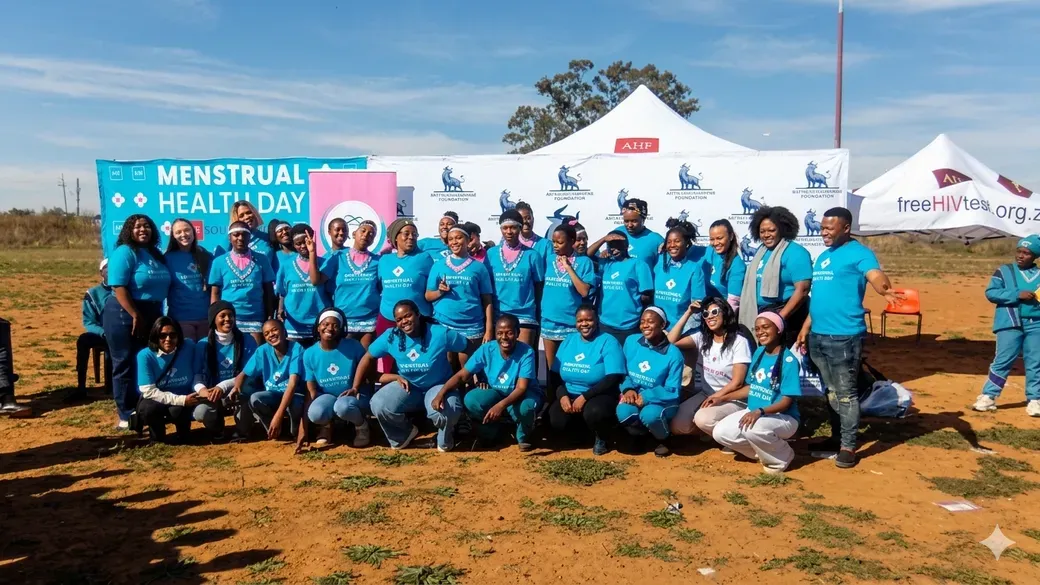
AHF South Africa Menstrual Health Day Event – Gauteng

On 28 May 2026 , Kgoro Ya Thuto Secondary School in Heidelberg, Gauteng, became the vibrant stage for AHF South Africa’s Menstrual Health Day commemorative event . The gathering formed part of the global Menstrual Health Day campaign, shining a spotlight on the urgent need to reduce stigma around menstruation and improve access to safe facilities and affordable menstrual products for young people across the country. The activation was delivered under AHF’s Youth Protection Programme and Girls Act initiative , in collaboration with the Department of Basic Education, lil lets period pads and the Baithudi Mampane Foundation . Together, these partners emphasized the importance of empowering learners with knowledge and fostering supportive environments in schools. Highlights of the Programme Learners participated in interactive sessions designed to break down barriers and encourage open dialogue and giveaways: Menstrual hygiene education : Practical lessons on health and hygiene practices. Debunking myths : Addressing misconceptions that perpetuate stigma. Product demonstrations : Showcasing reusable and affordable menstrual product options. Boys as allies : Promoting inclusivity and support from male learners. A particularly impactful element was the collaborative drafting of an advocacy ask document , where learners voiced their challenges and proposed solutions. These insights will contribute to a report to be presented to Parliament, ensuring that youth perspectives shape national dialogue on menstrual health. The Atmosphere The event was not only informative but also deeply engaging. Learners expressed enthusiasm in breaking the silence around menstruation, while educators and facilitators encouraged a culture of openness and respect. The energy in Heidelberg reflected a growing movement across South Africa to normalize conversations about menstrual health and dismantle harmful taboos.

Read More


Slovenian climbing star becomes the second woman ever to climb Bibliographie's 9b+ graded route.

Two-time Olympic champion Janja Garnbret became the first woman to complete the Bibliographie (9b+) ascent at 2000m in Céüse, France, on Saturday, June 6. The achievement saw her join just five other climbers and become only the second woman to conquer a route of that difficulty, which sits one level below the current highest grade in climbing, 9c. The feat emphasised the need for commitment, persistence, and, above all, patience. Here is all you need to know: - Garnbret broke through on the international circuit with Lead gold at the 2016 World Championships and has gone on to win a further nine world titles in Bouldering, Combined, and Lead, with the Slovenian making history as the first woman climber to win Olympic gold at Tokyo 2020 before adding another gold at Paris 2024. - Before taking on the 9b+ Bibliographie route, her highest graded redpoint route was a 9a in 2017 in Santa Linya, Spain, while she is also the world's first female climber to onsight an 8c (5.14b) sport climbing route (Fish Eye, Spain) in 2021. - The 27-year-old knew going into this huge challenge that she would need to be at the peak of her powers after an impressive winter training block to tackle one of the most historic and iconic limestone venues in sport climbing. - Located in the French region of the Hautes-Alpes, Céüse has long been considered one of the most historic crags, renowned for its high-quality limestone and world-class endurance routes. - Characterised by intricate body positioning, several demanding cruxes high above the ground, and sustained resistance climbing, there is a reason Bibliographie has seen only a handful of ascents until this day. - Only five other people had successfully climbed the 35-metre route before her, which was bolted by American Ethan Pringle in 2009 and first climbed by Germany's Alexander Megos in 2020. - Originally graded 9c by Megos after 60 days of trying, the route was later proposed at 9b+ by Italian Stefano Ghisolfi after the second ascent - a consensus that has since been widely accepted. - Ahead of the ascent, Garnbret revealed: "I'm not doing this to prove anything. I just love climbing, but I want to inspire the next generation not to be afraid of the grade. It doesn't matter if it's a man's or a woman's route - it's a route!" - Garnbret, who has also set a record number of sport climbing World Cup victories in her career, made five trips to the site knowing she needed composure from the opening moves to the final anchor. - She revealed: "I only had good conditions on about five days. Otherwise, it was either very hot and slippery or very cold, and my fingers would go numb. On two of those good-condition days, I reached a new high point, and on the third, I sent it. That’s the game when you climb outside." - On Saturday, temperatures hovered around 15°C - cooler than on previous days. A strong wind swept across the wall throughout the afternoon, keeping both the air and the limestone cold and creating the friction needed for the demanding sequences. - Garnbret started with the easier section graded around 8a+/8b, then a 17-move-long section and the first crux, which she graded around 9a. - After that, she launched into the second 9a crux of about 20 moves, and then she finished off the ascent with a 7b section, reaching the top of the route at approximately 4:30 pm, after a climb lasting around 15 minutes and, in total, more than 80 moves. - She enthused: "Today was just perfect. It was super windy, and the rock was cold and sticky. That’s exactly what I needed for the send. When the send happens, everything feels smooth, everything feels perfect. You almost don’t feel what you’re climbing. In all the previous tries, there was a lot of falling on the crux and the upper crux. Nothing came together, nothing clicked. At the same time, you have doubts, like: ‘Will I ever do it?’ So when it finally happens, it’s an incredible feeling. You remember all the work you’ve put in, all the commitment, all the patience. Today, my heart feels very full.” - Crucially, Garnbret switched up how she approached her successful feat. She said: "I felt really good today. Already during the warm-up, I felt like I was flying. I told myself: ‘It’s cool, it’s whatever, just climb like you normally do in a training go.’ And that’s what I did. But at the same time, I was fully locked in. I wasn’t letting it go, and I wasn’t letting it slip this time. Honestly, I was just enjoying it." - The achievement needed both a strong physical condition as well as a rock-solid mental approach. She revealed: "The challenge was mental, because I’m a very impatient person - I want everything now. So for me, projecting has always been really hard. This route required a lot of commitment: going up, trying all the time, failing, failing again and again, until I finally succeeded. It taught me that, with a calm mind and patience, anything can happen. Never count yourself out." - Asked what her advice would be to young climbers, she replied: "Believe in your dreams, even if they feel out of reach. Dream big, go for it, and never give up. This route lit a fire in me. It made me feel something special, and I kept coming back to it. It definitely helped me become a better athlete and a better climber." - As well as dreaming up other new projects, Garnbret can now turn her attention back to preparation for the next 2028 Olympic Games in Los Angeles, with the upcoming World Cup event in Innsbruck a chance to break the 50-victory barrier

Read More

Taking Parliament to the People Closing Debate Highlights Progress and Persistent Service Delivery Challenges

The National Council of Provinces’ (NCOP) Taking Parliament to the People programme concluded on Friday with a high-level debate led by President Cyril Ramaphosa, as premiers from four provinces reflected on service delivery challenges, governance interventions and infrastructure development in their respective regions. Premiers from the North West, Gauteng, KwaZulu-Natal and Northern Cape used the platform to outline progress made in stabilising municipalities, addressing illegal mining and improving public infrastructure, while acknowledging persistent frustrations among communities. Premiers of North West and Gauteng, Mr Lazarus Mokgosi and Mr Panyaza Lesufi respectively, had previously appealed directly to the President to deploy soldiers to tackle illegal mining, and the intervention has since yielded positive results. Premier Mokgosi also highlighted the impact of recent heavy rains, saying that the floods had caused significant damage to schools, roads and clinics across the province. “The heavy rains that took place in the country and this province had a devastating impact on our people, and we are assessing the damage on the ground. As soon as we know how much is needed, we will come and knock at your door Mr President to request for funds,” he said. Addressing residents of Dr Kenneth Kaunda District and the City of Matlosana Local Municipality, Premier Mokgosi acknowledged widespread dissatisfaction with municipal services, saying that his office has heard their cries, concerns and proposed solutions. Premier Mokgosi added that the provincial government had implemented a Section 139 intervention in the City of Matlosana Local Municipality to improve administration and financial management. The focus of the intervention will be on enhancing revenue collection and to insist on a funded budget, while reducing wasteful expenditure. Premier Lesufi praised President Ramaphosa’s illegal mining intervention, saying the deployment of soldiers had restored stability in affected communities. Soldiers have resolved the problem of illegal mining in Gauteng, and order has been restored, the Premier claimed. Mr Lesufi further credited the President’s intervention in addressing Gauteng’s water challenges, noting that a 26-million-litre water tower in Brixton had recently been opened. The Gauteng premier concluded by wishing the national football team success ahead of upcoming World Cup tournament. KwaZulu-Natal Premier, Mr Thami Ntuli, focused on local government performance and municipal stability ahead of this year’s local government elections. He said that the province has made measurable progress over the past 22 months, with the number of distressed municipalities declining from seven to two. “Stable municipalities have increased to 21. No municipality is under Section 139 intervention in KwaZulu-Natal compared to four a year ago,” he said. Mr Ntuli added that 37 municipalities had achieved between 75% and 100% of their service delivery and budget implementation targets, while audit outcomes had also improved. Northern Cape Premier, Mr Zamani Saul, said that the country is moving “in the right direction” under President Ramaphosa’s leadership and highlighted interventions aimed at stabilising municipalities. “We intervened decisively in our municipalities, based on our 10-point turnaround plan and we implemented section 139 intervention in Sol Plaatjie Municipality to restore governance and rebuild public confidence,” Premier Saul said. He added that the intervention is directed at restoring municipal stability, strengthening government systems, improving infrastructure maintenance and rebuilding public confidence in municipalities. Premier Saul also pointed to improvements in municipal infrastructure spending through the Municipal Infrastructure Grant, saying that in the 2024/25 financial year, municipalities in the province spent 87% of the allocated grant.

Read More