ISME Day 2
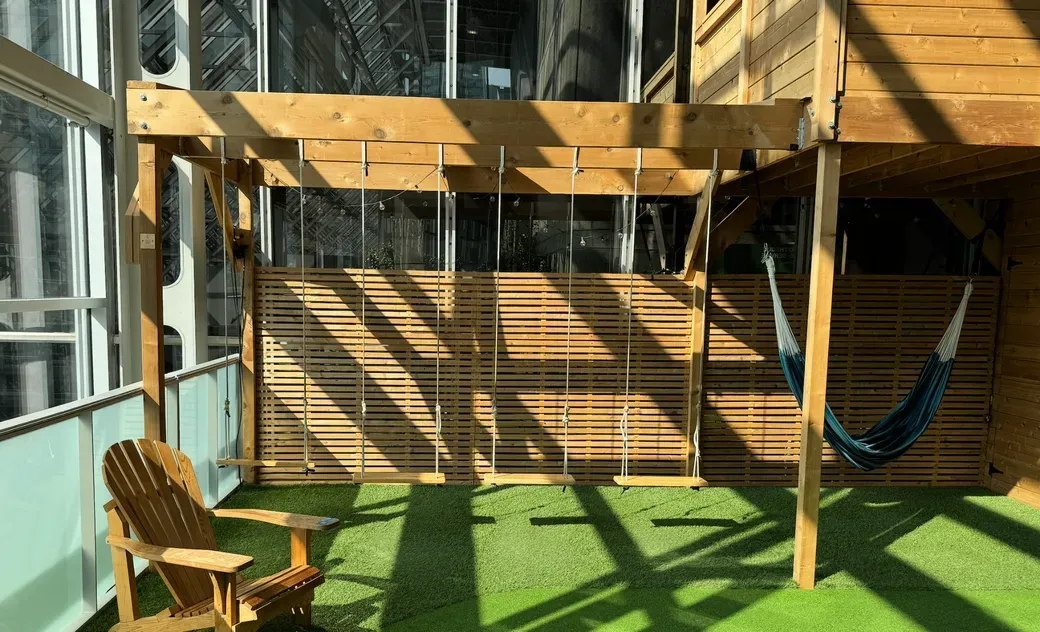
Swings in the quiet zone. What is there not to love about this conference space?!
Warm -Up: Ostinato
Ta Ta (cross arms, stomp foot, roll shoulders forward)
(za) Ke-le (arms up L-R, wiggle hips)
Moblo (za) (wiglle with bent knees)
Fe-leeeee-ro (tap foot in an arc)
Koo koo koo koo (dig)
Keynote: Tenille Townes
Music always makes us feel a little less alone
When you bet on yourself, it's often worth the gamble
Music helps turn on the lights in dark rooms of memory...
Air guitar competitions
Youtube: goes to judgment so quickly
Let feedback come slowly
Use backing tracks on Youtube to set melody and lyrics to
Only need chords 1, 4 and 5
About the creativity of working your thing
Do more
Perform more
Write a million songs from 1 inspiration source
Be brave
Improvisation as Liberatory Praxis in Popular Music Education (book title)
Prescriptive learning outcomes are bad
Improvisation becomes a rebellious act
Some people like rules because it makes them feel like they’ll get more things right
Class starters:
Fist-to-Five for how are you feeling?
How academically prepared do you feel for this day?
Which animal makes you smile?
Etc.
Fun check-in questions…
Don’t underestimate the power and benefit of not going to curriculum and having a karaoke lesson (students sign up)!
Teaching is a creative act (Sawyer, 2004, p.12)
Teaching is conceived of as improvisation
Tom Zlabinger
‘Open Jams’ is a Rock term, ‘Jam Sessions’ is a jazz term
Happiness is better when shared
Look up: Jazz: ‘Come on and let’s get free’
A student quote: ‘You get lifted up by falling’
Freire: ‘Human beings transform [the world] with their labour’
By playing with others, there is much to follow:
1. Togetherness (free, then going back to the chaos of the world),
2. Specialness,
3. Better together, amongst others (when everyone falls together on an agreed first-beat-of-the-bar, how high they shoot up together)
Ed Sarath
Improvisation is not a toy, not a thing
Look up: Oliver Lake (saxophone)
Improvised concert: high risk, high reward
Developed exercises for large band improvisation
MIT reimagining music theory
How are we doing on the change-o-meter? Ornamental change, or systemic change from the ground up
Graduate students can’t even think/suggest what a music degree could look like if wiped clear (starting from a clear slate)
Even as teachers, we are all indoctrinated in this way of teaching
Improvisation can be liberating from liberation itself
Multi-tiered battle needs to be fought
Now it is from farm-to-factory: compartmentalised
David Knapp: Improvised Teaching
Playing just a few chords is stale and detrimental to creativity and their learning
Re-start: student-led
Some students asked for more structure
Focusing only on performance is myopic (Sarath)
The improvisation IS the performance
All improvisation can enhance what is curriculum-focused
Jams at university are part of lunchtime activities, not curricular
No evaluation, no grades
Music education has been promising change forever, but it doesn’t come. We are pragmatic. It always aligns with the institution; we need a revolution
In (Real Book) and Out groups function hierarchically
Look for the edges; the conflicts (between groups) will be sharp. Address these with moments of kindness
Open improv is an important part of the jazz tradition
It is liberatory, getting us beyond the indoctrinated limitations
Creative and Democratic Processes in Band
Tanya Chanphanitpornkit
Who is the music for?
Who gets to decide?
At the end of each year, students do a programming project
They get to choose who is uplifted (give them links to choose from)
In band, if you want to make a musical choice for the band, you need to articulate why
We need to cultivate thinkers
Repertoire is a curriculum about who belongs, rehearsal process is about ideas we value…
Put students in the mentorship chain
Students lead sectionals, and conduct
Give the students a world to build, and they will build it. They will build the one that they want to live in
The students may need help growing into leadership
Laurinda Davidson (Queensland Girls’ School)
Have started programming women composers
Students conduct, plan themes for concerts, compose…
Curiosity, identity, ownership
Repertoire shapes who they think they can become
Tyler Wilkinson
Democratic practice on the podium
Belong—feel safe to contribute
Trust—trust students to think, listen, and solve musical problems
Lead—create independent musicians, not dependent performers
William Tonissen
Immersive rehearsal: moves beyond the written page—shared decisions and reflection (invite students into all three parts)
1. Investigate—explore composition, context, and story behind the music
2. Interpret—dialogue and choice
3. Extend—deepen with composition collaboration, creative connections, and reflection
Read Sean Powell on competition and music
Read Randall Allsup ‘remixing the classroom…’
Learn together through discussion
‘WIN’ Feedback: Andreas Cincera
When the brain switches between different modes of processing, it is exhausting work
Announce ‘feedback’ with non-judgemental follow-up
Feed up, feedback, feedforward
(Hattie) Praise is worse than punishment (effect size)
Reward is also not good
Corrective feedback is not great
Cues are good
Positive reinforcement is good (sets up a positive psychological moment that then is relived as positive)
Self-evaluation is not part of feedback—it’s a different mode, a performance
Generally, students are much more critical than they should be
Need 3 or 4 more reinforcements than negative critical feedback
We learn best outside of stress
Students need orientation, not just autonomy
Don’t give a student feedback from the front (face-to-face), but rather from the side. Otherwise, it feels like an attack
Reinforcement and intrinsic motivation
Feedback about competence (process), not the outcome
Recommendations (attack photo here…)
Talk about what is happening in the class (positive reinforcement) and what’s missing (don’t say what the mistake is—in memory, the brain might not be able to distinguish what was right or wrong)
Announce the focus of the feedback; be descriptive
Don’t make feedback sandwiches!
Asking questions is not feedback (a different brain process). Be careful not to jump between different processes too often, or too quickly
Self-Evaluation: What I did good? What I need to do next? (do not train on the mistake)
Language is important. Do not say ‘I want more sound’. Say ‘the music wants even more sound’. (Using ‘even more’ makes a big difference)
Include details of what should be reinforced
Next, describe prospective further processes
Finally, a meta-reflection
Translating: Releasing the Imagination (Maxine Green)
(MG) How might we teach learners to see the world otherwise?
Randall Allsup
The short era where humans read books is over
What will be the symbol system that replaces books?
The opposite to aesthetic engagement is numbness (MG)
An aesthetic experience is an encounter
Each party is interdependent
Negotiated between a maker and a receiver
MG worried about popular culture numbing us
The opposite of aesthetic is anesthetic
Art has to have grit—that awakens
When it works, a fire catches
In this experience, freedom happens—a rehearsal for democracy
If our students write songs, they need to be heard
Capacity of reading as meaning-making—freedom experienced in these small places: democracy
If we can do this, there is a chance for art
It's a democratic muscle (imagination) and needs to me exercised
Shinko (translator)
Awaken from passivity, break from the norms
Aesthetic experience requires conscious participation—the perceiver makes their own meaning depending on their cultural background
Activity: discover, share, compose, imagine
The children were not waiting for the teacher's prompt.
Through exploring, they are discovering things that they had never noticed before
Uncomfortable sounds are valued in Japanese music
Translation—ideas come alive in a new context. Meaning emerges in relation between people, a work of art, our environment, etc.
Every new experience is a new beginning
Pam Burnard
Passions of pluralism
I am... (what I am) not yet
Celebrating the art of the possible
'We are all under the same sky' (Ruth—artist)
'Unleashing Children's Voices in New Democratic Primary Education' (book from the Cambridge Routledge University Primary School
Future-making
UCPS Podcast Series
Sculpting new creativities
(MG) One must have the idea of leaving something behind, and going towards something new
Trust childing...
Teaching for openings is fraught with risk
Spaces have agency if we let them
MG always wanted us to be in between spaces
Popular culture is lulling us into what is
It's lazy thinking to be dogmatic
This book is not a translation, it's a transformation
MG/Shinko doesn't see binaries.
She is open.
IN chinese: trust the imagination
'Liubai'...leave blank for the imagination to populate