MISTEC Day 2
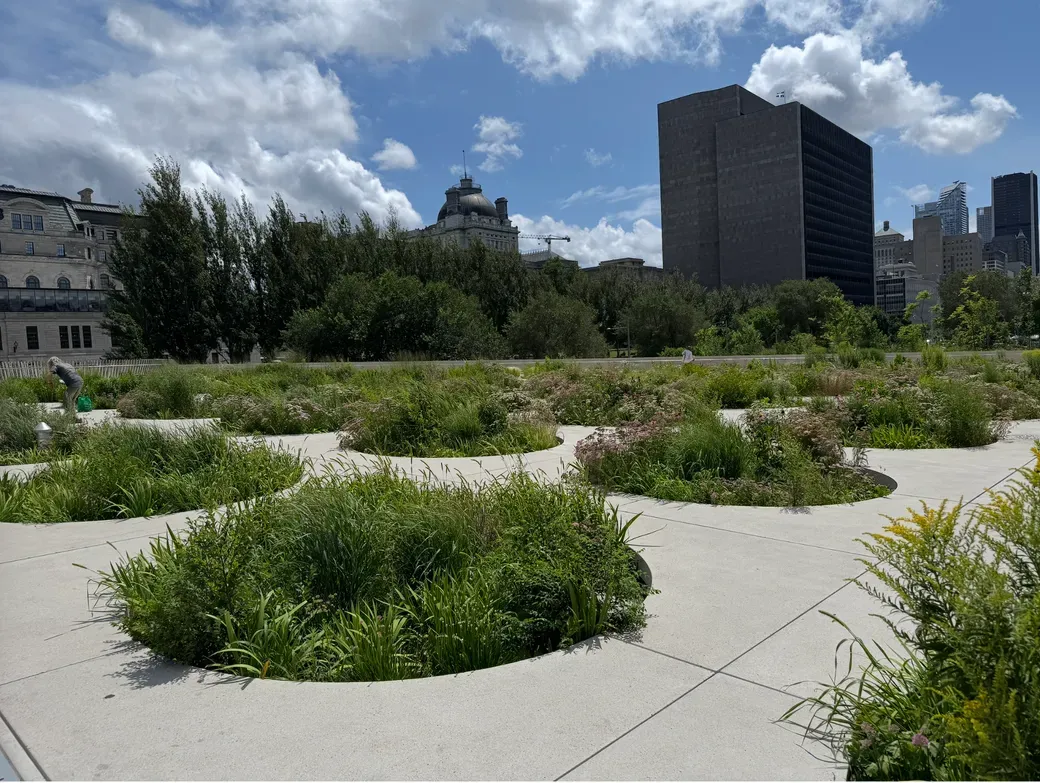
On the way down to Old Montreal... this used to be a car park in my youth!
Smaragda Chrysostomou:
Co-creating understanding (the power of Bohm's Dialogue).
relational practice
not planning towards decisions
participatory thought
It's about where understanding is located—in one mind, or shared between several? Sitting in a circle avoiding hierarchy...
listening
respecting
suspending (holding back assumptions and biases)
voicing (aiming for collective meaning)
Musical understanding emerges through relational dynamics (listed above).
How we research is how we teach.
Valerie Peters:
Music education, well-being and human potential laboratory. Lab—EMBEH.
Akosua Obuo Addo:
COIL in music education—COIL Connect.
Borger's core framework (2022)
Cuthbertson— culturally responsive
More from Tuesday:
mobilising knowledge
different abilities
focused on the people, not the music
Consultation circle for decolonisation of music education
Living Lab Camelia (advanced Alzheimer's) by Elodie https://www.camelia.ulaval.ca/en/team/elodie-chenel
Music Mondays https://coalitioncanada.ca/en/events/musicmonday/faq/
Coalition for Music Education https://coalitioncanada.ca/en/
Youtube channel (advocacy): LINK
Livia:
Music Education in Liquid Modernity
constant change—change is the only certainty
Freire—autonomous because of our dependency and our symbiotic relationships with and in the world.
Liquid music educators see knowledge as fluid
Brian from Butler University, Indiana
Band and disruptive pedagogies
Intentionally disruptive
Sustained experiences
Disruptive coursework
Creativity as a model rather than a performance
It's about responsiveness, community, access (gate keeping/gate opening), and normalisation
Decentering without delegitimising
Publications
Teaching for a FAIL (First Attempt in Learning) in the ensemble classroom: https://journals.sagepub.com/doi/abs/10.1177/00274321211060332
Points of Disruption in the Music Education Curriculum, Volume 2
CCP Trialogue for Music Literacy and Creativity
CCP=context, content, and process
content=the learning environment
context=articulate learning outcomes
process= engage participants in deriving concepts and generating learning activities to meet objectives based on the available resources.
create the environment
allow students to develop in it
literacy—ability/skill to employ (create+decipher)symbols to enhance acquisition of meaning (understanding), communication, and personal development towards problem solving and positive relationships.
What is musical education? It's so that people don't draw a blank when experiencing a musical moment.