MISTEC Day 4
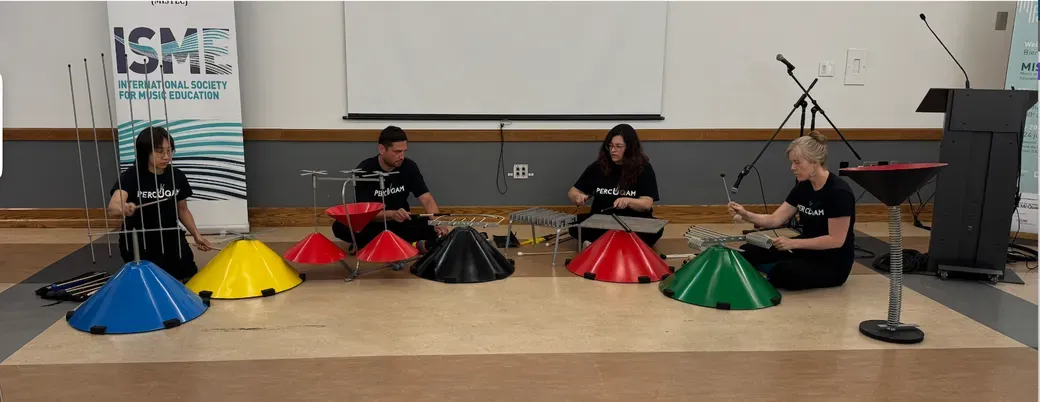
Warm-up with the UQAM percussion team on the Baschet Brothers instruments (instrumentarium). Very very cool! You can hit these things anywhere and everywhere—you can even put them on your head for different reverberation: https://youtu.be/B4YesiVwo8Y?si=pBnRD5zsHOinchKL
Yasumasa Yamaguchi: Reconsidering cultural inclusivity in Ai
Think about Ai in East Asian as digital colonisation.
Ai as data training—who can use it, and what kind of music can it support?
The data Ais are trained on are western-centric musics.
The Western model of music permeates university entrance exams worldwide: piano and voice in traditional Western-based styles.
When music becomes data: notes and rhythm are easy to translate from living sounds to digital
Historical and embodied practice is much harder to digify
Need to ask ourselves what is kept and found in computer data, and what is left behind
Musical training data: 94.3% Western, 5.7% Non-Western
Ai learns from this
Ai has trouble preserving oral, flexible pitch, local tuning, traditional instruments, and cultural meaning
Ai tends to simplify the cultural musics that it tries to replicate
Teachers need to use Ai more carefully to ensure musical diversity, critical literacy, and community collaboration
Posters
Susie (Victoria University): What is the purpose of music education in Australia? Autoethnographic study
Why do we have to learn notation?
Whose music matters?
What music knowledges are we asking our students to leave at the door?
Katie (LaTrobe): What makes a class ready for musicking?
What can be done to prepare students for the class they are about to participate in? This is not wasted time!
Lisa: Feldenkreis practice
Instrumental learning is based on rote repetition, which develops and exacerbates injury. It is based on a computer-based learning model.
Ana (Lisbon): Soundscapes to Sonotopia
Developing sensitive and creative listening:
Sarah (Brussels)
Primary school teachers forced to teach music who say they won't/can't
Methodology of self-confrontation
Rachel, Brad and James: Interrogating 'quality' in music education programs
What does quality mean?
Does it only represent cultural capital?
Robert Walker: Beethoven or Britney: https://search.informit.org/doi/abs/10.3316/INFORMIT.443186202990307
Aesthetic-Hierarchical Model (quality as disciplined musical literacy and cultural cultivation: Western art music)
Structural-Continuity Model (music practice embedded in a history of power)
Critical-Pluralist Model (Music is the birthright of every child. Quality as culturally responsive, context-driven musical learning)
Other words to use instead of quality: significant musical education, or comprehensive musical education
'Quality' means something different to government bodies, policy makers, teachers, principals, parents, and students.
See 'Music Counts' (Canadian site) for language use.
Quebec music resources
Presentation slides:
Site resources: https://smcq.qc.ca/
Select: Youth, Educational platform, create an account, subscribe
Stacks of amazing free resources here!
Including a BandLab activities including listening, interpreting, and creating
Listen, imagine, and describe
Concert Band arrangements with reflection sheets for students
Lots of interactive stuff
Notes:
Several people from different countries said that their pre-service teachers are sent off in pairs for their assignments. That this works very well because they can talk immediately with each other for comfort and feedback.