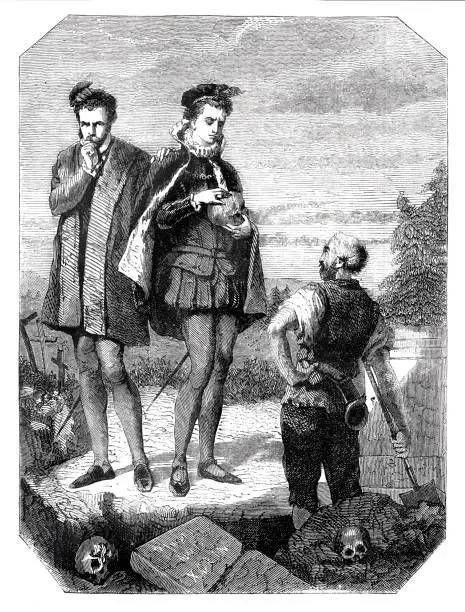
Hamnet and Hamlet
The Shakespeare Circle was a series of essays published in 2015 by Cambridge University Press, edited by Paul Edmondson and Stanley Wells, an Alternative Biography with the Shakespeare-shaped hole in the middle, made of those family, friends and associates in his life. While the boy Hamnet was given a chapter, Hamnet Sadler was not. If only they had asked !
The boy dies in 1596, aged 11, presumed to be a victim of the plague. Traditional biographies have Shakespeare at the graveside, mourning the loss of his only son and the inheritor of his legacy. This grief is extended into the speech in King John,
Grief fills the room up of my absent child,
Lies in his bed, walks up and down with me,
Puts on his pretty looks, repeats his words,
Remembers me of all his gracious parts,
Stuffs out his vacant garments with his form;
But not all scholars date King John from after Hamnet’s death. Neither is the idea that Hamlet and the onset of darker themes in the plays being traceable to the loss of the child any more than circumstantial. In fact, the plays that come immediately after 1596 are some of the lighter, more optimistic of the whole oeuvre, such as The Merry Wives of Windsor, Much Ado about Nothing and As You Like It. Katherine Duncan-Jones questions the idea of there even being a ‘Tragic Period’.
The idea that Shakespeare would have been in Stratford for the funeral is undermined by the need to get the news to him in London, or even finding him further afield on tour, leaving London in time of plague, and him travelling back in time. Not only that, but wondering quite how upset he was at the passing of the twin he knew he hadn’t fathered is further reason to doubt his attendance whereas Hamnet Sadler is much more likely to have been there.
If Hamlet, as is argued by James Shapiro in 1599, a Year in the Life of William Shakespeare, is the big, personal statement, longer, more complex and made with more than just box office in mind, it isn’t necessarily named after the boy. The boy was named after the Stratford acquaintance. The play is based on the story of Amleth, taken from The Revenge of Amleth in The History of the Danes by Saxo Grammaticus, written in the early C13th, in which the hero feigns madness as part of a plot to revenge the murder of his father by his uncle. A now lost revenge tragedy, possibly by Thomas Kyd, was on the London stage in the 1580’s in the period when Shakespeare arrived there.
Shapiro makes the case that Hamlet is something more to Shakespeare than his other work by showing how he,
tinkered obsessively – far more than his reputation for never blotting a line would suggest.
The excessive four-hour length of the full text of the play, the series of ‘doublings’ of plot (two revenges), character (two Hamlets, Rosencrantz and Guildenstern), language (‘book and volume’, ‘fantasy and trick’), the number of neologisms and the inclusion of a treatise on the theatre all make Hamlet more than it needed to be to fill the two and a half hours of an afternoon in the theatre and it is about a son with the wrong father but that is only a part of a much bigger design.
The reason for the darker themes from 1600 onwards can be as easily attributed to the death of his father, John, in 1601 or a new awareness of mortality as Shakespeare arrives in middle age.