The Late Plays, The Will and The Graves
If the proliferation of Hamnets, Hamlet and Amleth aren’t enough, there are a number of wills involved, too- Will Shakespeare, his ambiguous use of the word ‘will’ in the sonnets and elsewhere and his last will and testament.
Like the Sonnets, the marriage and the ‘Lost Years’, the evidence that the will provides sets more questions than it answers.
Shakespeare rewrites the will, apparently keeping pages 2 and 3 but replacing page 1 so that the scribe has to write smaller towards the bottom of the page to accommodate the revised wording, realizing halfway down that he’s running out of space. The provisions of the will begin with the bequest to Judith and the stringent conditions attached to them. Judith has married Thomas Quiney on 10th February, 1616 and the will is revised on 25th March. Quiney is a disreputable vintner, on a charge of fornication among other misdemeanours. The words ‘Sonne-in-law’ are struck out of the will completely and Shakespeare goes to some lengths to ensure that Judith’s interests are protected against any claims of his but it is noticeable that Susannah’s inheritance is more generous, unconditional and, having made a successful marriage to the physician, John Hall, she is more substantially provided for. While this may be circumspect on Shakespeare’s part, one can wonder why Susannah was not only made executor ahead of Anne but also fared so much better and had become the favourite daughter beyond Judith’s ill-advised choice of husband.
It is usually assumed that Anne would have automatically inherited one third of the estate, including the bed she slept in and so the problematic ‘second best bed’ is not necessarily the insult that it looks like to some, but what is already hers. Shakespeare goes to greater lengths to make specific provision for other friends. She is, however, provided for and Hamnet Sadler is a witness. Time might have soothed away much of the difficult feeling caused by their extra-marital business thirty-two years earlier. Shakespeare’s last period in London was marked by a move to an entirely different sort of play in which,
when hardly bothering
To be a dramatist, the Master turned away
From his taut plots and complex characters
To tapestried romances, conjuring
With rainbow names and handfuls of sea-spray
And from then turned out happy Ever-afters.
Louis MacNeice, Autolycus
The theme of ‘late’ plays like The Tempest, The Winter’s Tale and Cymbeline is reconciliation and however much one wants to resist mapping the life onto the work, or vice versa, one can’t help but notice the return to Stratford and making the best of bygones being bygones generating the feeling that an attempt is being made, as far as possible, for all that is well, or can’t by then be helped, to end well. Whether or not Shakespeare was a convivial character, there is a story that his death, which he might have been anticipating already, was brought forward by a drinking session during a social visit from Ben Jonson and in the company of local poet, Michael Drayton. He is, however, characteristically astute in having set his lands in order.
Katherine Duncan-Jones will have none of that, seeing the retirement in Stratford as anything but idyllic. He doesn’t become ill and die because he drinks; he drinks because he’s ill and then dies. She sees him as still angry and only amending the will under sufferance. Neither version of events sits well with Judith being William’s flesh and blood but both would be in line with her not being so.
In 2024, a letter addressed to ‘Good Mrs Shakspaire’ was discovered[1]. It places her living in Trinity Lane, London, and was found in the binding of a book published in 1608. This has been taken as a clue that Anne lived in London in the 1600’s and used to argue that the marriage was not unhappy. That would not contradict Shakespeare being in London without Anne from the early 1580’s until some time in the first decade of the C17th, for about twenty years or more, and would line up most accommodatingly with the reconciliation that prompted the theme of the ‘late plays’ that were written between 1608 and 1611.
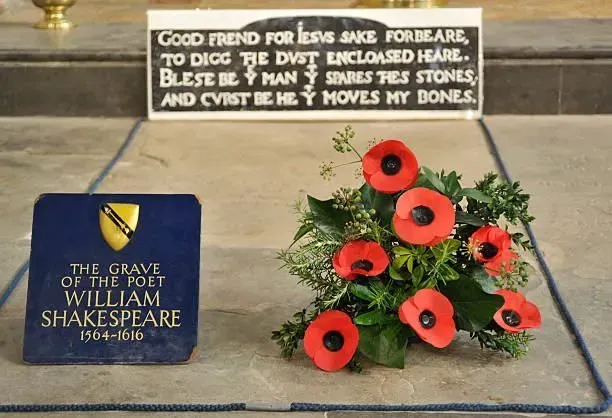
Hamnet is not buried with the family in front of the altar in Holy Trinity Church and can’t be expected to be. He died before the family acquired the right to be buried there, not as the family of the great writer but as an important Stratford family who could afford to be. And if he died too early, perhaps Judith died too late because the five graves fit into the available space beside the previously established plot of a long-serving vicar. On the other hand, there has been found enough space for, in order, left to right, from under the bust of Shakespeare up on the wall,
Anne, died 1623; William, 1616; Thomas Nash, who married Susannah’s daughter, Elizabeth, 1647; John Hall, 1635 and Susannah, 1649.
Judith lived until the age of 77 and died in 1662 by which time there was only room for her outside in the graveyard, as recorded in the parish records, on February 9th [2]. Those that have been given places in the family plot, though, are the closest Shakespeare could get to a line of male succession, not unlike his concern about his status as a ‘gentleman’, the application for a coat of arms and the standing of his family. One can’t help feeling that Judith might have been found a more auspicious resting place had it been thought priority enough. The will and the graves suggest a set of preferences in family relations while Shakespeare does as much as he respectably ought to for those less favoured.
[1] Matthew Steggle, The Shakspaires of Trinity Lane: A Possible Shakespeare Life-Record, https://www.tandfonline.com/doi/full/10.1080/17450918.2025.2481116#abstract accessed 7/1/2026
[2] https://shakespearedocumented.folger.edu/resource/document/parish-register-entry-recording-judith-shakespeare-quineys-burial accessed 27/08/2024