It's not 1938, the WPA ain't hirin' and apples don't cost a nickel
One of the hidden-gem portrayals in the so-called Snyderverse, Dawn of Justice: Superman vs Batman, powerful acting by Laurence Fishburne-and skilled directing by Zack Snyder giving artistic space to one the great actors of our time who delivers a timeless performance that still resonates a decade later.
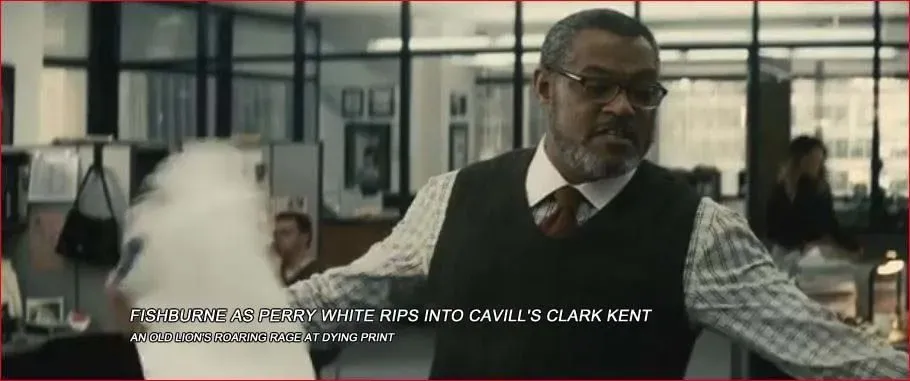
Fishburne intentionally channeling the late legendary newsman Ed Bradley and bringing a quiet gravitas to the character that transcended other angry news boss portrayals, offering us a potent visual of the reality of the old newsman Perry White's feelings about his print media world facing obsolescence and literally being torn to pieces by this younger generation (Clark) that ushered in this maddening digital world, as he strides confidently toward Kent taunting and dangling a large sheet of paper at a man he may or may not know is in reality the Man of Steel beneath that shirt.
An old-school investigative reporter of Perry's skills and intuition is surely not naive enough to be fooled by a pair of glasses, evidenced by his bemused though frustrated reactions to Clark's sudden disappearances as they crop up in the film.
Fishburne does so not by telling us or preaching to us about the changing world of vanishing print media but instead by showing us with a striking symbolic visual, ripping a mock Daily Planet paper printout of Clark's empty digital drop box right in front of Clark-and us, giving the scene a potent jolt of momentum as it gets underway, in a moment that highlights a stark contrast and much-debated point of contention, that of Snyder's artfully encased subliminal themes versus Gunn's overripe, some say vapid, preaching in today's retelling of Superman.
Then Fishburne offers us the potent reference to 1938-the year Superman was created-to apples not costing a nickel any more and to the WPA, the Works Progress Administration that was an ambitious Depression-era federal employment program and functions in the scene in at least one facet as perhaps a mild jab-and authoritative warning by the old veteran newsman to Kent about his own job security at this obvious insubordination on full display by a righteous-minded and idealistic young Kent.
British actor Henry Cavill's performance as Clark Kent is underrated, giving us not the timid, attention-drawing klutz we've seen from other versions but instead a stout, stand-uppish man unable to hide the second theological virtue dripping out of him that is the real giveaway that he is indeed Superman beneath that shirt, a god hiding in plain sight among us.
A truly nuanced performance from a veteran actor who played Henry VIII's loyal friend the Duke of Suffolk in the Tudors and who as Clark recalls him here with Perry in this work, contrasting that congenial performance with this confrontational one and bringing us a sense of dignity that in every way stands up to Fishburne's fine performance while respecting the roots of Shuster and Siegal's hidden-nobility arc for the character.
You can literally read Cavill's expression and thereby Clark's thoughts as the conversation ends and Fishburne gives a pointed farewell with a snapping, irritated grab of the discarded paper he takes with him as he initiate's the scene's exit and exclamation point by Fishburne that only appears to go unanswered. It is Clark's facial reaction where Cavill steals the scene back from the legendary actor and moves the story forward into the next one while mirroring the scene's theme of youth defying elders to move the world forward.
Perry's final frustrating invective, ''nobody cares about Clark Kent taking on the Batman.'' appears to be the boss's last word but subliminally is clearly met with a dramatic irony in the character that Cavill delivers ever so slightly, his boss walking away back now turned, and shares only with the viewer and not Perry where a light bulb moment washes across a quick turn of Cavill's forehead that seems to say ''well maybe they'll care about SUPERMAN taking on the Batman,'' the moment the seed of the story's central conflict is born.
Yet it is Fishburne's Perry White that explains the Snyderverse's popularity with comic book traditionalists, lamenting with us older folks in the audience our vanishing past through the actor's artistic depiction which functions a clear nod to Superman creators Siegal and Shuster who in 1938 in the midst of economic depression created the Superman/Clark Kent character originally for newspaper strips that changed comicdom and modern American culture in unforgettable ways that still stand today.
Mike Pizzolato
***
PERRY WHITE (dangles the large paper printout taunting Clark, then rips it into pieces as he speaks)
...just the goddamn Bat-thing I told you not to pursue.
CLARK KENT
The police won't help, the Press has to do the right thing.
PERRY WHITE (defiantly pointing the temple tips of his glasses at the young reporter)
You don't get to decide what the right thing is.
CLARK KENT
When the planet was founded, it stood for something Perry.
PERRY WHITE
And so could you if it was 1938, but it's not 1938, the WPA ain't hiring no more, and apples don't cost a nickel not in here, not out there. You drop this thing! Nobody cares about Clark Kent taking on the Batman
https://www.youtube.com/watch?v=Th3WcAVCaKo
It's not 1938, the WPA ain't hiring, apples don't cost a nickel
One of the hidden-gem portrayals in the so-called Snyderverse, Dawn of Justice: Superman vs Batman, powerful acting by Laurence Fishburne-and skilled directing by Zack Snyder giving artistic space to one the great actors of our time who delivers a timeless performance that still resonates a decade later.
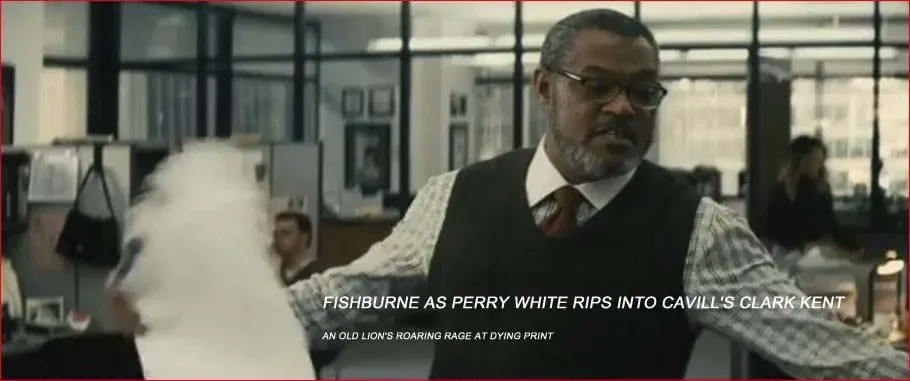
Fishburne intentionally channeling the late legendary newsman Ed Bradley and bringing a quiet gravitas to the character that transcended other angry news boss portrayals, offering us a potent visual of the reality of the old newsman Perry White's feelings about his print media world facing obsolescence and literally being torn to pieces by this younger generation (Clark) that ushered in this maddening digital world, as he strides confidently toward Kent taunting and dangling a large sheet of paper at a man he may or may not know is in reality the Man of Steel beneath that shirt.
An old-school investigative reporter of Perry's skills and intuition is surely not naive enough to be fooled by a pair of glasses, evidenced by his bemused though frustrated reactions to Clark's sudden disappearances as they crop up in the film.
Fishburne does so not by telling us or preaching to us about the changing world of vanishing print media but instead by showing us with a striking symbolic visual, ripping a mock Daily Planet paper printout of Clark's empty digital drop box right in front of Clark-and us, giving the scene a potent jolt of momentum as it gets underway, in a moment that highlights a stark contrast and much-debated point of contention, that of Snyder's artfully encased subliminal themes versus Gunn's overripe, some say vapid, preaching in today's retelling of Superman.
Then Fishburne offers us the potent reference to 1938-the year Superman was created-to apples not costing a nickel any more and to the WPA, the Works Progress Administration that was an ambitious Depression-era federal employment program and functions in the scene in at least one facet as perhaps a mild jab-and authoritative warning by the old veteran newsman to Kent about his own job security at this obvious insubordination on full display by a righteous-minded and idealistic young Kent.
British actor Henry Cavill's performance as Clark Kent is underrated, giving us not the timid, attention-drawing klutz we've seen from other versions but instead a stout, stand-uppish man unable to hide the second theological virtue dripping out of him that is the real giveaway that he is indeed Superman beneath that shirt, a god hiding in plain sight among us.
A truly nuanced performance from a veteran actor who played Henry VIII's loyal friend the Duke of Suffolk in the Tudors and who as Clark recalls him here with Perry in this work, contrasting that congenial performance with this confrontational one and bringing us a sense of dignity that in every way stands up to Fishburne's fine performance while respecting the roots of Shuster and Siegal's hidden-nobility arc for the character.
You can literally read Cavill's expression and thereby Clark's thoughts as the conversation ends and Fishburne gives a pointed farewell with a snapping, irritated grab of the discarded paper he takes with him as he initiate's the scene's exit and exclamation point by Fishburne that only appears to go unanswered. It is Clark's facial reaction where Cavill steals the scene back from the legendary actor and moves the story forward into the next one while mirroring the scene's theme of youth defying elders to move the world forward.
Perry's final frustrating invective, ''nobody cares about Clark Kent taking on the Batman.'' appears to be the boss's last word but subliminally is clearly met with a dramatic irony in the character that Cavill delivers ever so slightly, his boss walking away back now turned, and shares only with the viewer and not Perry where a light bulb moment washes across a quick turn of Cavill's forehead that seems to say ''well maybe they'll care about SUPERMAN taking on the Batman,'' the moment the seed of the story's central conflict is born.
Yet it is Fishburne's Perry White that explains the Snyderverse's popularity with comic book traditionalists, lamenting with us older folks in the audience our vanishing past through the actor's artistic depiction which functions a clear nod to Superman creators Siegal and Shuster who in 1938 in the midst of economic depression created the Superman/Clark Kent character originally for newspaper strips that changed comicdom and modern American culture in unforgettable ways that still stand today.
Mike Pizzolato
***
PERRY WHITE (dangles the large paper printout taunting Clark, then rips it into pieces as he speaks)
...just the goddamn Bat-thing I told you not to pursue.
CLARK KENT
The police won't help, the Press has to do the right thing.
PERRY WHITE (defiantly pointing the temple tips of his glasses at the young reporter)
You don't get to decide what the right thing is.
CLARK KENT
When the planet was founded, it stood for something Perry.
PERRY WHITE
And so could you if it was 1938, but it's not 1938, the WPA ain't hiring no more, and apples don't cost a nickel not in here, not out there. You drop this thing! Nobody cares about Clark Kent taking on the Batman