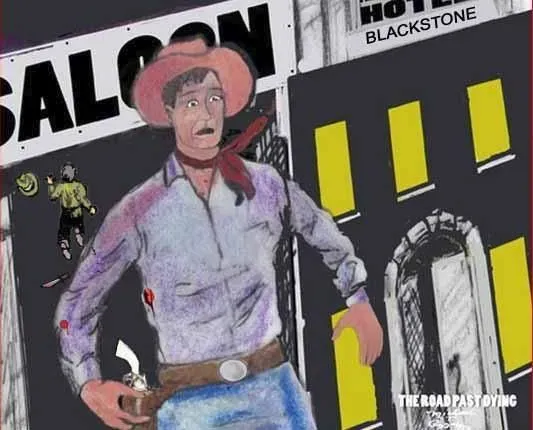
The Road Past Dying, a Western short story by Mike Pizzolato
John Paul wakes in the infirmary after a friend’s knife nearly ends him. Ginny keeps watch, and the father he barely knows stands in the doorway. Pain strips him to truth, forcing him to face the few who stayed-and the man he might still become. Surviving the blade was easy.
Living again is the hard trail.
The Road Past Dying
-A Western short story by Michael T. Pizzolato
originally published in The Spectra, 2008
John Paul adjusted his hat and ran his thumb underneath the brim. He had just been in the hoosegow last week for fighting with his old buddy Nathaniel after a drunken night, and he knew he had to stay out of Marshall Hickok’s way, so he had intended to grin and bear a few more lost hands than move on. The card dealer, who was pretty much a bunk artist, gingerly laid down his hand. John Paul muttered a barely audible curse, tossing his own hand of cards into the pile of cash on the table. Fed up with coppering his bets all night, he coaxed himself out of the bare, wooden chair.
The dealer had been sneaking from the bottom all night, but he couldn’t do anything about it short of blasting off the scoundrel’s belt buckle from under the table.
A large and imposing man, John Paul’s square features and tan face betrayed his ranching days in the Kansas sun. His eyes were gray and wild. His right hand was aggravated by a mild but constant tremor, which his left hand often struggled to subdue.
Ignoring the dealer’s pleas for him to continue, he stirred toward the bar. The other men at the poker table offered mock protests at his departure, and one of them puffed cigar smoke his way. He ambled past a flow of several drunken cattlemen, whose movement sliced through a haze of cigar smoke rising from the nearby poker table. The smell of whiskey and stale kerosene overcame his nostrils, while a sea of noise from the saloon crowd’s frenzied merriment put him on edge.
A drunken man—one of the cattlemen from Lawrence—cast him an indignant look while brushing against his shoulder. The cattleman’s stubborn gaze melted when he noted John Paul’s six-foot frame. The bigger man pressed impatiently past the insolent cattleman with a light shove.
At that moment, an excitement seized John Paul. He noticed Ginny and made his way to the end of the bar, removing his hat and parking his back onto the wall of the outer bar opposite her on the inside of the bar. He tossed his hat onto a stray bar stool next to the wall but remained standing, leaning back on the wall. Weary of killing time at the card table for the last half-hour, he welcomed the wave of relief flowing into his belly as he looked on her.
Her florid face was as pretty as a freshly painted barn, while her hair swept upward with a fancy brass clasp twinkling right at him. Sheet music saluted his ears from the piano a few feet from them along the wall.
“Any luck?” she asked.
“I been luckier,” he said, stealing a quick glimpse of her bosom.
“Anything to drink?” she offered, pretending not to notice the glimpse.
“Maybe an Arbuckle’s,” he said.
She broke into a short laugh.
“You want coffee? That’s rich. Since when have you ever turned down a chance to bend an elbow?”
“Since I been so soaked, I’m losin’ my concentration. I been bilked outta' more dinero lately n’ I care to recall. That chiseler over there,” he said, pointing to the dealer, “...he got me good tonight.”
Ginny’s right hand lifted a disobedient lock of her blonde hair dangling from her forehead.
“You gonna whip him, too?” she teased, referring to the fight he had with Nathaniel last Saturday night. “You 'n your so-called friend nearly beat each other to death until Marshall Hickok came between y’all.”
She adjusted her dress, which seemed little more than a bare-shouldered corset with purple violet prints tightly hugging her torso. Purple lining bordered the violets and danced around the curves of her breasts, while her long dress of the same material poured freely in waves from her waist to just below her knees. Her eyes, large and blue, seemed touched by deeper experience than her saloon job revealed. She was a saloon girl, about twenty-five years old, but the Bull's Head Saloon of Abilene was a modern, upstanding 1870s saloon. She was not the type of girl found in the lower-class places where the girls bedded down with customers and all manner of men.
The saloon’s interior was a charade of timid yellow walls gradually dimming with each passing cattle season. Two windows on the front wall, tall and wide, lit the saloon with daylight, until several strategically placed kerosene lamps would later be called on as sentries for the stark night soon to droop over Abilene.
“That sweet face of yours just ain’t made for a poker game,” Ginny chided. “Those ol’ buzzards see right through you.”
“They only see what I let ’em see,” John Paul said defiantly.
She shook her head and poured coffee into a cup and saucer. A tired old shadow, casting a collar across half of the bar from one of the tall windows, began to gray. Mr. Reagan, the barkeeper, grabbed a taper from under the bar and journeyed out to light the kerosene lamps. Ginny waved to him that she would momentarily keep watch for him.
The cup and saucer nickered in her hands as she slid the coffee to John Paul.
“And look where all that drinkin’ just landed you,” she said. “I know you’re only acting like such a bad egg. But this is the 1870s, John Paul, and it ain’t the time or place for all that.
Besides, with men the likes of John Wesley Hardin around and buddyin’ up to Marshall at that—you might consider where you’re heading in this life or you’ll be in the next life mighty quick. You know that Hardin fella' shot a man over at the hotel for snorin’ too loud!”
“If I knew you were gonna be on me like this,” he teased, “I’d 'a married you a long time ago. B’sides, I carry a gun most of the time for protection, Ginny.”
“You need to forget about that gun, John Paul, and find something to do besides playin’ cards and drinkin’—something peaceful.”
A gray-bearded gentleman, who smelled like he needed a bath, walked up next to them, pounding a heavy fist down onto the bar while gesturing at Mr. Reagan before the barkeeper had a chance to venture toward the kerosene lamps. Within a few moments, John Paul saw two glasses of beer atop the bar. He heard the thunk of chinking coins as the beers slid over the counter toward the cattleman with only a slight spill. The gray-bearded man vanished, and Mr. Reagan went about lighting the lamps.
The piano music died abruptly, while the saloon crowd flared up. A woman’s voice pealed with laughter, which sounded like the ringing of a dinner bell. A broad male laugh from the back of the saloon rumbled past John Paul as he returned his attention to her. Ginny lifted her arms up and preened, fiddling with the clasp holding her bouquet of golden-blonde hair in place.
“When are you gonna sketch another picture of me? I still have the hatbox."
A pang of regret soured his belly as he remembered how she learned about his drawing ability. Bringing up his cursed talent for charcoal drawing agitated him.
"Only weaklings who can't hold a brandin' iron without tremblin' draw pictures," John Paul said. "So says your Paw, but I saw it was a beautiful drawing," she said. "A drawing of me lyin' in bed amongst all them bed sheets after our first time together."
"Alright Ginny, that's enough. I'd just as soon forget about that drawin' of you that morning."
A ruffled look diluted his face. "But I sure won't ever forget that night."
She elbowed up to him on the bar and nestled her chin into the palm of her hand an inch from his face. "To draw me on the underneath of my hatbox like that. You sure didn't draw a lot of the bed-covers, just mostly me," she giggled. "I didn't notice it for a week until I was putting the boxback on the top shelf of my closet."
"I know I should a' never done that, Ginny. I don't know what got into me. I didn't even know I could still draw. It'd been so long since I picked up a crayon. What's a charcoal crayon doin' hidin' in your bedside drawer?"
"What were you doin' in my bedside drawer early in the mornin' after makin' mash with me all night?" she replied with a smile.
"Ginny, it ain't like I gave you a diamond ring or anything," he said. She lifted her eyebrows and grinned playfully at him.
"No, no," he laughed. "We been through all that. I asked you once before. I nearly left Abilene after that."
Her tone grew serious. "I wasn't ready, Jon Paul. Not after what happened to Henry."
Henry, her first love, was a quirky-smoking tobacco farmer from her home state of Virginia.
When he died of a lung ailment, she grew restless and began to hate living in the state for which she was named. She left Virginia to live with relatives in Abilene after a quarrel with her father, himself a tobacco farmer, who had wanted her to marry a wealthy planter for whom she cared little. A gregarious soul, Ginny found a job she loved, working in the saloon where she was well-paid and met more new people in one day than she would in a year in Virginia.
“John Paul, drawin’ pictures like that is a wonderful thing to be able to do. The newspaper might could use an artist, or you could sell drawings an' artsy what-nots, even crayons or paints an’ little brushes. Open up a little shop down there in the vacant place, just like you talked about. I can see it,” she said wistfully. “It’s right beyond the post office just past the general merchant’s store. Folks could come out of the general store with money in their pocket and see your little place next door. You might could get off of that ranch of your daddy’s and make a mark for yourself.”
“That’s a silly dream. And besides, it’s not for me, Ginny. I ain’t that good at drawing anyway.” She shook her head at him, but he ignored the gesture. He recalled telling her about the silly dream shortly after she discovered the hatbox portrait. He was having a rough time on the ranch back then with his overbearing father and only wanted to do something different than ranching, something with his mind and not his back, but the dust had since settled a bit between him and his father.
Ranching for his father, while not the best work in the world, had become tolerable and had afforded him food and shelter along with a whiskey or two on Saturday nights. Besides, as an only child, he would inherit the ranch one day when his father passed on. Ginny was a fine woman, but she did not care much about the ranch and did not seem to like his father.
He could tell she was getting about ready to settle down, but he knew she would not wait forever for him to get his life in order. More importantly, she was not buying his attempt to feign satisfaction with his father or with his ranching duties.
“I told ya' what my paw used to do to me whenever he caught me drawin’ with a charcoal crayon,” he said.
She nodded sympathetically. “It’s crazy for a man to frighten the talent from his own son by threatening to shoot his drawing hand off,” she said. “That’s a horrible thing to do to a boy…” “I know, but it was only a threat. It’s what he felt he had to do, Ginny. He didn’t want his son off in art school when he needed help with the ranch.”
“Lord A’mighty, John Paul, you defend him, the way that man treated you.”
“That man’s my paw, Ginny. I even carry his full name. ‘Sides, he’s been mostly good to me—a roof over my head and food to eat. It’s been hard since ma died. He needs me there to help…”
“Oh that’s rich, John Paul. You know he’s got enough money to buy all the help he needs on that ranch. You need more’n food and shelter from your father,” she said. “you need to know you’re cared about. Your maw was right to send you back east to study art in the Old States. Too bad she got sick and…”
His mood grew somber. “I still think of’er each and every day,” he said, “after all this time.” She let out an exasperated sigh. He inhaled the flowery scent of her perfume and the peppermint on her breath.
“If your maw was still alive, you might be on a different path now than out on that ranch punchin’ cows and quarrellin’ with that old man.”
“Well, she ain’t here, and it’s too late to change now. I’m thirty and gittin’ no younger. I might as well put my mind to doin’ what I do best.”
“But I’m here,” she said, “and I have to listen to you every time you’re mad with him or mad about working in the hot sun, or even mad about Nathaniel, and you know Nathaniel ain’t right. The wars back when Kansas was bleedin’ did somethin’ to his mind. You should stay away from him. More’n that, I don’t like the way he looks at me.”
“I’ve known Nathaniel since we were kids,” John Paul said. “I guess he’s seen a lot of bad stuff in the Border Wars I never had to see, and he turns up on the Confederate side when the war starts up.”
“Nobody in Kansas knew what to be back then, slave or free. Mighty bad times,” she said. “Still, I can’t see how anybody would take orders like them soldiers do,” he said. “It just ain’t fer me. I gotta’ be my own man.”
Her face soured. She walked away then stopped, shifting on her heels to face him.
“John Paul, bein’ your own man means doing what you want to do with your life, not what your paw wants you to do with it.”
It was about four hours past sunset. He had found a stray bar stool where he sat to himself, quietly nursing a beer and thinking about the conversation with her. His eyes occasionally followed her as she served drinks and consorted with customers. He had long ago resolved any feelings of jealousy about her work in the saloon, but he knew old feelings died hard, he still felt a pang now and then, especially when her silvery laugh sailed past him.
As the early morning hours hovered over Abilene, John Paul had nodded off at the bar while nursing a beer. He awoke with the thought he had heard bells jingling, only to see Mr. Reagan gathering up stray glasses from the top of the bar. The Bull’s Head was closing for the night. He looked around, but Ginny had disappeared, likely to the rooming house she lived in just behind the saloon. He toyed with the idea of paying her a late-night visit, but immediately discarded the idea.
As he pushed through the bat wings, he grumbled a goodbye to Mr. Reagan. His boots thunked on wooden planks then skidded and rustled across dust and gravel. The night sky was a dying blue, interrupted by rows of dusky buildings lined against it. He ambled down the side street past the rooming house. Her light was on, not unusual for her. Intelligent and educated in good schools back east, she was probably reading at her bedside lamp.
A warmth glowed inside him at how she had chided him about his direction in life. It meant that she was clearly interested in him and maybe even interested in getting married. It was a good night after all-a night for pleasant dreams. He gave one last glance up at her window.
A pang like the burning sting of heated cattle irons sliced into his rib cage and chest. John Paul’s breathing halted as he was forced to inhale deeply with all the strength his chest muscles could muster. His right arm burned from some kind of frightful force. Liver-colored shadows and glistening light flashed before him. He grew dizzy; his legs lost all sensation as he buckled to the ground. His hat spun off his head and tumbled like a prairie weed along the ground. He heard footsteps and saw the form of his old friend clamoring away, feet sifting through dust and gravel. The attacker scampered around the corner past the row of buildings and vanished into the black of night. He wanted to tell Nathaniel he had just dropped his fine Bowie knife he got from the war, his proudest possession, but then John Paul realized he had just been stabbed with that very knife by Nathaniel, a man once his best friend.
Daylight flooded into the room. He felt weak, and his face and throat seemed heavy. The feathery comfort of the bed coddled his back and head. He struggled to gaze on her face, with its tears streaming. Why was she crying? He recalled bits and pieces. Nathaniel’s prized Bowie knife; his frantic fleeing; how did they find him in the street in the middle of the night? How did he survive? Why does his right arm burn so?
“John Paul, how’re you feelin’?”
Her voice soothed him. He tried to clear his throat. His own voice sank as he struggled to speak. The room was filled with sunlight, so it must have been some time during the day, probably early morning. His gaze caught an old grandfather clock reading nine o’clock. He recognized the clock from Doc’s infirmary, the back room behind his office.
“Don’t try to talk now, John Paul.” She forced him to eat a few bites of grits and buttered toast until he turned his head away. He dozed off. The pain in his right arm strung all the way to his neck and chest. Was he dying? Her face was there again, smiling at him. The silly dream about the art shop popped into his mind. He knew she loved his artistic talent and his artistic soul. Then regret tormented him for playing cards, for drinking, and for walking home drunk in the wee hours of the morning.
“You’re going to be fine, John Paul. Doc says your rib is broken by your arm…” His bandaged arm and hand craved art and drawing of any sort now, despite the pain. He only wanted to sketch her face again, every detail—the rich, full lips, the bouncing blonde hair, the upturned nose, the rosy glow, down to the mole on her left cheek, so that he could bring her image with him into the afterlife.
Her hand was resting atop his blankets.
John Paul mustered his failing strength for his first full sentence since the dangerous moment in the street. He croaked the words:
“Will I draw again?”
(continued, click next page top menu)