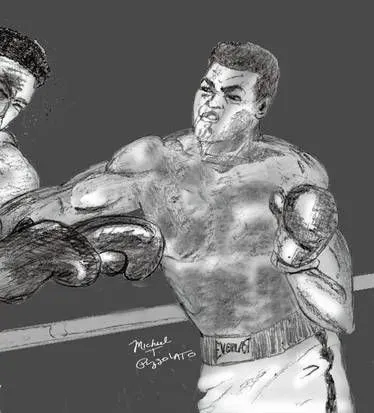
Ali Road to Greatness
The fight in Zurich, Switzerland, against Jurgen Blin- the day after Christmas in 1971 was early on the comeback trail for Ali after his devastating loss to Frazier earlier in the year at a time when only one heavyweight had ever regained the title. He looks starkly different from the flashy young whiz kid who knocked out Cleveland Williams, finishing his title run with a scintillating performance over outmatched Zora Folley before a forced 3-year layoff.
He's rusty and sluggish against Jurgen and is trying to work out the bugs over a vastly inferior opponent whom he still manages to knock out in the 7th with a perfectly thrown right cross. Ali is slower, heavier and older.
His punches and combinations are not sharp. He's clearly affected by what Frazier had dealt him and is a long way from being ready to fight again for the championship. He was probably not really ready to fight Frazier the past March.
It's amazing how he fine-tunes his game over the next 4 years while his own youthful prime is fighting him, ebbing away ever so slowly.
But by the time he gets a second fight with Joe Bugner, it's 1975 and he's lighter, aggressive and attacking with cat-quick combinations of stinging punches, moving sharply, shifting and dancing, thoroughly dominating Bugner over 15 rounds.
He had regained the title the year before from George Foreman to wide acclaim in a masterful performance. He easily handles Bugner and is now scant months away from an epic battle against Joe Frazier in Manila that will place him forever in the pantheon of boxing's greatest fighters.
But this Christmastide in 1971 against Jurgen Blin, he's far from being that kind of boxer and surely must be thinking to himself that he still has many long and weary miles to go before he is even within sight of that hall of heroes.
Ali is still far from championship form in Japan in April '72 against Mac Foster, a game but soft opponent.
It is just months after a lackluster effort against Jurgen Blin the previous Christmas. His jab is better but not yet the work of art it will be. He's too heavy at 226 and can't put together effective combinations. He handles Foster easily, but it's becoming clear to everyone that the dancing master can no longer dance for the distance like he did as champion in the '60s.
He seems to be searching for other defensive maneuvers to get him through the fight while conserving himself for the late rounds, that hellish place in the ring where even the mightiest man has his breaking point.
And so, fight after fight along the comeback trail, he keeps resorting to the ropes and testing his ability to take punishment, especially to the body. It is sheer madness, of course, but aren't all inventors and artists a bit mad?
Within two years, he is down to 217 but has over-trained for his first encounter with Joe Bugner in February '73, still a 12-round win. Yet the benefits of the Bugner1 training effort will remain with him for the battles ahead, especially in the broken jaw contests with Ken Norton the same year.
He has fashioned many new defensive techniques along the way, including the odd one of playing the ropes while taking punishment which puzzles even the announcer when he does it in this Tokyo fight with Mac Foster: "He did this against Frazier; why he is still doing it, I don't know!"
THE ANSWER IS LONG IN COMING TWO AND A HALF YEARS LATER, loudly and clearly audible in the jarring crowd noise bouncing off a tin roof hastily-constructed to protect the fighters from potential rains that never come on this sweltering African first light of the day before Hallow's Eve in 1974.
Ali is escorting a stumbling George Foreman to the floor with a half-cocked glove and an icy glare, his arms then aloft in victory. Foreman in his hellish place seems strangely relieved as he falls with open arms onto the canvas and into the wrong side of history after enduring nearly 8 frustrating rounds with this mad scientist-this master artist and inventor-who has worked so deceptively hard at his craft through the peaks and valleys over the years so as to forge himself into the very fighter he always told us he was--the greatest of all time.
They had the hospital plane warming up on the runway to take Ali to Spain for treatment in anticipation of the life-threatening injuries that Foreman was supposed to dole out to him.
In the end, it was Foreman who could have been mortally injured, but the masterful Ali instead cocked his hand and held back on that last punch that, if landed, might have seriously injured or brain-damaged an out-on-his-feet Foreman who was falling head-first in an arms-outward embrace of the canvas like Von Richthofen's Fokker finding the fated beet field.
And then there was Ali-still standing, the quality of mercy not strained, the last pound of flesh un-taken.
-Mike Pizzolato