The Holy Spirit-Who Is He?
Join Sassy Christian Woman on a journey of faith, inspiration, and empowerment. Explore our books, journals, devotionals, and unique merchandise designed to uplift your spirit. Embrace your sassy side with us today!
Life has a way of presenting situations that leave us scratching our heads, clutching our pearls, and asking, "Lord, what am I supposed to do with this?"
The good news is that God's Word is not silent.
Here you'll find Bible studies, teachings, and practical insights designed to help you navigate real life through the lens of Scripture. Whether you're seeking encouragement, direction, healing, or a deeper understanding of God's Word, put your phone on vibrate, pull up a chair, grab your Bible, your journal, and maybe your coffee too.
Let's Talk Bible about it!

Discover the Person, Power, and Purpose of the Holy Spirit.
From the Upper Room to everyday life, let's explore who the Holy Spirit is, what He does, and why His presence still matters today.
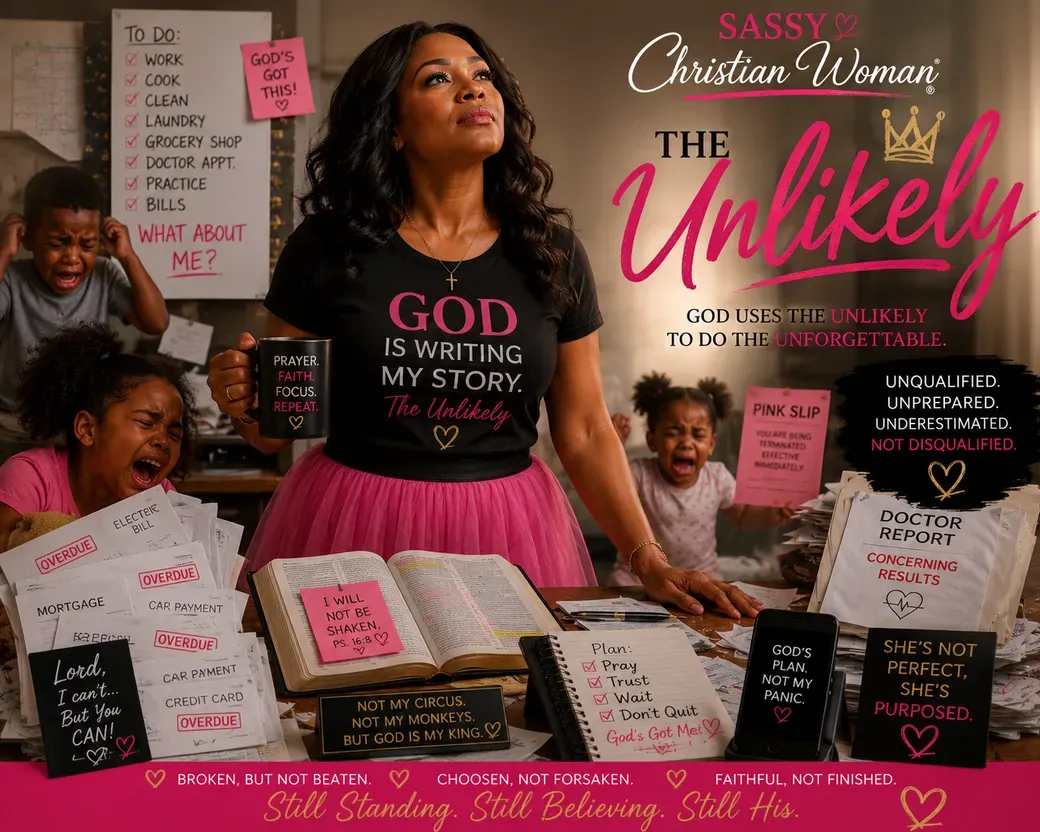
Throughout Scripture, God repeatedly chose the overlooked, underestimated, and unexpected to accomplish extraordinary things.
Good thing for us.

Discover how God met women in the midst of pain, betrayal, loss, rejection, and trauma—and what their stories reveal about healing and hope.
Let's be honest, Sis.
There is no shortage of Bible studies, devotionals, podcasts, YouTube channels, books, influencers, experts, and people willing to tell you what you should be doing.
So why Sassy Christian Woman?
Because around here, we're not interested in religious performance.
We're interested in real transformation.
We believe you can love Jesus with your whole heart and still have a personality.
You can be faith-filled and fashionable.
Prayerful and powerful.
Strong and soft.
Anointed and authentic.
We talk about the things church folks sometimes avoid.
The hard seasons.
The unanswered prayers.
The disappointments.
The healing journey.
The calling you're still trying to figure out.
The confidence you're still trying to build.
And yes...
Sometimes we even talk about shoes and bags.
Because God cares about every part of your life—not just the part that shows up on Sunday morning.
This isn't a place for perfect women.
It's a place for growing women.
Women who are learning.
Healing.
Trusting.
Stretching.
Becoming.
Women who understand that faith isn't about pretending you have it all together.
It's about trusting God while He's putting the pieces together.
So if you're looking for biblical truth, practical wisdom, honest conversations, and just enough holy sass to keep things interesting...
Welcome home, Sis.

🔒 CHAPTER TWO: HAGAR
INTRODUCTION — Seen When No One Else Was Looking Hagar does not enter Scripture with celebration. She enters as property. She is not introduced through lineage or blessing, but through ownership—Sarai’s servant. Her story begins inside someone else’s household, someone else’s plan, someone else’s desire for control. And yet—God sees her. That alone should make us pause. Hagar is the first woman in Scripture to receive a personal encounter with God outside the covenant line. She is the first to be pursued by God in the wilderness. And she is the only person in the Bible who gives God a name.
Let that sit.
Hagar’s story is not about curiosity gone wrong. t’s about powerlessness, exploitation, and survival inside systems she did not design. She did not reach for a tree. She was positioned for a womb. She did not question God’s command. She was obeying someone else’s. Hagar is a woman used to advance a promise that wasn’t hers—then blamed when the plan became complicated.
And still—God finds her.
Not in a home.
Not under protection.
But in the wilderness.
That matters. Because Hagar’s God does not wait for safety, status, or spiritual pedigree. He meets her where power has failed her—where survival has become the assignment. If Eve teaches us about the loss of innocence, Hagar teaches us about the cost of invisibility.
📦 Spiritual Key #1 — Being Seen Is Not the Same as Being Valued
*Key Truth:
Being visible to people does not mean you are protected by them—but being seen by God changes everything.
Hagar was seen every day.
She was useful.
She was positioned.
She was watched.
But she was not valued.
She lived in full view of a household that benefited from her body while ignoring her humanity. Her presence mattered only as long as she was useful to someone else’s plan.
And yet—God saw her. Not as a resource.
Not as a solution. Not as collateral damage.
But as a person.
*Why This Matters (Especially If You’ve Ever Felt Used):
Many women confuse being needed with being valued.
You were included—but not protected.
Chosen—but not considered.
Kept close—but never covered.
And when harm followed, you were blamed for reacting to conditions you did not create.
Hagar didn’t fail a system. She was expendable to it.
And God refuses to overlook that.
*Spiritual Application: Let God Name What People Benefited From Ignoring
Sis, hear this clearly: being seen by people did not keep you safe—but being seen by God still matters.
Instead of asking:
Why didn’t they value me?
Why was I disposable?
Try asking:
Where did God see me when no one else did?
What did He name that others refused to acknowledge?
Hagar did not earn God’s attention.
She received it.
And that seeing became the beginning of her healing.
Reader Pause — Let This Settle in Your Soul
Before we move on, pause here.
If you’ve ever been used, overlooked, blamed, or pushed into a situation you didn’t choose—this story already recognizes you.
You don’t have to make meaning yet.
You don’t have to connect dots.
You don’t have to decide how this applies.
Just notice what stirred.
God saw Hagar.
And He sees you.
Let that settle in your soul.
Absolutely. Let’s step into this like proclamation, not just comparison—revelation wrapped in narrative.
There are some stories in Scripture that do not simply sit on the page—
they echo.
They echo across generations.
They echo through lives that were never supposed to look like purpose.
They echo in women who were never positioned to be chosen—
yet were chosen anyway.
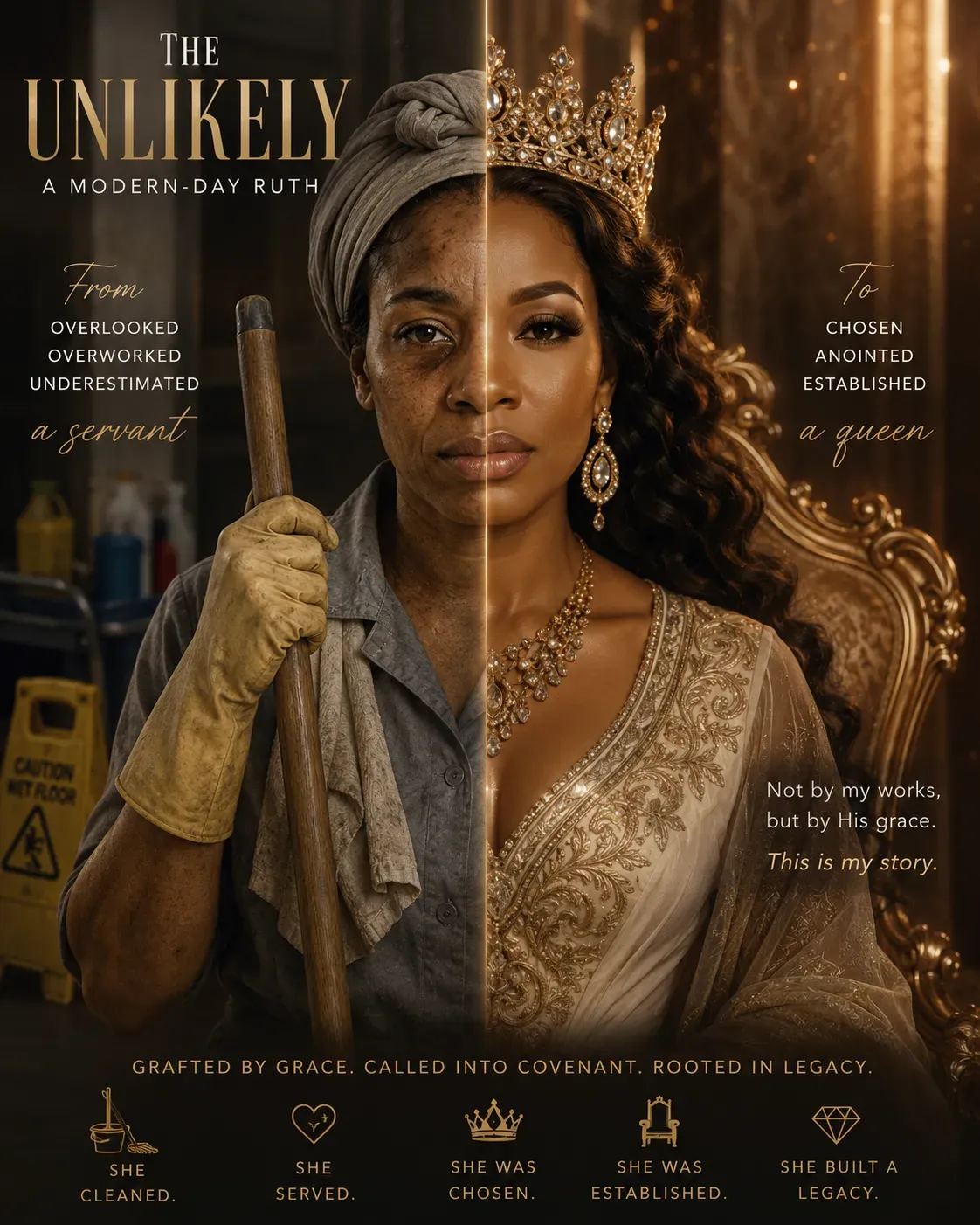
One of those stories belongs to Ruth.
And if you listen closely—
you will hear that same echo in my mother.
Ruth’s story does not begin in promise.
It begins in loss.
Widowed.
Displaced.
Uncertain.
Not only grieving what she had lost,
but standing in a future that offered no guarantees.
And my mother—
though her story unfolded in a different time—
stood in that same kind of beginning.
A child at ten years old,
forced to process what no child should ever have to carry.
Loss did not knock politely at her door.
It entered, rearranged everything,
and left her to make sense of a world that no longer felt stable.
Ruth buried a husband.
My mother buried innocence.
And yet—
neither woman allowed loss to become their identity.
Ruth made a decision that would alter her entire life:
“Where you go, I will go.
Your people shall be my people,
and your God, my God.”
She chose covenant
before she saw provision.
She aligned herself with God
before she saw evidence of what that alignment would produce.
And my mother—
though she was not raised in what we would call “the church”—
stepped into that same kind of divine alignment.
She was not born into the family of God as we define it.
She was brought into it.
Welcomed.
Formed.
Transformed.
Not by lineage—
but by grace.
Ruth gleaned in fields she did not own,
surviving on what was left behind.
It was not glamorous.
It was not secure.
It was enough.
And sometimes,
“enough” is where God begins His greatest work.
My mother gleaned too—
not in barley fields,
but in moments.
In borrowed stability.
In spaces that did not always feel like home.
In opportunities that required her to take what was available
and trust God with what was missing.
She learned how to live
before life ever felt settled.
Then came Boaz—
the kinsman-redeemer.
Not rushed.
Not accidental.
But appointed.
A man who recognized her value
before the world ever validated it.
A man who did not just see her struggle—
but responded with covering, provision, and covenant.
And in my mother’s life,
that same divine pattern unfolded.
My father—Solomon—
entered not as a rescue,
but as a continuation of God’s plan.
Older.
Established.
Positioned.
Not just a husband—
but a partner in purpose.
Just as Ruth stepped into a field and found favor,
my mother stepped into covenant
and found alignment.
And what followed was not just provision—
it was multiplication.
Because Ruth’s story does not end at marriage.
It culminates in lineage.
She, the outsider,
became part of the genealogy of Jesus Christ.
Let that settle.
The one who did not belong—
was written in.
The one who was not expected—
was remembered.
The one who arrived empty—
became essential.
And my mother—
though her name may not appear in Scripture—
walked that same divine rhythm.
She did not just receive from the family of God.
She built within it.
She taught.
She preached.
She poured.
She raised a generation
that would know God, serve God, and carry His name forward.
She helped establish a legacy
that did not begin with her—
but would not be the same without her.
This is the testimony of The Unlikely.
Not the one who had the right background.
Not the one who had the perfect start.
Not the one who was positioned by circumstance.
But the one who was:
Grafted by grace
Aligned through covenant
And rooted in legacy
Reader Pause + Reflection
Where have you counted yourself out
because of where you started?
Where have you believed
that your beginning disqualified your becoming?
Ruth was not born into the lineage—
she was brought into it.
And what God did for her—
He is still doing.
Grounding Line
You are not limited by where your story began.
You are positioned by what you are willing to say yes to.
Bridge Statement
Because when God writes a life,
He does not consult history for permission.
He rewrites it through grace.
And what comes next is not just survival—
it is evidence of divine intention.
Join Sassy Christian Woman on a journey of faith, inspiration, and empowerment. Explore our books, journals, devotionals, and unique merchandise designed to uplift your spirit. Embrace your sassy side with us today!

The Person of the Holy Spirit-Who Is He?
The Holy Spirit is the third Person of the [Christian Trinity]—co-equal, co-eternal, and one with God the Father and God the Son (Jesus Christ). He is not an impersonal force or "it," but a divine Person who acts, feels, teaches, and indwells believers, serving as their Helper, Counselor, and Comforter.
The Holy Spirit: The Trinity
The Trinity consist of three persons equally divine and yet inseparably one We alone believe in a tripersonal God—that the one God is the Father, the Son, and the Holy Spirit.
To speak of the one God of the Bible is to speak of the Father, Son, and Spirit—they are each God, but they are not each other.
There was never a God who was not Father and Son together in the unity of the Spirit, coequal, coeternal in the essence of the divine being.
The Three Persons
While they share the exact same divine essence, they act in distinct ways:
The Father: Seen as the source or head of the Trinity. He is the Creator and the ultimate judge.
The Son: God revealed in human form as Jesus Christ. He is the Savior who redeems humanity.
The Holy Spirit: The unseen, active presence of God in the world today. Acting in various roles including comforter, guide, and counselor.
The Holy Spirit Was In the Beginning with God Active In Creation
1 In the beginning God created the heaven and the earth. And the earth was without form, and void; and darkness was upon the face of the deep. 2 And the Spirit of God moved upon the face of the waters. Genesis 1:1-2
By his spirit he hath garnished the heavens; his hand hath formed the crooked serpent. Job 26:13
O Lord, how manifold are thy works! in wisdom hast thou made them all: the earth is full of thy riches. 25 So is this great and wide sea, wherein are things creeping innumerable, both small and great beasts. 26 There go the ships: there is that leviathan, whom thou hast made to play therein.27 These wait all upon thee; that thou mayest give them their meat in due season. 28 That thou givest them they gather: thou openest thine hand, they are filled with good.29 Thou hidest thy face, they are troubled: thou takest away their breath, they die, and return to their dust.30 Thou sendest forth thy spirit, they are created: and thou renewest the face of the earth. Psalm 104:24-40
The Holy Spirit Was Active with God In Creation of Man
7 And the Lord God formed man of the dust of the ground, and breathed into his nostrils the breath of life; and man became a living soul. Genesis 2:7
8 But there is a spirit in man, And the breath of the Almighty giveth them understanding. Job 32:8
4 The spirit of God hath made me, and the breath of the Almighty hath given me life. Job 33:4
7 Whither shall I go from thy spirit? or whither shall I flee from thy presence?
8 If I ascend up into heaven, thou art there: if I make my bed in hell, behold, thou art there.Psalm 139:7-8
12.Yea, surely God will not do wickedly, neither will the Almighty pervert judgment.13 Who hath given him a charge over the earth? or who hath disposed the whole world?4 If he set his heart upon man, if he gather unto himself his spirit and his breath;15 All flesh shall perish together, and man shall turn again unto dust. Job 34:12-15
James 1:2-3 2 My brethren, count it all joy when ye fall into divers temptations; 3 Knowing this, that the trying of your faith worketh patience.
We are to endure our temptations/sufferings as a good soldier of Christ. Knowing that our sufferings are not in vain, and we shall reap a harvest of blessings if we don't faint!