Maximizing Growth: A Step-by-Step Guide to Building Strategic Partnerships for B2B SaaS
Strategic partnerships are one of the most powerful — and most misused — growth levers in B2B SaaS. Here's how to do them right.
I was recently on a panel with SaaS Alliance talking about product and platform partnerships, and one theme kept surfacing: teams are still building integrations based on gut feel or what sounds strategically impressive, not what customers actually need.
I've seen this play out at Microsoft, Egnyte, and Passport Labs, and across every SaaS product I've worked on since. The pattern is always the same. A partner looks exciting, someone in leadership says "we should integrate with them," three months later adoption is flat, and the engineering team has moved on to the next shiny thing.
Strategic partnerships can accelerate distribution, unlock new customer segments, and deepen retention — but only when they're built on the right foundation. Here is the process I actually use.
Step 1: Align on Charter Before You Talk to Anyone
The fastest way to waste six months on a partnership is to start with capabilities instead of context.
Before a single partner conversation begins, your team needs a clear, bounded answer to three questions:
What business outcome is this partnership meant to drive — new pipeline, retention, expansion, product gap, market entry?
What does winning look like for both sides — not just yours?
What are we explicitly not trying to do here?
At Egnyte, when I led cloud storage and app partnerships, we operated from a clear belief: enterprise content workflows don't live in a single product. Our charter wasn't "partner with everyone" — it was to remove the friction points where customers had to leave Egnyte to get work done, and to own the integrations that mattered most to the verticals we were targeting.
That focus prevented us from chasing every inbound partnership request that came through the door. Alignment on charter is the prerequisite. Without it, you're not building a partnership — you're building a dependency you'll eventually have to unwind.
Step 2: Start With Your Existing Customers, Not Your Competitor's Marketplace
The most common mistake I see is starting the integration research with a competitor scan. That's the second step, not the first.
Your existing customers are already telling you what they need — most of the time, you're just not listening systematically. Before you look outward, look inward:
What tools do your customers already have in their stack, and why?
Where are they doing manual work that your product should be automating?
Where does your product drop them off into a context switch they didn't choose?
What comes up repeatedly in sales calls as a reason deals stall or close late?
I ran customer surveys — and used existing data from sales conversations in Gong and support tickets — before making any significant platform decision across Microsoft, Egnyte, and Passport Labs. The signal is always in the data you already have.
At Passport Labs, curb management and IoT partnerships followed the same logic: customers weren't asking for more integrations broadly — they were blocked on specific workflow gaps in billing and were frustrated with the fragmentation, dealing with multiple app and vendors. That directed us toward Turnstone Data Labs, an ML company building occupancy models for smart cities, rather than a broader and less targeted partner sweep while partnering with the Consumer app companies with on-street inventory and Passports Payment rails, to drive data and distribution strategy. Not. customers didn't ask for the occupancy solution, but efficiency and streamlining operations with multiple vendors, but you think one step ahead - what you will do with data you have now, that's your moat and what more you can do to deliver value? What you can build, partner, and buy of shelf?
It's also not a one-time exercise. Each stage of product and partnership development should follow with more quantitative validation — usage data, user testing, activation analysis — to pressure-test assumptions before you commit engineering resources. And second stage to drive MVP to prove joint OKRs and value with actual pilot customer, let's say within a quarter to see if there is value, and clear ROI and potential.
Step 3: Then Look at Competitor Ecosystems
Once you know what your customers are telling you, layer in competitive intelligence. Look at what integrations your competitors have already built — their marketplaces, app directories, and partner pages.
If three or four competitors all support the same integration, that's a market signal. It doesn't mean you copy it blindly, but it tells you the workflow problem is real and validated.
The framework I've used since my Egnyte days and still apply today: map your own product's competitive position first, then determine where the gaps are between what competitors offer and what your customers say they need. Those gaps are your highest-priority white space.
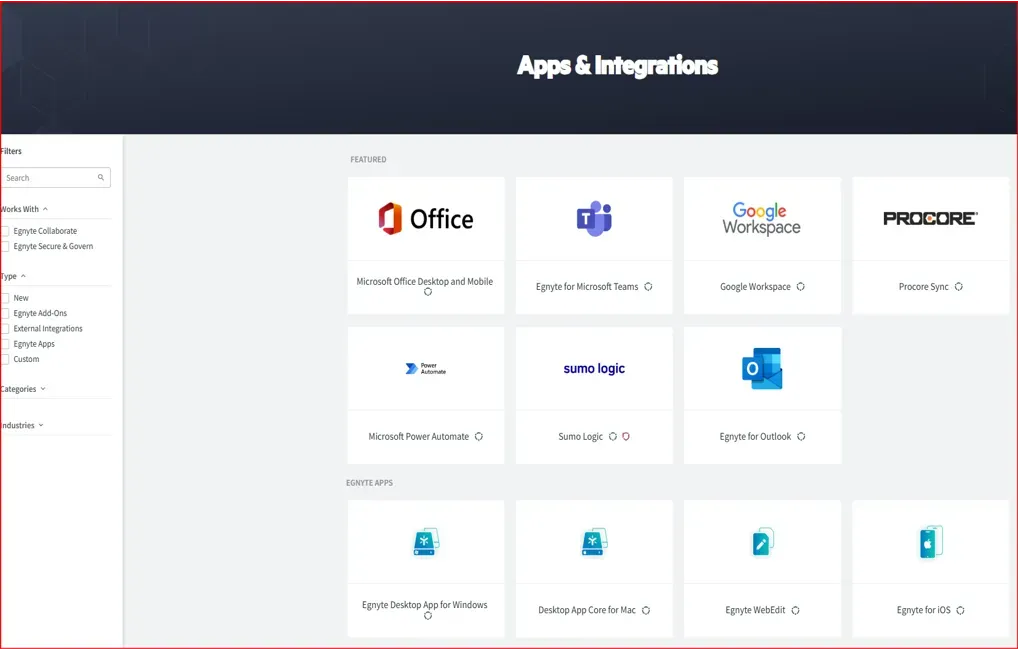
At Egnyte, M365 and Google Workspace integrations were table stakes — 99% of enterprises already had them bundled. Competitors like Box and Dropbox had the same. So the question wasn't whether to build those integrations — it was how to find the wedge: where Egnyte could complement the productivity suite in ways our competitors couldn't, specifically for the compliance-heavy verticals we served best and for front-line workers in Vertical SaaS we specialized in - construction tech for example.
Breadth gets you in the door. Depth and breaking new ground and 0-1 differentiation is what drives retention and brand.
Step 4: Prioritize by Workflow Friction, Not always by Brand Name
Not all integrations are equal — and the most recognized brand isn't always the most strategic partner.
How I think about prioritization depends on where the company is in its platform journey:
If you're bootstrapping a new ecosystem, logos and breadth matter. Getting anchor integrations live signals market credibility to buyers and investors.
If you're scaling an existing ecosystem, depth matters more than breadth. Find the nimble partner who shares your customers, your vision, and your urgency to execute.
Across both stages, I ask three questions to pressure-test every integration candidate:
1. Does this remove major workflow friction? If a customer has to manually export data from your product and import it somewhere else every day, that's an integration worth building. If it saves two clicks a month, it's not.
2. Does this help sales close deals faster? Integrations that surface repeatedly in sales calls deserve a separate tracking process. When a prospect says "we need this to work with [X] before we can sign" — that's not a feature request. That's a revenue signal.
3. Does this unlock a new customer segment? Sometimes the right integration opens a door to a buyer you couldn't reach before — a new vertical, a new company size, a new channel. That's strategic value beyond workflow efficiency.
Step 5: Build the Feedback Loop Across Teams
One of the questions that got the most discussion on the panel: how do you ensure other departments are actually feeding you data for prioritization?
My honest answer: you have to build the process deliberately, or it won't happen.
Sales needs a lightweight way to log integration blockers in deals — not a 10-field form, just a tag or a note in the CRM. Customer success needs a channel to escalate workflow friction they're hearing on calls. Support tickets need regular review for integration-adjacent issues.
None of this is technically complicated. What makes it hard is that product teams often treat it as optional, and then wonder why prioritization feels like guesswork.
As a leader, getting cross-functional buy-in requires consistent advocacy — not just one kickoff meeting. Build the process, reinforce it, and tie it to outcomes the other teams already care about.
Step 6: Build the Integration Ladder
Strong platform products evolve integrations in deliberate stages. Trying to build Stage 3 before Stage 1 is stable is one of the most common ways integration programs collapse.
Stage 1 — Foundation API access, basic data sync, authentication. Get this right before anything else.
Stage 2 — Workflow Triggers, automation, webhooks. This is where integrations start delivering recurring value in users' daily work.
Stage 3 — Ecosystem Marketplace apps, developer platform, third-party extensions, joint solutions with strategic partners. This is how companies like Slack, Shopify, and Notion built compounding network effects.
Each stage requires a different internal investment model — and a different kind of partner relationship. Be honest about which stage you're actually in.
Step 7: Validate Before You Build
This sounds obvious. It almost never happens consistently in practice.
Talk to customers before scoping the build, not after
Track integration feature requests over time — and chase the why, not just the volume
Run discovery with prospects who are actively blocked on an integration — their urgency will tell you more than a survey
Analyze usage data for workflow drop-off signals before assuming you know where the friction is
Strategic integrations require dedicated resources — internal and external — and they don't come free. Validating demand before committing engineering time is the discipline that separates platform teams that scale from those that accumulate technical debt in the form of underused connectors.
Step 8: Measure What Matters After Launch
The launch is not the finish line. After building an integration, the metrics that tell the real story are:
Activation rate — are customers who have access actually turning it on?
Workflow usage — are they using it regularly, or once and never again?
Retention impact — does integration usage correlate with lower churn?
Expansion revenue — does it open upsell or cross-sell motion?
Sometimes the most requested integration is not the most used. After driving awareness through in-product surfaces (I've used Pendo.io effectively for this), CSM outreach, and PMM campaigns — if adoption still doesn't follow, be prepared to sunset it. A long list of connectors nobody uses is a liability, not an asset.
The goal isn't the integration. It's adoption, engagement, and retention — treated as a portfolio that moves you toward platform-level stickiness.
The Principle Underneath All of It
The best partnership strategy isn't the one with the longest list of partners or the most recognizable logos. It's the one built on the clearest understanding of what your customers are actually trying to accomplish — and a disciplined plan to remove the friction standing between them and that outcome.
Build trust and transparency with partners from the start. Invest in shared resources: co-branded materials, integrated demos, joint success metrics. Communicate regularly and run performance reviews that keep both sides accountable to outcomes, not just activity.
A great integration doesn't feel like an integration. It also doesn't end with one integration point and charter. Its more than vendor management, is strategic and long-term and you do end up doing better things along the way even though you start small, just like land and expand SaaS model.