The Partnership Playbook No One Teaches You: What I Learned Building Skype Mobile Into 10+ Devices
A great integration isn't about the API. It's about finding the white space where both sides win.
I've led product integrations at Microsoft, Egnyte, and across B2B SaaS — and the most common mistake I see isn't technical. It's strategic. Teams jump straight to "what can we build together?" before they've answered "why does this partnership exist, and for whom?"
This is the framework I've built and refined across years of doing this work. It's grounded in one of the most complex integration plays I've run: embedding Skype natively into Cyanogen OS devices to compete in emerging markets against Google GMS apps and Apple iOS — simultaneously.
Before You Build, Align on Your Charter
The fastest way to waste six months on an integration is to start with capabilities instead of context.
When I headed the Skype Product Growth and Integrations team, we operated from a core belief: the next generation of applications would not live in silos. Systems and apps had to work seamlessly together — removing friction, creating value at the intersection.
But that belief alone wasn't a strategy. Before a single line of API work began, we had to answer: what is the specific white space we're entering, and what does winning look like for Skype and our partners?
Our charter was clear and bounded:
Increase Skype awareness and engagement through mobile partnerships in growth markets
Drive Android adoption through deeper OS-level integration — not just app distribution
That focus prevented us from chasing every shiny co-build opportunity. Alignment on charter is the prerequisite. Without it, you're not building a partnership — you're building a dependency.
Start With Your Existing Customers, Not Your Partner's Pitch Deck
The most common mistake I see in integration work is skipping customer discovery entirely and going straight to partner workshops. You'll end up with a technically impressive integration that nobody asked for.
Before we looked outward, we asked our users directly:
What apps are already in their stack, and why do they use or avoid certain ones?
What are their real motivations for using Skype — brand, privacy, cost?
Where does our product drop them into a context switch they didn't want?
What frustrations do they have with native apps or competing OTT products?
Survey responses via community channels and partner social gave us 100+ answers, and three clear themes emerged:
Users wanted privacy and security — WhatsApp's noise was a real friction point
The dialer was the first thing they reached for, but calling plans weren't competitive
They wanted an open, cross-platform ecosystem — not locked into iOS
That insight directly shaped our integration strategy with Cyanogen OS — a growing startup whose value proposition was "give users a choice," built on an open-source ROM community that was gaining traction in exactly the markets we wanted to enter.
The customer signal told us where to go. The partner capability told us how to get there.
Map the White Space Before You Write the Roadmap
Once you have customer insight, the next step is competitive positioning — not feature comparison.
The framework I've used consistently: map your product's competitive strengths, then identify the gaps between what competitors offer and what customers actually need. Those gaps are your highest-priority white space.
For Skype in emerging markets, the opportunity was specific: WiFi-first spontaneous communication in markets with high international call volume, unstable network conditions, and a strong cultural habit of voice calling. Native dialers were the default behavior. OTT apps were an afterthought.
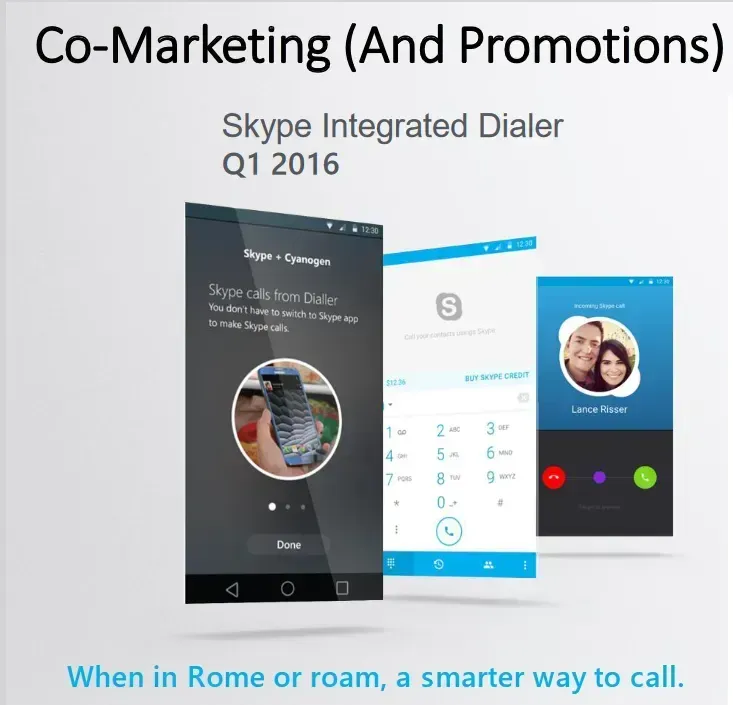
The white space wasn't "make Skype available on more Android devices." It was: build a calling experience inside the dialer itself — the way Apple had done with FaceTime, but across Mobile, Desktop, and Web, and not locked to a single OS.
That reframe changed everything about the technical architecture and the partner ask.
Strategy Is Not Enough — Lead the Joint Roadmap
Here is where the rubber meets the road. Customer discovery and white space analysis are necessary, but if you can't execute jointly, customers never see the value.
For the Skype-Cyanogen integration, execution meant:
50+ iterations of joint UX developed together, not thrown over the wall
Partner APIs for voice and video calling built in parallel with the UX work
A Mobile SHIM (SDK) designed specifically for the connectivity realities of emerging markets — low footprint, resilient to unstable networks
Cloud infrastructure to support OTA (over-the-air) updates without bloating the app
Cyanogen owned the OS-level signals and the native app layer implementation. We owned the calling infrastructure, the PSTN trunking, and the video escalation experience. The division of ownership was explicit — not assumed.
The product journey covered every stage: how users discover the new experience on first device setup (OOBE), how they land their first "aha" moment seeing Skype contacts built into the phone dialer, how a regular call escalates to video seamlessly — a FaceTime-equivalent experience, but platform-agnostic.
Each UX stage was validated quantitatively through user testing before we moved forward. We announced at Mobile World Congress with strong early metrics: 44% DAU/MAU on calling — a real signal of product-market fit, not a vanity launch.
Watch the Data, Scale Slowly, Iterate Relentlessly
The launch was not the finish line.
Shortly after the MWC demo, we identified a core activation problem: Skype was on the device, but users didn't know when or why to open it. An app sitting dormant among 50 others isn't delivering value — to the user or to us.
The solution came from combining OS-level signals from Cyanogen with Microsoft's Azure ECS service. We built contextual nudges that surfaced Skype exactly when it was relevant: when a user was placing an international call, when they were roaming, when Skype could save them real money. We watched the guardrail metric — uninstall rate — to make sure we were adding value, not noise.
The same ECS service powered A/B testing on nudge messaging and handled localization without bloating the SHIM with language packs.
We scaled to 10+ OEM devices and launched across APAC markets from that foundation.
The Three Things That Made It Work
Looking back, three values drove the outcome:
Reach — meeting users inside the dialer they already used, not asking them to find us.
Frictionless — building the experience at the OS level, not as another OTT app competing for attention.
Value-added — solving a real problem (cost, cross-platform access, call quality) at exactly the moment users felt it.
Those three aren't specific to Skype or to mobile. I've applied the same lens to integration strategy in B2B SaaS, platform partnerships, and enterprise distribution. The context changes. The discipline doesn't.
What I'd Tell Any PM Starting an Integration Today
Define the charter, goals, align before you define the API. Talk and understand your customers before you talk to your partner's BD team. Find the white space where your strengths meet their distribution and their users' unmet needs. Then own the joint roadmap — not just your side of it.
A great integration doesn't feel like an integration. It feels like the product was always supposed to work that way.